Войти | Регистрация
Авторизуйтесь для получения расширенных возможностей
- г. Dhaka, 3/8, North Pirerbag, 60 Feet Main Road
- +880-967-8247365 (звонок бесплатный)
- Пн-Вс 9.00 - 18.00
- support@informatix.systems
- Посмотреть на карте

Best Tools for Docker & Containers in 2025
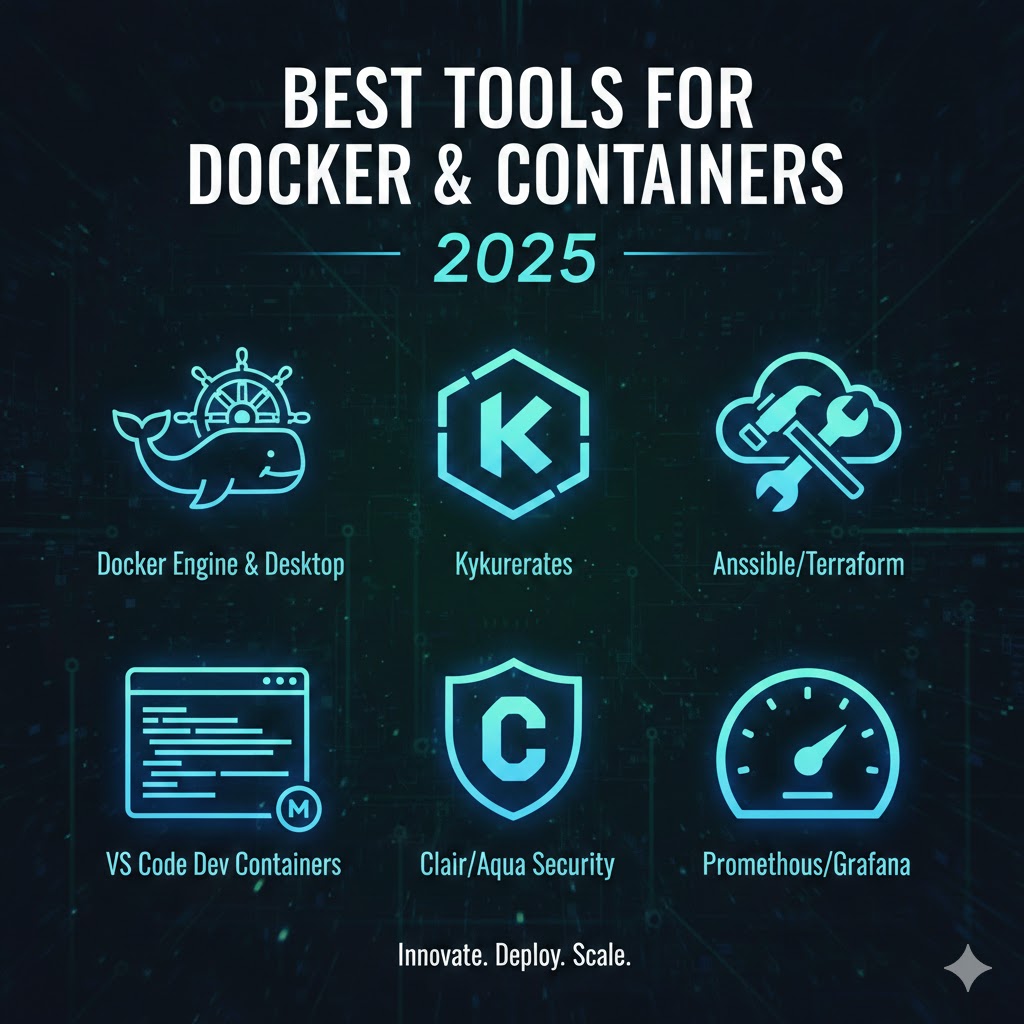
Docker and containers have revolutionized the way we build, deploy, and manage applications in today’s rapidly evolving software environment. With businesses shifting to microservices architectures, containers offer immense flexibility, scalability, and efficiency. However, managing containers can be complex, which is where tools for Docker and containerization come in.In 2025, Docker and container technology will be more integral to business infrastructures than ever. Container tools are evolving rapidly, and staying up to date with the best options is crucial for development teams and IT professionals. In this blog post, we will explore the top tools for Docker and containers in 2025, how they simplify management, and why they are essential to modern DevOps, cloud-native development, and container orchestration.
The Rise of Docker and Containers
Why Containers are Vital for Modern Development
In today’s agile software development environment, Docker and containers have become integral. Containers encapsulate an application and its dependencies into a single, portable unit. Unlike traditional virtual machines, containers do not require a full OS, which makes them lightweight and fast. Developers can test their applications in environments that mirror production without worrying about environment inconsistencies.Containers are especially effective when it comes to microservices architectures, which have gained immense popularity in the last few years. Containers allow each microservice to run in an isolated environment, which promotes scalability, flexibility, and easy updates.
The Evolution of Docker and Containerization
Docker was released in 2013 and quickly became the de facto containerization platform. Since then, the container ecosystem has exploded, with new tools emerging every year to help developers and IT professionals optimize container management. In 2025, Docker has matured and expanded into a robust set of technologies, with a focus on automation, orchestration, security, and performance.
The Importance of Container Tools
Managing Containers at Scale
As organizations deploy containers at scale, managing them becomes increasingly difficult. Without proper tooling, maintaining large numbers of containers can lead to inefficiency, security risks, and performance bottlenecks. Tools for container orchestration, monitoring, security, and CI/CD automation are vital to keep operations running smoothly.
The Benefits of Using Container Tools
-
Efficiency: Automation tools enable businesses to quickly deploy, scale, and manage containerized applications.
-
Consistency: Tools ensure that containerized applications behave the same in development, testing, and production environments.
-
Security: Security tools help enforce policies, scan for vulnerabilities, and monitor container behavior in real-time.
-
Scalability: Orchestration tools allow businesses to scale container workloads dynamically, enabling high availability and disaster recovery.
Best Docker Tools in 2025
Docker Desktop
Docker Desktop is the cornerstone of Docker development, providing a GUI for managing containers locally. Docker Desktop is perfect for individual developers looking to create and test containers on their own machines. In 2025, Docker Desktop continues to be a must-have tool, with new integrations for Kubernetes and improved performance.
-
Key Features:
-
Built-in Kubernetes for local cluster management.
-
Easy-to-use GUI for creating and managing containers.
-
Integration with Docker Hub for easy image sharing.
-
Continuous updates for security and performance.
-
Portainer
Portainer is a lightweight and simple-to-use container management tool. It offers a web interface for managing Docker containers, making it an excellent choice for teams who need to oversee their containerized applications with minimal complexity.
-
Key Features:
-
Multi-cluster management with a simple UI.
-
Support for Docker Swarm and Kubernetes.
-
Role-based access control (RBAC) for security.
-
Docker volume and network management.
-
Rancher
Rancher provides a comprehensive container management platform for deploying and managing Docker containers and Kubernetes clusters. It simplifies the process of managing containerized applications at scale, particularly for organizations adopting hybrid cloud environments.
-
Key Features:
-
Multi-cluster management for Kubernetes clusters.
-
Easy-to-use interface for developers and administrators.
-
Built-in security features like vulnerability scanning and role-based access.
-
Excellent support for Docker and Kubernetes deployments.
-
Kubernetes
Kubernetes (K8s) is the industry-standard orchestration platform for managing containers. Kubernetes automates deployment, scaling, and management of containerized applications, making it ideal for large-scale container environments.
-
Key Features:
-
Automated scaling and load balancing.
-
Self-healing features for automatic recovery from failures.
-
Advanced networking and service discovery.
-
Integration with various container runtimes and storage systems.
-
Docker Compose
Docker Compose simplifies the management of multi-container Docker applications. It allows you to define and run multi-container Docker applications using a simple YAML file. For developers, it ensures that containers work seamlessly together.
-
Key Features:
-
Definition of services, networks, and volumes in a single file.
-
Simplifies the management of complex applications.
-
Multi-environment support with different configuration files.
-
Helm
Helm is the Kubernetes package manager, helping developers to define, install, and upgrade Kubernetes applications. It’s essential for deploying applications in Kubernetes, allowing developers to manage Kubernetes resources in a more efficient manner.
-
Key Features:
-
Template-based application deployments.
-
Easy rollbacks for deploying older versions.
-
Strong community support with pre-built Helm charts.
-
Top Container Orchestration Tools
Kubernetes
As mentioned earlier, Kubernetes remains the most widely-used tool for container orchestration. With its extensive ecosystem and robust feature set, it’s essential for businesses managing large, complex containerized applications.
Docker Swarm
Docker Swarm is Docker's native clustering and orchestration tool, designed for simplicity and ease of use. It’s a lightweight alternative to Kubernetes for users who need basic orchestration without the complexity.
-
Key Features:
-
Easy-to-setup clustering for Docker containers.
-
Integrated with Docker CLI.
-
Automatic load balancing and scaling.
-
OpenShift
OpenShift, backed by Red Hat, is a Kubernetes-based container orchestration platform designed for enterprise applications. It’s an enhanced version of Kubernetes with additional features like built-in CI/CD pipelines and integrated security tools.
-
Key Features:
-
Automated scaling and management of containerized apps.
-
Security features like integrated role-based access and policy enforcement.
-
Seamless CI/CD pipeline integration.
-
Mesos
Apache Mesos is a powerful container orchestration tool designed for distributed systems. It allows for fine-grained resource allocation and can manage both containers and non-container workloads.
-
Key Features:
-
Dynamic resource allocation for containers.
-
Support for multiple orchestrators like Kubernetes and Marathon.
-
High availability and fault tolerance.
-
Container Monitoring and Logging Tools
Prometheus
Prometheus is a powerful open-source monitoring system designed for containerized applications. It collects and stores metrics, making it ideal for real-time monitoring of containers.
-
Key Features:
-
Powerful query language for metrics.
-
Integrates easily with Grafana for visualizations.
-
Automated scraping of container metrics.
-
Grafana
Grafana is a leading visualization tool used with Prometheus and other data sources. It helps developers visualize container performance and system metrics in real-time.
ELK Stack (Elasticsearch, Logstash, Kibana)
The ELK Stack is a popular suite for logging, searching, and analyzing container logs. Elasticsearch collects logs, Logstash processes them, and Kibana provides powerful visualizations.
-
Key Features:
-
Real-time log aggregation and analysis.
-
Scalable and highly customizable.
-
Integration with other tools like Fluentd and Prometheus.
-
Fluentd
Fluentd is a log collector and processor that integrates with various data sources, including Docker containers. It aggregates logs from containers and sends them to storage backends like Elasticsearch.
-
Key Features:
-
Supports hundreds of plugins for log forwarding.
-
Real-time log processing and filtering.
-
Scalable architecture.
-
Security Tools for Docker & Containers
Aqua Security
Aqua Security provides comprehensive protection for containerized environments, offering vulnerability scanning, runtime protection, and access control.
-
Key Features:
-
Vulnerability scanning of container images.
-
Real-time security policies and runtime protection.
-
Compliance checks for Docker and Kubernetes environments.
-
Twistlock (by Palo Alto Networks)
Twistlock, now part of Palo Alto Networks, offers container security that focuses on vulnerability management, runtime protection, and compliance for containerized environments.
-
Key Features:
-
Container image scanning for vulnerabilities.
-
Runtime protection for containers and microservices.
-
Compliance management tools for Kubernetes.
-
Container CI/CD Tools
Jenkins
Jenkins remains the go-to tool for automating the build and deployment of containerized applications. With a vast plugin ecosystem, it integrates seamlessly with Docker and Kubernetes.
GitLab CI
GitLab CI provides native integration with GitLab and allows seamless deployment to containerized environments like Docker and Kubernetes.
Сообщения не найдены
Написать отзыв