- 3/8, North Pirerbag
- 60 Feet Main Road
- Mirpur, Dhaka 1216
- +880-967-8247365
- support@informatix.systems

Advanced Persistent Threats Forecasting 2030
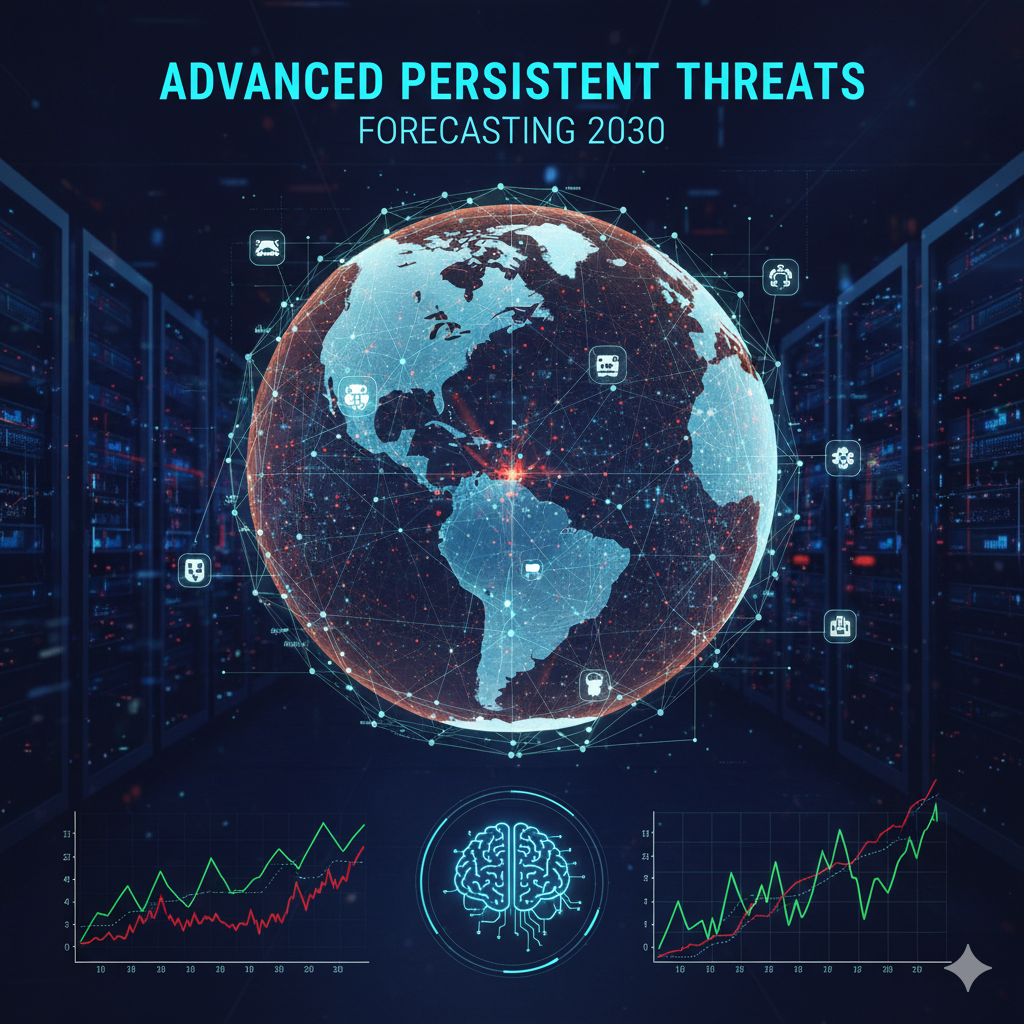
As global connectivity expands through cloud infrastructure, artificial intelligence (AI), and emerging digital ecosystems, a new breed of cyber threat has evolved: Advanced Persistent Threats (APTs). These state-sponsored or highly organized cyber actors conduct prolonged, stealthy intrusions to infiltrate critical systems, ranging from corporate networks to national defense infrastructure. By 2030, APTs will execute attacks with precision guided by autonomous AI, quantum decryption, and global misinformation campaigns. Traditional threat detection methods are no longer sufficient. Enterprises and governments must now pivot toward APT forecasting, the science of predicting the tactics, techniques, and procedures (TTPs) of threat actors using machine learning, behavioral analytics, and predictive intelligence frameworks. APT forecasting enables defenders to anticipate sophisticated intrusions before they materialize. Modern prediction systems rely on deep neural models, data correlation from threat-sharing networks, and quantum-resilient encryption analytics. These technologies transform cybersecurity from reactive defense to pre-emptive cyber governance, capable of detecting threat ecosystems at their inception. At Informatix.Systems, we provide cutting-edge AI, Cloud, and DevOps solutions for enterprise digital transformation. Our AI-powered APT forecasting systems integrate real-time monitoring, behavioral prediction, and federated intelligence to deliver unmatched cyber foresight. This article delves into the future of Advanced Persistent Threats (APTs) Forecasting by 2030, exploring emerging strategies, technologies, and methodologies that will reshape how global enterprises and governments defend their critical infrastructures.
Understanding Advanced Persistent Threats (APTs)
What Is an APT?
An Advanced Persistent Threat refers to a coordinated cyber campaign where adversaries infiltrate a network using advanced techniques and maintain sustained, undetected access to extract intelligence or compromise assets.
Key APT Characteristics:
- Advanced: Utilizes sophisticated tools like zero-day exploits, malware automation, and AI evasion techniques.
- Persistent: Maintains long-term infiltration to maximize data collection or damage.
- Targeted: Focused on high-value assets, governments, finance, healthcare, and defense sectors.
APT operations combine technical proficiency, patience, and strategy, making them one of the greatest cybersecurity challenges of the coming decade.
Evolution of APTs in the Digital Age
| Era | Defining Development | Primary Adversarial Techniques |
|---|---|---|
| 2010–2020 | Targeted attacks using spear phishing and malware implants. | Manual penetration, insider collaboration. |
| 2021–2025 | AI-assisted attacks emulating human behavior patterns. | Automation, zero-day exploitation. |
| 2026–2030 | Fully autonomous multi-vector APT operations. | Quantum-driven cryptographic breaches, AI coordination, and global data manipulation. |
By 2030, APT groups will act using hybrid strategies combining AI-driven deception and distributed swarm intelligence, blurring the line between digital espionage and cognitive warfare.
The Rising Need for APT Forecasting
Modern SOCs face millions of daily alerts, many of which are benign, but buried within them are indicators of high-value APT activity. The ability to forecast APT movements before they evolve is essential to prevent catastrophic breaches.
Business and Strategic Importance:
- Reduced Attack Dwell Time: Predict potential infiltration before actors become persistent.
- Operational Continuity: Safeguards supply chain, cloud, and digital assets.
- Financial Protection: Minimizes losses caused by prolonged compromises.
- Regulatory Compliance: Aligns with ISO 42001, GDPR 3.0, and future quantum-safe frameworks.
- National Defense Readiness: Enhances predictive military and intelligence cybersecurity.
APT forecasting thus represents the fusion of intelligence analysis, AI automation, and strategic foresight.
Key Technologies Powering APT Forecasting in 2030
Artificial Intelligence and Machine Learning
AI systems analyze data lakes containing millions of signals to model adversarial patterns. Using supervised, unsupervised, and reinforcement learning, these models predict likely TTP transitions of threat actors.
Deep Neural Networks
LSTM (Long Short-Term Memory) and Convolutional Neural Networks (CNNs) identify behavior anomalies and long-term infiltration trends across enterprise networks.
Quantum-Resilient Analytics
By the late 2020s, quantum computing will introduce risks to encryption. AI-powered quantum analytics will proactively simulate and strengthen systems against post-quantum exploitation.
Federated Threat Intelligence Frameworks
Federated models integrate datasets from cross-border CTI networks, generating collaborative global insights without violating data privacy.
Behavioral Correlation Engines
Machine learning aligns threat behavior with MITRE ATT&CK matrices, mapping actor evolution in real time. At Informatix.Systems, our AI-driven APT forecasting engine combines behavioral correlation, federated learning, and cloud-based analytics to deliver autonomous threat predictions and actionable insights.
Key Components of AI-Driven APT Forecasting Systems
Data Ingestion and Standardization
Aggregating intelligence from SOC logs, IoCs, and global CTI feeds into normalized, enriched datasets.
Neural Threat Analytics Engine
AI models generate multi-variable prediction layers for network, user, and endpoint behaviors.
Automation and Orchestration
Integration with SOAR frameworks ensures instant policy enforcement and quarantining of predicted risk vectors.
Visualized Intelligence Layer
Interactive dashboards provide analysts with risk heatmaps and attack pathway probabilities.
Self-Learning Improvement Cycle
Continuous feedback loops enable autonomous recalibration for improved accuracy across evolving threats. This architecture enables AI ecosystems to forecast not only direct attacks but also their preconditions and chain reactions.
Emerging APT Forecasting Methodologies
Behavioral Forecasting
AI models detect subtle deviations in legitimate user and system behavior to anticipate lateral movement and credential abuse attempts.
Predictive SOC Models
Combines Security Operations Center (SOC) analytics with machine learning for dynamic risk scoring and incident prioritization.
Cognitive Adversarial Simulation
Digital twins simulate potential APT campaigns, using historical data to model response outcomes before real-world execution.
Threat Actor Clustering
Algorithms group actors based on tactics and objectives, predicting geographical or sector-specific targeting trends.
Global Threat Prediction Networks
Cross-organizational AI nodes collaboratively share machine learning weights, creating adaptive forecasting intelligence beyond national perimeters.
APT Attack Vectors Expected by 2030
- AI-Powered Malware Ecosystems: Adaptive payloads that mutate to evade detection.
- Quantum Encryption Bypass: Exploits weaknesses in outdated cryptographic protocols.
- Synthetic Identity Intrusions: Deepfake technologies used for insider credential abuse.
- Cloud Supply Chain Breaches: Targeted vectors exploiting SaaS vulnerabilities.
- Autonomous Drone and IoT Exploits: Coordinated attacks on physical-digital infrastructures.
APT forecasting tools in 2030 will integrate IoT telemetry, OT analytics, and AI model training to predict and preempt these hybrid vectors.
Integration of Cloud and DevOps in APT Defense
Cloud-native infrastructures decentralize APT monitoring, improving detection scalability. AI-integrated DevSecOps pipelines offer real-time vulnerability prediction at every level of release architecture.
Core AI-DevOps Integrations Include:
- Predictive vulnerability assessment during software builds.
- Automated rollback of compromised containers in real time.
- Cloud-based predictive policy deployment to defend hybrid ecosystems.
At Informatix.Systems, we embed AI-powered predictive models directly into DevOps pipelines, ensuring continuous protection through automation and scalability.
Behavioral Analytics in APT Prediction
Behavioral analytics will anchor predictive cyber defense strategies by monitoring user intent and system response dynamics.
- User and Entity Behavior Analytics (UEBA): Identifies deviations in privileged account activity.
- Network Behavior Analytics (NBA): Detects micro-fluctuations in communication patterns.
- Adaptive Learning Models: AI evolves thresholds dynamically to reduce false positives.
These systems ensure precision, forecasting human-driven threats with measurable accuracy and minimal noise.
The Role of Federated AI in Global APT Forecasting
Federated AI allows cross-enterprise collaboration without centralizing sensitive data, ensuring privacy and compliance.
Advantages Include:
- Preservation of confidential threat data.
- Model weight sharing improves prediction efficiency.
- Cross-sector learning enhances collective defense awareness.
Federated approaches create a global cyber defense fabric, allowing enterprises worldwide to share predictive insights securely.
Challenges in APT Forecasting
- Data Volume and Complexity: Large-scale unstructured intelligence demands high compute capabilities.
- Adversarial AI Manipulation: Malicious actors use AI to trick predictive models.
- Ethical and Legal Limits: Cross-border data sharing requires strict governance compliance.
- Quantum Security Gap: Accelerating encryption obsolescence challenges retention of predictive precision.
- Lack of Skilled Workforce: Limited availability of interdisciplinary AI-cyber defense specialists.
At Informatix.Systems, we address these challenges through Explainable AI (XAI) frameworks, ethical governance, and continuous AI retraining pipelines designed for transparency and adaptability.
Quantitative Metrics for APT Forecasting Efficiency
| Metric | Description | Purpose |
|---|---|---|
| Prediction Accuracy (PA%) | Success rate of accurate threat forecasting. | Measures model performance. |
| False Positive Reduction (FPR) | Number of eliminated irrelevant alerts. | Enhances SOC productivity. |
| Detection Latency (DL) | Time gap between prediction and shutdown. | Reflects response readiness. |
| Adaptive Intelligence Index (AII) | Evaluates model learning efficiency. | Measures long-term scalability. |
| Cross-Network Intelligence Score (CNIS) | Evaluates the quality of shared insights. | Reflects collaboration effectiveness. |
By tracking these metrics, enterprises validate the performance and maturity of their predictive APT systems.
The Future of APT Forecasting Beyond 2030
- Quantum-AI Fusion Exploits Detection: Predicting attacks emerging from quantum computing breakthroughs.
- Autonomous Threat-Fusion Systems: Fully autonomous global AI cybersecurity grids.
- Cognitive Military Applications: AI-predictive frameworks for defense and counterintelligence.
- AI Governance Integration: Global norms enforcing ethical intelligence automation.
- Digital Immune Infrastructure: Self-healing networks capable of predictive algorithmic restoration.
APT forecasting will transition into an autonomous global ecosystem where AI agents collectively predict, share, and neutralize cyber conflicts.
Informatix.Systems: Pioneering the Future of Predictive Cyber Defense
At Informatix.Systems, we provide cutting-edge AI, Cloud, and DevOps solutions for enterprise digital transformation. Our APT Forecasting Systems combine federated machine learning, predictive modeling, and automated orchestration to safeguard enterprises and governments from next-generation threats.
Core Specializations:
- AI and ML-Powered Attack Forecasting
- Predictive Threat Intelligence Dashboards
- Quantum-Resilient Data Protection
- Cloud-Integrated DevSecOps Fortification
- Ethical and Explainable AI Governance
Our mission is to transform enterprise security from reactive containment to proactive prediction, fostering global digital trust. The cyber battlefield of 2030 demands foresight, automation, and intelligence. As Advanced Persistent Threats evolve in stealth and complexity, APT forecasting represents the ultimate convergence of AI, cloud, and predictive analytics. Organizations that leverage these predictive capabilities will outpace attackers, transitioning from passive defenders to strategic risk predictors. In the future, cyber resilience will belong not to the fastest reactors but to the most intelligent anticipators. At Informatix.Systems, we empower enterprises and defense agencies to build predictive infrastructures designed for speed, agility, and immunity against evolving cyber aggression. Forecast smarter. Automate faster. Defend intelligently, with Informatix.Systems.
FAQs
What is APT forecasting?
APT forecasting uses AI and data analytics to anticipate and prevent advanced cyber threats before execution.
How does AI improve APT detection?
AI identifies behavior anomalies, correlates threat data, and predicts adversary activity based on learned patterns.
What are the main technologies used in APT forecasting?
Deep learning, machine learning, federated intelligence, SOAR integration, and quantum-safe analytics.
Can APT forecasting prevent zero-day attacks?
Yes, predictive models detect early indicators and predict weaknesses likely to be exploited by new zero-day vulnerabilities.
What role does quantum computing play in APT forecasting?
Quantum analytics will enhance both attack simulation and encryption resistance for cyber protection models.
What sectors benefit most from APT forecasting?
Defense, finance, healthcare, government, and cloud service providers face the greatest risk from long-term infiltration.
How is Informatix.Systems contributing to predictive defense?
We design AI-powered, cloud-integrated APT forecasting systems that transform detection into a predictive science.
Will autonomous AI replace human analysts by 2030?
No, collaboration between AI and analysts ensures decisions remain explainable, contextual, and ethically governed.
No posts found
Write a review