- 3/8, North Pirerbag
- 60 Feet Main Road
- Mirpur, Dhaka 1216
- +880-967-8247365
- support@informatix.systems

AI-Driven Cyber Threat Intelligence Trends 2028
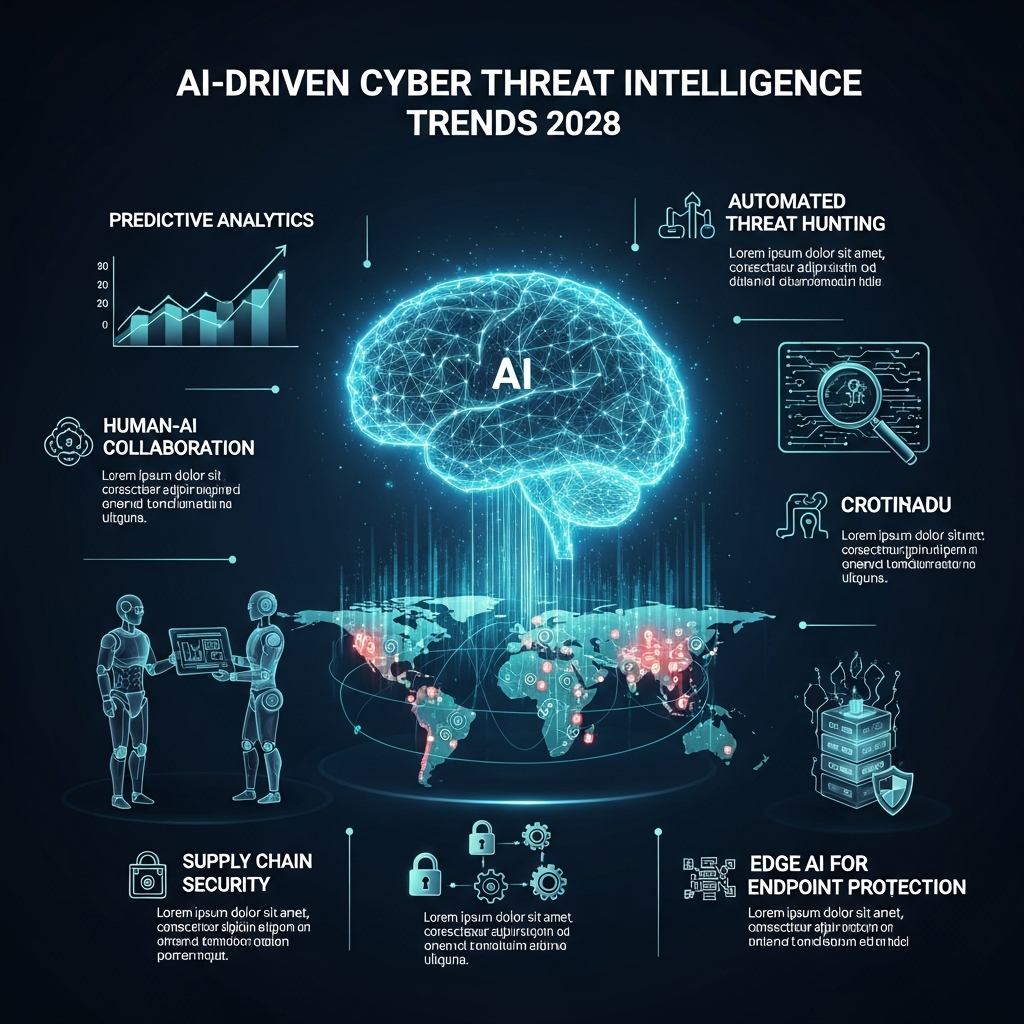
Artificial intelligence (AI) is transforming how organizations detect, analyze, and respond to cyber threats. As global digital transformation accelerates, the complexity of cyberattacks is rising, fueled by automation, AI-generated malware, and sophisticated adversarial networks. By 2028, cybersecurity will no longer rely solely on reactive detection; instead, proactive AI-driven threat intelligence (CTI) will become the cornerstone of enterprise defense strategies at Informatix.Systems, we provide cutting-edge AI, Cloud, and DevOps solutions for enterprise digital transformation, helping organizations harness real-time intelligence to predict, prevent, and neutralize threats before they strike. Businesses today face an evolving threat surface due to widespread cloud adoption, IoT integration, and hybrid work architectures. This digital sprawl demands a new breed of cybersecurity, smart, adaptive, and self-learning. AI-driven Cyber Threat Intelligence (CTI) uses advanced models to collect and analyze massive datasets across endpoints, networks, and applications, identifying hidden patterns that indicate potential attacks. As we look toward 2028, the convergence of AI, machine learning (ML), quantum computing, and automation will revolutionize the CTI landscape. Enterprises that fail to adopt these technologies risk falling behind in resilience, compliance, and customer trust. This article explores the most critical AI-driven cyber threat intelligence trends projected for 2028, detailing how emerging technologies, ethical frameworks, and intelligent systems are redefining cybersecurity for the next decade.
The Rise of Predictive AI in Cyber Defense
How Predictive Intelligence Outpaces Traditional Cybersecurity
By 2028, predictive AI will dominate enterprise security architectures. Unlike conventional defense, which reacts to confirmed attacks, predictive AI models use historical data and behavioral analytics to forecast potential threat vectors.
Key functions of predictive AI:
- Behavioral baselining and anomaly detection
- Automated threat scoring and prioritization
- Real-time pattern recognition for zero-day exploits
Example: An AI system can detect a subtle anomaly in DNS traffic that hints at early-stage data exfiltration weeks before manual detection. At Informatix.Systems, we integrate predictive analytics into enterprise SOCs, empowering organizations with proactive intelligence across cloud and hybrid networks.
AI-Enhanced Threat Hunting and SOC Automation
From Manual Threat Hunting to Autonomous Operations
Security Operations Centers (SOCs) of 2028 are expected to be largely autonomous. With AI and ML-enabled platforms, analysts can shift focus from repetitive tasks to strategic remediation.
Major advancements include:
- AI-powered correlation engines for cross-incident analysis
- Automated alert triage to minimize false positives
- Cognitive assistants that provide contextual threat narratives
The integration of Natural Language Processing (NLP) allows SOC platforms to interpret and summarize unstructured threat reports. Informatix.Systems’ AI-driven SOC frameworks unify human expertise and machine precision, establishing high-efficiency security ecosystems for enterprises.
Adversarial AI: Weaponization of Artificial Intelligence
The Next Front in Cyber Warfare
While AI strengthens defenses, cybercriminals are weaponizing it as well. Adversarial AI attacks involve manipulating training data or exploiting AI models to evade detection.
Emerging threats:
- Generative AI is creating adaptive malware
- Deepfake-driven phishing campaigns
- Data poisoning is compromising model accuracy
By 2028, counter-adversarial AI defense models will be essential. At Informatix.Systems, we research robust algorithms that resist model evasion and malicious training interference through federated learning and adversarial hardening.
Integration of Quantum-AI Security Frameworks
Quantum computing will dramatically impact cryptography and threat intelligence by 2028. Post-quantum encryption and AI-enhanced cryptanalytic models are expected to redefine digital identity and transaction security.
Advantages of Quantum-AI Integration:
- Near-instant decryption of complex threat data
- Enhanced pattern-matching accuracy
- Quantum-secure key distribution for encrypted communications
Enterprises will need AI-enabled CTI systems capable of processing quantum-resilient telemetry. Informatix.Systems pioneers in quantum-ready AI security architectures to future-proof enterprise digital ecosystems.
Autonomous Cyber Defense Ecosystems
Self-Healing Networks and AI-Driven Resilience
Autonomous cyber defense environments leverage reinforcement learning to detect, isolate, and self-heal compromised systems.
Core components:
- AI-driven intrusion containment
- Dynamic policy orchestration
- Real-time vulnerability patching
By 2028, enterprises will deploy autonomous defense layers that operate continuously without human input, guided by ethical AI frameworks to maintain compliance and transparency.
Advanced Threat Intelligence Sharing via AI Federations
AI federations enable secure, anonymous data collaboration across enterprises and sectors. These decentralized AI ecosystems share models and insights while preserving data sovereignty.
Benefits:
- Rapid collective intelligence generation
- Cross-domain anomaly mapping
- Confidential infrastructure defense collaboration
At Informatix.Systems, we champion federated learning CTI models, ensuring that shared intelligence strengthens everyone without exposing private datasets.
Deep Learning for Behavioral Analytics
Human-Centric Security Through Deep Neural Networks
Deep learning models extract intricate patterns of user and network behavior, distinguishing between legitimate anomalies and malicious intent.
Key applications:
- Insider threat detection
- Ransomware campaign identification
- Credential misuse prevention
By 2028, behavioral analytics will be fully automated. Informatix.Systems integrates these capabilities within enterprise-wide security fabrics for continuous adaptive protection.
AI-Driven Cloud and Edge Security Monitoring
As cloud and edge computing grow exponentially, AI-fused telemetry aggregation will become the norm. Monitoring billions of distributed devices requires AI-orchestrated analysis pipelines capable of detecting threats at the speed of data.
Innovations:
- Edge-based ML inference for latency reduction
- AI segmentation of cloud microservices
- Unified visibility across hybrid infrastructures
Through Informatix.Systems’ cloud-native AI solutions enable enterprises to gain resilient protection across multi-cloud architectures, enhancing uptime and reliability.
Ethical AI and Regulatory Compliance in CTI
Balancing Innovation with Governance
By 2028, the fusion of AI and cybersecurity will raise ethical questions about privacy, data rights, and algorithmic accountability.
Key regulatory trends:
- Global AI ethics frameworks (EU AI Act, NIST AI RMF)
- Transparency in model decision-making
- Responsible use of offensive AI research
Informatix.Systems actively promote Responsible AI Governance, ensuring enterprise CTI systems comply with local and international security regulations while maintaining transparency and trust.
The Future SOC: AI-Augmented Workforce
Human-AI Collaboration for Next-Gen Threat Response
The future of cybersecurity isn’t fully autonomous; it’s augmented. AI will empower, not replace, analysts by providing deeper insights, natural language briefings, and automated risk scoring.
Future roles evolving within AI-powered SOCs:
- AI security analysts
- Threat data engineers
- Model explainability experts
Informatix.Systems envisions the AI-augmented security engineer, equipped with toolsets for rapid situational awareness, real-time decision-making, and continuous learning. By 2028, AI-driven Cyber Threat Intelligence will redefine every layer of enterprise security, from predictive analytics and autonomous defense to ethical compliance and quantum readiness. Businesses that integrate AI into their security fabric today will lead the race for digital trust and resilience tomorrow. At Informatix.Systems, we provide cutting-edge AI, Cloud, and DevOps solutions for enterprise digital transformation. Our experts design intelligent cybersecurity ecosystems that anticipate emerging threats, protect mission-critical infrastructures, and empower enterprises to operate securely in the AI-first era. Partner with Informatix.Systems to revolutionize your cyber defense strategy with AI-driven threat intelligence. Contact our cybersecurity experts today to begin your digital resilience journey.
FAQs
What is AI-driven cyber threat intelligence?
It refers to the use of artificial intelligence and machine learning models to analyze threat data, detect anomalies, and proactively predict cyberattacks.
How will AI transform cybersecurity by 2028?
AI will automate detection, improve prediction accuracy, and enable fully autonomous SOC environments capable of self-defense and recovery.
Can AI prevent zero-day attacks?
Yes. Predictive AI models analyze vast network behaviors to identify early warning signals—often detecting unseen vulnerabilities before exploitation.
What role will quantum computing play in cybersecurity?
Quantum-AI synergy will enhance cryptographic strength, threat decryption speed, and secure key management for next-generation networks.
What is adversarial AI, and why is it dangerous?
Adversarial AI manipulates machine learning models by injecting malicious data to evade detection systems. It poses a major challenge for AI-driven defense frameworks.
Are AI-based security solutions compliant with regulations?
Informatix.Systems ensure all AI-driven solutions align with global governance frameworks, maintaining transparency, fairness, and ethical standards.
What industries benefit most from AI-driven threat intelligence?
Banking, healthcare, government, and critical infrastructure sectors gain the most from AI-based early detection and risk analytics solutions.
No posts found
Write a review