- 3/8, North Pirerbag
- 60 Feet Main Road
- Mirpur, Dhaka 1216
- +880-967-8247365
- support@informatix.systems

CTI Services for Executive Risk Reporting
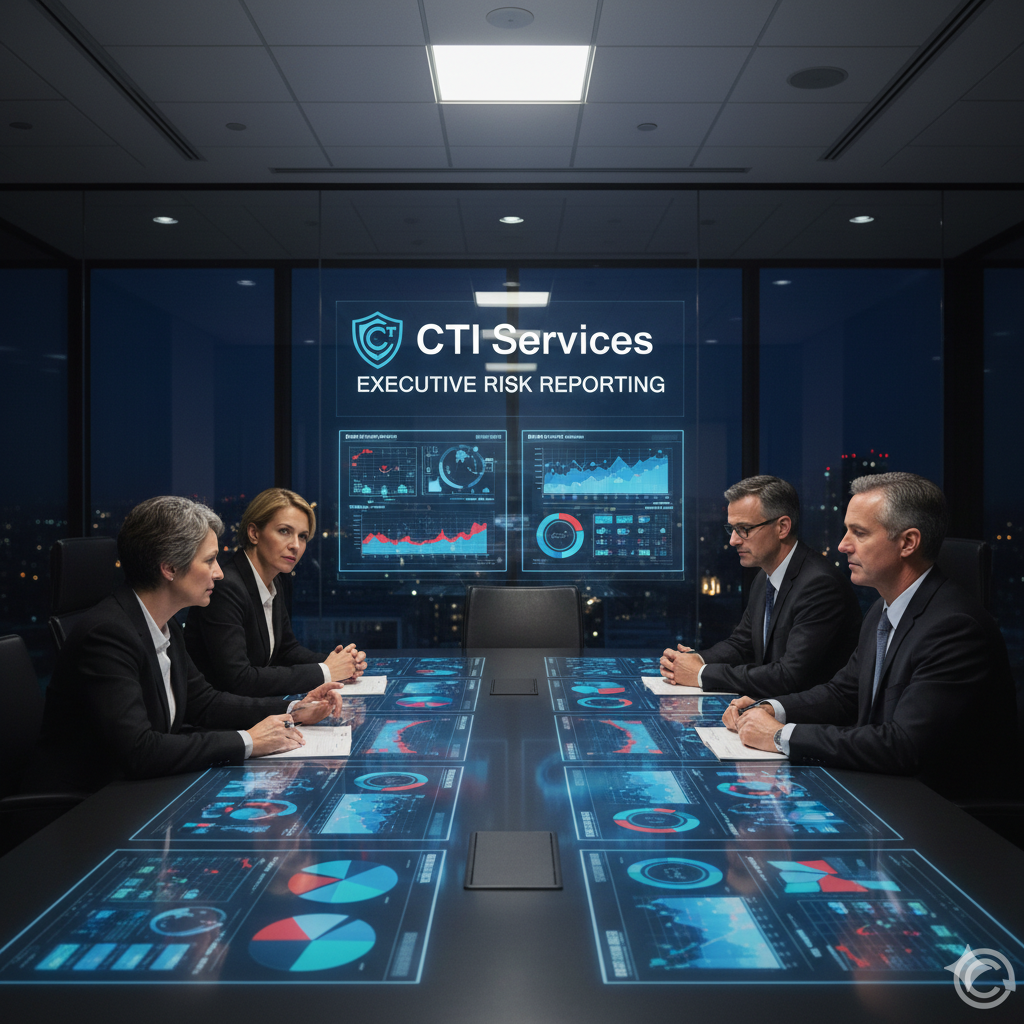
In today's hyper-connected enterprise landscape, executives face unprecedented cyber risks that threaten revenue, reputation, and regulatory compliance. Cyber Threat Intelligence (CTI) services have emerged as a cornerstone for executive risk reporting, providing actionable insights into threats targeting organizations. CTI involves gathering, analyzing, and disseminating information about cyber threats, including tactics, techniques, and procedures (TTPs) used by adversaries. Unlike traditional security alerts, CTI services tailor intelligence for C-suite consumption, translating complex data into strategic risk assessments. For 2026, with rising nation-state attacks and ransomware sophistication, executives demand real-time visibility into threat landscapes. At Informatix.Systems, we provide cutting-edge AI, Cloud, and DevOps solutions for enterprise digital transformation, enabling seamless CTI integration into risk dashboards. Business importance cannot be overstated: organizations leveraging CTI reduce breach impacts by up to 50% through proactive measures. CTI services monitor open-source intelligence (OSINT), dark web forums, and proprietary feeds to forecast risks. This empowers boards to prioritize investments, align with frameworks like NIST and MITRE ATT&CK, and demonstrate compliance under regulations such as SEC disclosure rules. Executives benefit from summarized reports highlighting industry-specific threats, executive targeting like spear-phishing, and third-party exposures. Forward-looking CTI platforms use AI for predictive analytics, shifting from reactive to preventive risk management. As threats evolve, CTI services ensure resilience, with metrics showing faster incident response and stronger security buy-in from leadership. This article explores CTI services comprehensively, from fundamentals to 2026 implementations, equipping enterprises for superior executive risk reporting.
What Are CTI Services?
CTI services collect, analyze, and deliver cyber threat intelligence to mitigate risks. They aggregate data from diverse sources like dark web chatter, malware repositories, and threat actor communications.
Core Components of CTI
- Data Collection: Real-time monitoring of OSINT, deep web, and closed sources.
- Analysis: Expert validation correlating indicators of compromise (IOCs) with TTPs.
- Dissemination: Tailored reports for stakeholders, from SOC teams to executives.
Types of CTI
CTI categorizes into strategic, operational, tactical, and technical intelligence. Strategic CTI informs long-term risk postures for executives. At Informatix.Systems, we provide cutting-edge AI, Cloud, and DevOps solutions for enterprise digital transformation, customizing CTI feeds for precise risk reporting.
Why Executives Need CTI for Risk Reporting
Executives require simplified, business-aligned threat views amid complex data volumes. CTI bridges technical security and boardroom decisions, quantifying cyber risks in financial terms.
Strategic Imperative
- Boards demand evidence-backed insights for cyber insurance and compliance.
- CTI reveals supply chain vulnerabilities before exploitation.
Risk Quantification
CTI platforms score threats by business impact, using models like Threat Intelligence Effectiveness Index (TIEI).
Key Benefits of CTI Services
CTI services enhance executive risk reporting with proactive defense. Benefits include reduced downtime and prioritized investments.
Operational Advantages
- Early Detection: Monitors executive mentions on malicious forums.
- Faster Response: Automates playbooks, cutting mean time to respond (MTTR).
- Cost Savings: Prevents breaches averaging $4.5M in losses.
Business Impact
CTI fosters security buy-in, with 93% of organizations maintaining in-house capabilities. At Informatix.Systems, we provide cutting-edge AI, Cloud, and DevOps solutions for enterprise digital transformation.
Types of CTI for Executive Use
Executives favor strategic and operational CTI for high-level reporting. Tactical CTI supports SOCs, feeding upward summaries.
Strategic CTI
Focuses on long-term trends, industry threats, and geopolitical risks.
Operational CTI
Delivers real-time incident insights with mitigation recommendations.
| CTI Type | Focus | Executive Value |
|---|---|---|
| Strategic | Trends & Actors | Board briefings |
| Operational | Active Threats | Risk prioritization |
| Tactical | IOCs & TTPs | Incident correlation |
Building a CTI Program for Executives
Successful CTI programs start with stakeholder alignment. Follow these 10 steps for comprehensive practices.
Planning and Requirements
Implementation Steps
At Informatix.Systems, we provide cutting-edge AI, Cloud, and DevOps solutions for enterprise digital transformation.
Top CTI Platforms for 2026
Leading platforms combine AI, scalability, and executive dashboards. Top picks include Stellar Cyber, Bitsight, and CrowdStrike.
Platform Comparison
| Platform | Key Strength | Executive Features |
|---|---|---|
| Bitsight | Exposure Management | Risk scoring |
| CrowdStrike | Endpoint + CTI | Real-time summaries |
| Cyble Vision | AI Prediction | Custom dashboards |
Selection Criteria
Prioritize integrations with SIEMs and compliance reporting.
Integrating CTI into Risk Dashboards
Executive dashboards visualize CTI via KPIs like threat scores and exposure trends. Use SMART metrics: Specific, Measurable, Actionable.
Essential Metrics
- Lagging: Breach costs avoided.
- Leading: Threat detection rates.
Dashboard Best Practices:
CTI Metrics for Executive Reporting
Metrics prove CTI value, tracking stakeholder satisfaction and risk reduction.
Key Performance Indicators
- Report Utilization: Frequency of executive access.
- Risk Mitigation: Threats neutralized pre-incident.
- ROI Calculation: Cost savings from prevented attacks.
| Metric | Type | Stakeholder |
|---|---|---|
| Risk Decrease | Operational | Executives |
| RFI Response Time | Administrative | SOC |
Best Practices for CTI Implementation
Adopt Zero Trust and automate workflows for 2026 efficacy.
Proven Strategies
- Automation: AI-driven enrichment reduces noise.
- Collaboration: Align CTI with risk teams.
- Continuous Monitoring: Third-party risk oversight.
At Informatix.Systems, we provide cutting-edge AI, Cloud, and DevOps solutions for enterprise digital transformation.
Challenges in CTI Adoption
Common hurdles include data overload and skill gaps. Overcome with managed services.
Mitigation Tactics
- Overcome Silos: Unified platforms.
- Skill Building: Partner with experts like Informatix.Systems.
Future of CTI in 2026
AI-native CTI will dominate, with predictive analytics and Open XDR integration. Expect quantum-resistant feeds and regulatory mandates.
Emerging Trends
CTI Success Stories
Media firms used CTI for legal wins; supply chains mitigated developer risks.
Key Takeaway: Tailored CTI drives measurable outcomes.
At Informatix.Systems, we provide cutting-edge AI, Cloud, and DevOps solutions for enterprise digital transformation. CTI services revolutionize executive risk reporting by delivering actionable, real-time intelligence that aligns security with business goals. Enterprises adopting CTI in 2026 gain proactive defenses, quantifiable ROI, and regulatory edge. Key insights include strategic integration, AI leverage, and metric-driven validation for sustained resilience. Transform your risk posture today. Contact Informatix.Systems at https://informatix.systems for bespoke CTI solutions powering enterprise digital transformation. Schedule a demo now.
FAQs
What distinguishes CTI services from basic threat feeds?
CTI services provide contextual analysis, TTP mapping, and executive summaries beyond raw IOCs.
How does CTI support regulatory compliance?
CTI generates audit-ready reports for SEC, NIS2, evidencing proactive risk management.
What ROI can executives expect from CTI?
Up to 50% breach cost reduction via early detection and prioritized remediation.
How to select a CTI platform for 2026?
Prioritize AI integration, scalability, and executive dashboards like Bitsight or Cyble.
Can CTI protect against executive targeting?
Yes, monitors personal mentions on the dark web for spear-phishing prevention.
What metrics measure CTI program success?
Track risk reduction, report utilization, and MTTR improvements.
How does Informatix.Systems enhance CTI?
Through AI, Cloud, and DevOps for seamless enterprise deployment.
No posts found
Write a review