- 3/8, North Pirerbag
- 60 Feet Main Road
- Mirpur, Dhaka 1216
- +880-967-8247365
- support@informatix.systems

Cyber Threat Intelligence and Advanced Cyber Defense
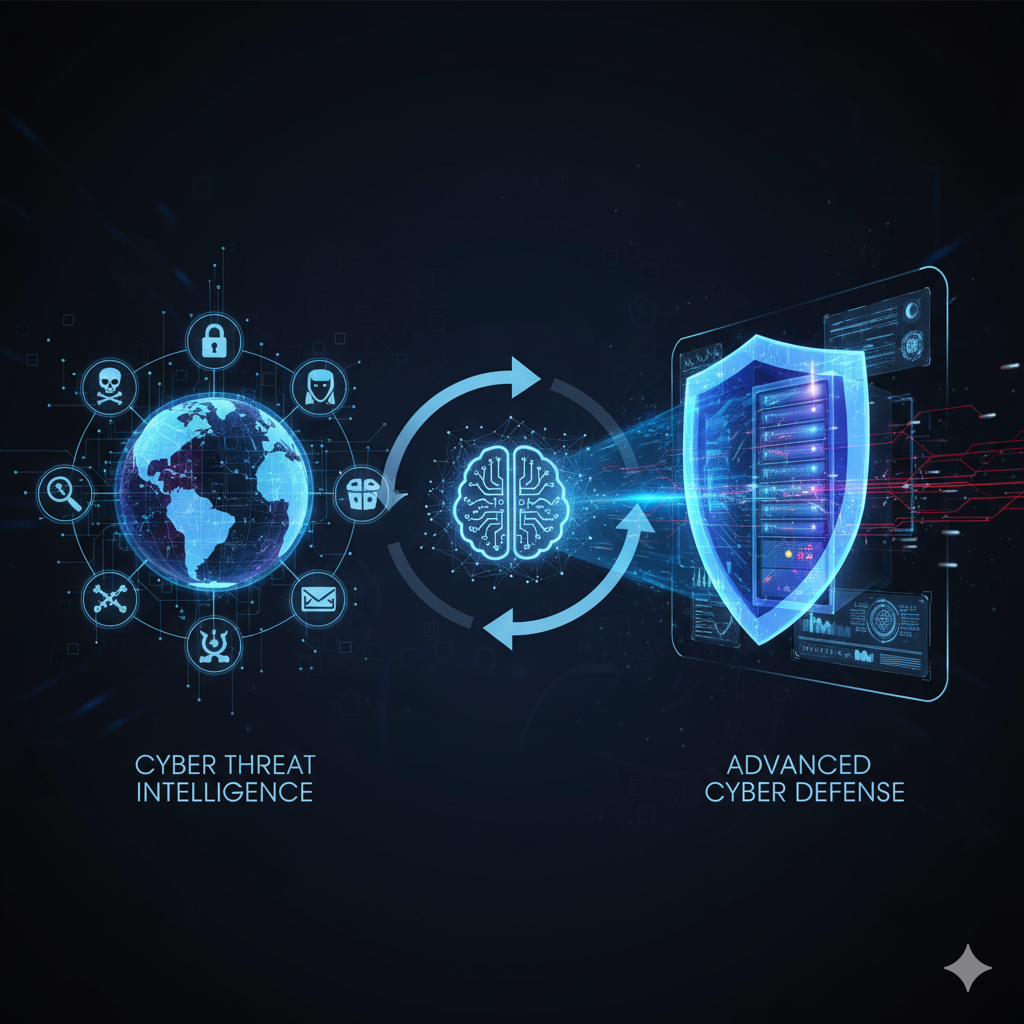
Cyber threat intelligence (CTI) powers advanced cyber defense by converting raw threat data into strategic foresight, enabling enterprises to disrupt attacks before impact in an era of AI-augmented adversaries. By 2026, cyber threats will have evolved dramatically: agentic AI orchestrates polymorphic malware, quantum computing cracks legacy encryption, and supply chain compromises cascade globally, projecting $13 trillion in annual damages. Traditional defenses falter against dwell times under 24 hours and zero-day exploits; cyber threat intelligence fused with advanced techniques like deception engineering and autonomous response restores the advantage. Enterprises leveraging CTI report 70% dwell time reductions, 50% fewer breaches, and compliance superiority under NIST 2.0 and EU AI Act. This synergy drives profound business outcomes: minimized downtime in critical operations, optimized insurance via quantified resilience, and accelerated digital transformation. At Informatix.Systems, we provide cutting-edge AI, Cloud, and DevOps solutions for enterprise digital transformation, embedding CTI for advanced cyber defense into resilient architectures. Optimized for 2-3% density on core terms like advanced cyber defense, cyber threat intelligence, and AI cyber defense, this guide dissects frameworks, tools, tactics, and forward-looking strategies. For Bangladesh's expanding fintech and manufacturing sectors facing nation-state APTs, tailored CTI ensures sovereign security amid geopolitical tensions. Advanced defense paradigms, predictive analytics, threat hunting, and zero trust amplify CTI, shifting from perimeter castles to elastic, intelligence-led meshes.
CTI Foundations in Advanced Defense
Cyber threat intelligence categorizes threats into strategic, operational, tactical, and technical streams, fueling defenses from executive briefings to endpoint blocks. In advanced contexts, CTI enriches MITRE ATT&CK mappings, predicting TTP evolutions via ML. Enterprises prioritize crown-jewel assets, correlating intel to business risks.
Foundational benefits:
- Proactive disruption: Preempt campaigns.
- Attribution accuracy: 90% via behavioral patterns.
- Resource focus: High-fidelity alerts only.
Scales to defend against 2026's volume.
Strategic CTI for C-Suite
Geopolitical intel informs board-level hedging.
Intelligence-Driven Threat Hunting
Advanced defense mandates proactive hunting: CTI hypothesis generation guides hunts across endpoints, networks, cloud. Tools like Elastic EDR query logs against IoCs, and AI uncovers stealthy anomalies. Hypotheses from dark web leaks trigger structured hunts.
Hunting methodology:
- Hypothesis: CTI-derived scenarios.
- Collection: Telemetry aggregation.
- Detection: ML pattern matching.
- Response: Containment playbooks.
Elevates advanced cyber defense.
Zero Trust Architecture with CTI
Zero Trust verifies every transaction; CTI dynamically updates policies, blocks IPs from active campaigns, adapt micro-segmentation to TTPs. Continuous validation uses intel for risk-scoring sessions.
ZTNA-CTI integration:
- Real-time policy engines.
- Behavioral baselines from intel.
- Adaptive access controls.
Deception Technologies Enhanced by CTI
Honey pots, decoys mimic assets; CTI populates with realistic lures from adversary preferences. High-interaction traps capture TTPs for intel refinement. Canarytokens alert on interactions.
Deception layers:
- Passive: Sensors only.
- Active: Dynamic traps.
- AI-driven: Auto-morphing baits.
AI and Autonomous Defense Systems
AI cyber defense automates CTI ingestion: neural nets classify threats, reinforcement learning optimizes responses, and agent swarms coordinate hunts. Self-healing networks isolate breaches autonomously.
Autonomy spectrum:
- Alerts.
- Full remediation.
- Strategic adaptation.
Counters AI attackers. At Informatix.Systems, we provide cutting-edge AI, Cloud, and DevOps solutions for enterprise digital transformation, deploying autonomous systems.
SOAR Orchestration for CTI
SOAR platforms like Demisto ingest CTI, execute sequenced responses: isolate, forensic, notify. Bidirectional loops feed intel back for enrichment.
Orchestration playbook:
- Triage intel.
- Enrich context.
- Execute actions.
- Post-mortem analysis.
Cloud-Native Advanced Defense
Multi-cloud CTI via CSPMs correlates workloads with global feeds. Kubernetes operators enforce intel-driven network policies; serverless functions process streams.
Cloud defense pillars:
- Workload protection.
- Identity threat detection.
- Data exfiltration prevention.
Endpoint Detection and Response (EDR)
EDR fuses CTI with behavioral analytics: block based on technique prevalence, rollback ransomware via snapshots. Next-gen adds memory forensics automation.
| EDR Feature | CTI Enhancement | Impact |
|---|---|---|
| Behavioral Blocking | TTP Matching | 80% Evasion Block |
| USB Control | Malware Intel | Zero Infections |
| Rollback | Ransomware Signatures | Data Recovery |
Network Detection and Response (NDR)
NDR monitors traffic against CTI baselines: encrypted C2 detection via entropy analysis, lateral movement graphing. Zeek signatures from intel feeds.
NDR capabilities:
- Metadata analysis.
- Protocol anomaly spotting.
- Decryption proxies.
Metrics and Continuous Improvement
KPIs: threat coverage ratio, false positive rate, and disruption rate. Feedback loops refine intel platforms. ROI models quantify prevented losses.
Defense metrics dashboard:
- Dwell time trends.
- TTP coverage %.
- Cost per incident.
2026 Threat Landscape and Countermeasures
Quantum attacks on RSA; AI deepfakes in phishing; IoT botnets at scale. Counter: post-quantum crypto from CTI warnings, watermarking defenses, edge ML.
Evolving countermeasures:
- Quantum-resistant algos.
- AI vs. AI battles.
- Supply chain intel sharing.
Case Studies in Advanced Defense
Microsoft thwarted SolarWinds via CTI sharing; CrowdStrike's Falcon prevented 1B attacks using behavioral intel. Manufacturing firm used deception to dismantle APT41.
Key takeaways:
Regulatory Alignment and Compliance
CTI evidences NIST controls, GDPR breach reports; automates SBOM intel for CISA compliance. Maps threats to frameworks like CIS 2.0.
Compliance boosters:
- Automated reporting.
- Third-party risk intel.
- Audit-ready trails.
Avoids penalties.
Cyber threat intelligence and advanced cyber defense forge impenetrable frontlines, blending proactive intel with AI-orchestrated responses to dominate 2026's threat arena. From hunting and zero trust to autonomous systems and metrics, CTI elevates defenses from static to dynamic supremacy. Enterprises adopting this paradigm secure operations, compliance, and innovation. Transform your defenses now. Engage Informatix.Systems for AI, Cloud, and DevOps solutions powering CTI excellence. Secure your free advanced defense audit at https://informatix.systemstomorrow.
FAQs
What role does CTI play in advanced cyber defense?
Provides actionable foresight for hunting, deception, and automation.
How does AI enhance CTI-driven defenses?
Enables autonomous responses and predictive disruption.
Key tools for CTI-advanced defense integration?
Cortex XSOAR, Elastic EDR, Recorded Future.
What frameworks guide CTI defenses?
MITRE ATT&CK, Diamond Model, Zero Trust.
2026 threats and CTI countermeasures?
Quantum, AI attacks, counter with PQC, agentic defenses.
How to measure advanced defense effectiveness?
Dwell time, disruption rate, and ROI from prevented losses.
Benefits of SOAR in CTI defense?
Orchestrates rapid, intel-fed responses.
Does CTI support cloud-native defenses?
No posts found
Write a review