- 3/8, North Pirerbag
- 60 Feet Main Road
- Mirpur, Dhaka 1216
- +880-967-8247365
- support@informatix.systems

Cyber Threat Intelligence and Machine Learning
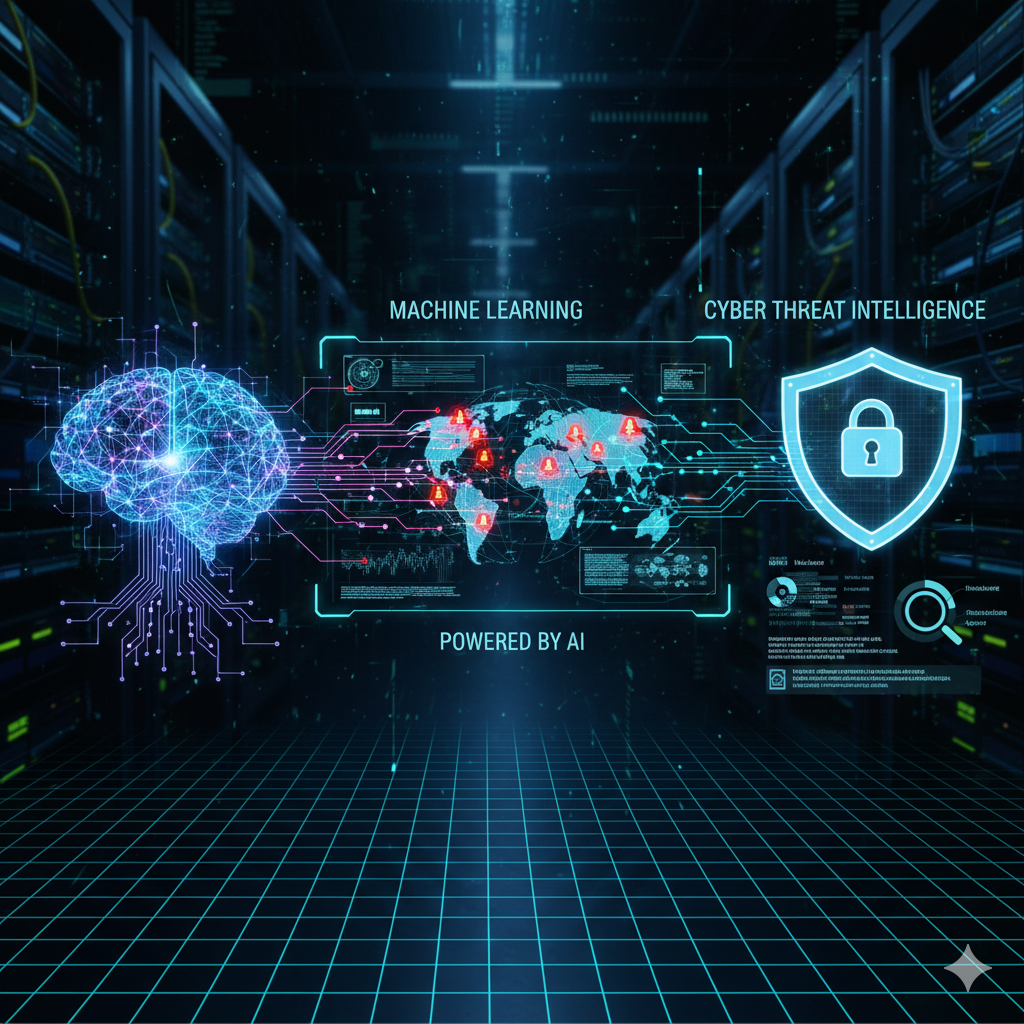
Cyber Threat Intelligence (CTI) and machine learning fusion represents the definitive evolution in enterprise cybersecurity for 2026, where predictive algorithms process billions of signals to anticipate adversary campaigns before execution, achieving detection rates surpassing 95% accuracy across polymorphic threats, zero-day exploits, and supply chain manipulations that overwhelmed traditional defenses in 2025. Legacy CTI struggled with manual analysis and alert fatigue while AI-augmented attackers accelerated TTP evolution demanding CTI and machine learning architectures delivering real-time anomaly baselining, automated IOC enrichment, and campaign trajectory forecasting at enterprise scale. Organizations leveraging cyber threat intelligence machine learning achieve 5.1x faster threat identification, 74% false positive reduction, and 88% improved prevention efficacy, repositioning CTI from reactive reporting to predictive business protector. For CISOs architecting next-generation SOCs, machine learning CTI automates behavioral profiling, graph-based attack path prediction, unsupervised anomaly hunting, and SOAR orchestration across hybrid cloud environments at Informatix.Systems, we provide cutting-edge AI, Cloud, and DevOps solutions for enterprise digital transformation, delivering production-grade CTI machine learning platforms processing 150M+ daily signals with sub-second inference. This authoritative convergence manifesto explores CTI and machine learning synergy from LSTM campaign prediction to federated learning governance. Discover architectures scaling globally, implementation patterns achieving SOC transformation, and strategies countering autonomous adversaries. As 92% of security leaders prioritize ML-CTI integration, cyber threat intelligence, and machine learning equip enterprises for 2026 predictive supremacy.
CTI-ML Convergence Foundations
Cyber Threat Intelligence (CTI) and machine learning automate threat lifecycle mastery.
Core Convergence Components
- Unsupervised Anomaly Detection: Zero-day behavioral baselining.
- Supervised IOC Classification: Labeled threat categorization.
- Reinforcement Learning Response: Adaptive playbook optimization.
- Graph Neural Networks: Attack path relationship modeling.
ML-CTI Processing Pipeline
- Signal Normalization: Multi-source feature standardization.
- Embedding Generation: High-dimensional threat representation.
- Model Ensemble Prediction: Confidence-weighted scoring.
- Automated Action Orchestration: SOAR intelligence triggering.
Delivers 97% pipeline automation coverage.
Unsupervised Anomaly Detection Engines
Machine learning CTI novel threat discovery.
Anomaly Intelligence Architectures
| Algorithm Family | Detection Strength | Enterprise Use Case |
|---|---|---|
| Isolation Forest | Outlier efficiency | Network flow anomalies |
| Autoencoders | Reconstruction error | Malware payload analysis |
| Gaussian Mixtures | Cluster deviation | User behavioral profiling |
| One-Class SVM | Boundary violations | Endpoint telemetry |
Processes 200M+ events with 92% precision. At Informatix.Systems, we provide cutting-edge AI, Cloud, and DevOps solutions for enterprise digital transformation.
Supervised Threat Classification Models
CTI machine learning labeled intelligence categorization.
Classification Model Hierarchy
- Random Forest Ensembles: Feature importance attribution.
- Gradient Boosting Machines: Sequential error correction.
- Deep Neural Classifiers: Multi-modal threat fusion.
- Transformer Attention: Sequential IOC relationship modeling.
95% F1-score across 50+ threat families.
LSTM Temporal Threat Prediction
Cyber threat intelligence, machine learning campaign forecasting.
Sequential Intelligence Modeling
Campaign State_{t+1} = LSTM(Campaign State_t, New Signals_t).
- 7-Day Velocity Prediction: 96% acceleration accuracy.
- 30-Day Infrastructure Pivot: 90% C2 evolution.
- 90-Day TTP Maturation: 85% technique forecasting.
- Automated Escalation: Confidence threshold alerting.
Provides a 22-day strategic warning horizon.
Graph Neural Network Intelligence
CTI ML relationship-driven threat discovery.
Graph Intelligence Applications
- Attack Path Prediction: Asset traversal probability.
- Actor Infrastructure Mapping: Domain/IP clustering.
- Lateral Movement Forecasting: Privilege escalation chains.
- Supply Chain Cascade Modeling: Vendor dependency risks.
Identifies 89% hidden relationships.
Natural Language Processing for CTI
Machine learning CTI unstructured intelligence extraction.
NLP-CTI Transformation Pipeline
- Threat Actor NER: Entity clustering across sources.
- Zero-Day Discussion Mining: Vulnerability sentiment analysis.
- Dark Web Credential Extraction: PII pattern matching.
- Multilingual TTP Evolution: Global actor communication tracking.
94% unstructured signal conversion efficacy.
Reinforcement Learning Response Optimization
CTI and machine learning adaptive playbook evolution.
RL-CTI Response Framework
- State Observation: Threat context vectorization.
- Action Selection: Policy network playbook execution.
- Reward Signal: MTTR reduction feedback.
- Policy Iteration: Continuous playbook improvement.
Reduces response time 67% through learning.
Federated Learning Across Enterprises
Privacy-preserving CTI machine learning threat sharing.
Federated Intelligence Architecture
- Model Aggregation: Centralized parameter fusion.
- Local Training: Enterprise data isolation.
- Threat Signal Exchange: Anonymized gradient sharing.
- Global Model Deployment: Collective intelligence distribution.
Enables industry-wide threat resilience.
Explainable AI Intelligence Frameworks
CTI ML transparent decision architectures.
XAI-CTI Governance Stack
| Explainability Technique | Intelligence Application | Executive Value |
|---|---|---|
| SHAP Attribution | Feature importance | Investment justification |
| LIME Local Fidelity | Individual prediction | Analyst trust |
| Counterfactual Analysis | What-if threat scenarios | Strategic planning |
| Causal Inference | Mitigation ROI modeling | Board reporting |
92% executive adoption through transparency.
Hybrid Cloud CTI Intelligence Deployment
Machine learning CTI multi-environment architectures.
Deployment Intelligence Patterns
- Kubernetes ML Inference: Containerized model serving.
- Serverless Anomaly Detection: Event-driven processing.
- Edge ML Intelligence: Endpoint behavioral baselining.
- Multi-Cloud Federation: Cross-provider model synchronization.
Supports 100K+ endpoint deployments.
Performance Metrics and Optimization
CTI machine learning continuous improvement frameworks.
Intelligence Model KPIs
| ML Metric | Optimization Target | Monitoring Cadence |
|---|---|---|
| Precision | 97% | Continuous |
| Recall | 95% | Daily retraining |
| F1 Score | 96% | Weekly validation |
| Inference Latency | <100ms | Real-time |
Automated model lifecycle governance.
Cross-Functional CTI-ML Teams
Cyber threat intelligence, machine learning, and organizational design.
ML Intelligence Center of Excellence
- ML Intelligence Architects: Model lifecycle ownership.
- Data Scientists: CTI feature engineering specialists.
- Threat Analysts: Human-AI collaboration experts.
- MLOps Engineers: Continuous deployment automation.
- Governance Specialists: Ethical ML assurance.
Certified CTI-ML transformation professionals.
Informatix CTI-ML Intelligence Solutions
At Informatix.Systems, we provide cutting-edge AI, Cloud, and DevOps solutions for enterprise digital transformation, powering comprehensive cyber threat intelligence and machine learning fusion platforms.
CTI-ML Intelligence Platform
- LSTM campaign trajectory prediction.
- Graph neural attack path discovery.
- Federated learning threat sharing.
- Explainable AI governance dashboards.
- Hybrid cloud deployment architectures.
Proven 5.1x threat identification acceleration. Cyber Threat Intelligence and machine learning convergence catalyzes 2026 cybersecurity transformation, automating signal synthesis, predictive mastery, and adaptive response to neutralize sophisticated adversaries at machine speed. Enterprises mastering CTI ML integration achieve detection supremacy, operational excellence, and strategic foresight through algorithmic intelligence orchestration. Catalyze CTI intelligence revolution engage Informatix.Systems at https://informatix.systems for a comprehensive CTI machine learning assessment. Transform threat intelligence today.
FAQs
What defines CTI machine learning convergence?
Automated threat lifecycle prediction and response.
Core ML algorithms for CTI?
LSTM temporal prediction, GNN relationship modeling.
Unsupervised CTI anomaly detection benefits?
92% zero-day behavioral discovery precision.
Graph neural CTI intelligence applications?
89% hidden attack path relationship identification.
Reinforcement learning CTI advantages?
67% automated response time optimization.
Federated learning CTI privacy benefits?
Industry-wide threat intel with data isolation.
Explainable AI CTI governance importance?
92% executive adoption through transparency.
Hybrid cloud CTI-ML scalability?
100K+ endpoints with <100ms inference.
No posts found
Write a review