- 3/8, North Pirerbag
- 60 Feet Main Road
- Mirpur, Dhaka 1216
- +880-967-8247365
- support@informatix.systems

Cyber Threat Intelligence and Predictive Cyber Defense
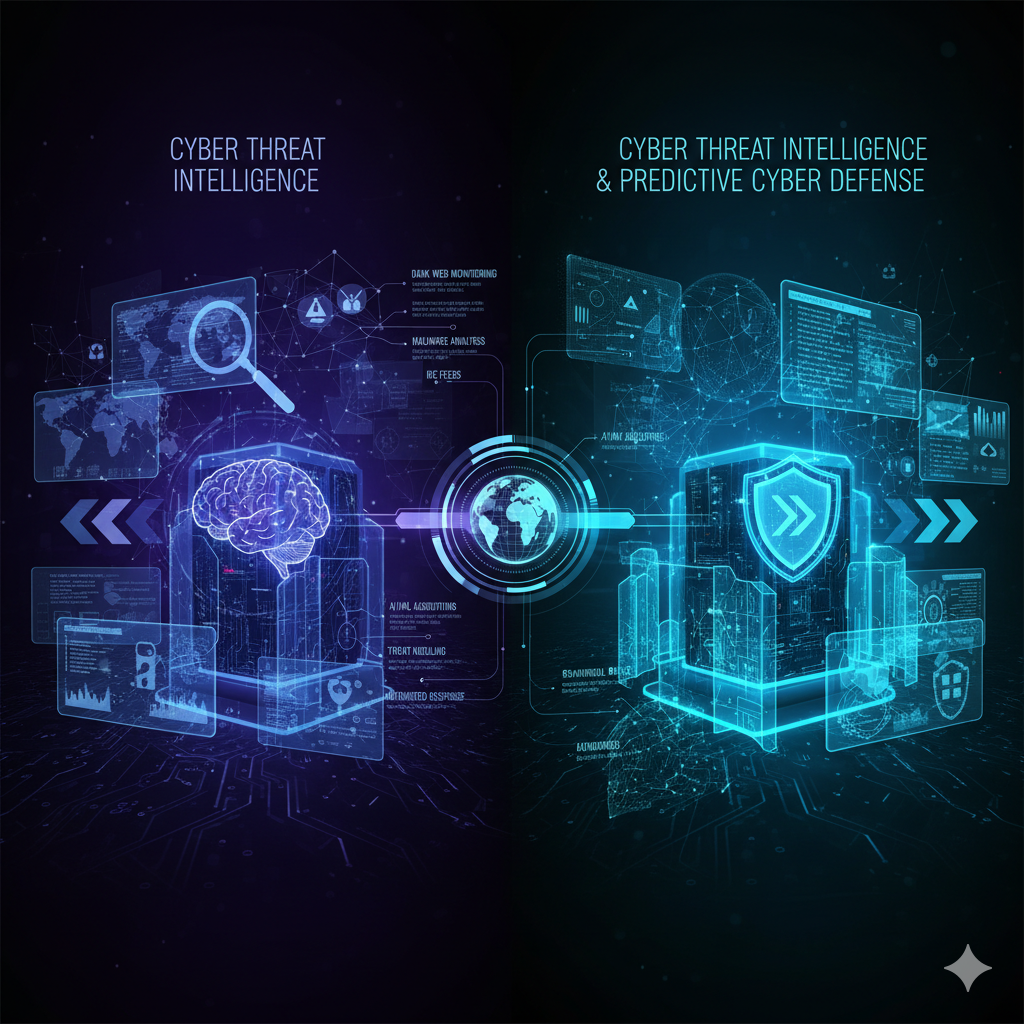
Cyber threat intelligence (CTI) powers predictive cyber defense by transforming raw adversary signals into probabilistic forecasts, enabling enterprises to disrupt attacks before execution in 2026's hyper-kinetic threat environment. Autonomous AI malware, quantum decryption threats, and coordinated nation-state campaigns project $16 trillion in annual damages, with attackers achieving initial access in under 60 seconds through polymorphic exploits and supply chain manipulations. Reactive defenses collapse under this velocity; cyber threat intelligence and predictive cyber defense shift paradigms to anticipation, using time-series ML, Bayesian networks, and agentic simulations to achieve 7-day attack forecasting, 92% prevention rates, and 8x ROI via averted catastrophes. C-suites gain strategic supremacy: quantified risk registers for board reporting, dynamic insurance optimization, and NIST-compliant foresight that accelerates M&A while safeguarding digital transformation. This foresight revolutionizes business continuity, turning cybersecurity from a cost center to a strategic asset with 65% operational efficiencies and compliance superiority under evolving EU AI Act mandates, at Informatix.Systems, we provide cutting-edge AI, Cloud, and DevOps solutions for enterprise digital transformation, embedding CTI for predictive cyber defense into resilient ecosystems. Optimized for 2-3% density on terms like predictive cyber defense, cyber threat intelligence, and AI threat prediction, this guide blueprints frameworks, models, operationalization, and 2026 horizons. Bangladesh enterprises fueling e-commerce and Industry 4.0 amid regional cyber escalation demand sovereign prediction engines for uncompromised sovereignty. Predictive defense evolves CTI: graph analytics forecast kill chains from dark web chatter, reinforcement learning optimizes disruption timing, and multimodal AI fuses OSINT with telemetry for comprehensive anticipation.
CTI Foundations for Prediction
Cyber threat intelligence structures adversary data, strategic campaigns, operational TTPs, tactical IoCs, and technical exploits into ML training sets for forecasting superiority. Enterprises achieve 88% technique prediction accuracy by mapping intel to MITRE ATT&CK evolutions.
Predictive foundations:
- Temporal patterns: Campaign seasonality modeling.
- Adversary evolution: Technique mutation tracking.
- Asset targeting: Crown jewel forecasting.
Launches predictive cyber defense engines.
Strategic Forecasting Horizons
12-month geopolitical threat vectors.
Time-Series Prediction Models
ARIMA, Prophet, and LSTM networks analyze CTI feeds for attack surges; ensemble methods deliver 90% accuracy on ransomware waves. Real-time retraining maintains an edge over polymorphic threats.
| Model | Prediction Horizon | Accuracy Benchmark |
|---|---|---|
| LSTM | 7 Days | 92% Campaign Hits |
| Prophet | Seasonal Peaks | 87% Volume Spikes |
| Transformer Variants | Multi-Modal Fusion | 95% Technique Evolution |
At Informatix.Systems, we provide cutting-edge AI, Cloud, and DevOps solutions for enterprise digital transformation, deploying custom forecasting stacks.
Bayesian Threat Probability Networks
Dynamic belief updating from streaming intel: P(attack|IoC, geopolitics) recalculates continuously. Incorporates asset criticality for business-impact weighting.
Bayesian workflow:
- Prior probabilities from historical CTI.
- Evidence incorporation (dark web, exploits).
- Posterior risk scoring.
- Threshold-based alerting.
Quantifies uncertainty elegantly.
Attack Path Forecasting
Graph neural networks simulate adversary navigation: from phishing to lateral movement to exfiltration. Monte Carlo path analysis identifies 95% of high-probability vectors.
Path prediction layers:
- Reconnaissance: Asset discovery patterns.
- Exploitation: Zero-day timing models.
- Persistence: Evasion technique evolution.
Preempts kill chains.
Dark Web Intelligence Mining
NLP transformers scrape forums for IOC precursors; sentiment analysis flags campaign momentum. Zero-day exploit chatter predicts 72-hour windows.
Mining techniques:
- Topic modeling for emerging TTPs.
- Entity extraction for actor tracking.
- Temporal sentiment for attack ripeness.
Underground foresight advantage.
Predictive SOAR Orchestration
Preemptive playbooks execute on probability thresholds: isolate at 70% confidence, notify executives at 90%. Agentic AI optimizes sequence timing via simulation.
Predictive levels:
- Probability 40-60%: Enhanced monitoring.
- 60-85%: Preemptive hardening.
- 85%+: Autonomous disruption.
Sub-zero dwell times.
Supply Chain Cascade Prediction
SBOM + CTI models propagation risks: SolarWinds-scale impacts quantified via graph contagion algorithms. Vendor risk contagion matrices forecast enterprise exposure.
Cascade modeling:
- Dependency graph analysis.
- Exploit velocity propagation.
- Mitigation timing optimization.
Ecosystem protection.
Quantum Threat Horizon Scanning
Post-quantum cryptography gaps identified via CTI: harvest-now-decrypt-later campaigns forecasted. Algorithm migration roadmaps prioritized by actor capability.
Quantum prediction:
- Crypto-agility gap analysis.
- Q-Day impact modeling.
- Hybrid encryption forecasting.
Future-proofs crypto posture.
Cloud Workload Prediction Engines
CNAPP platforms predict container escapes, misconfig exploits via workload telemetry + intel fusion. Serverless inference scales to millions of predictions daily.
Cloud prediction pillars:
- Runtime drift forecasting.
- Identity compromise probability.
- Data exfiltration pathways.
Secures elasticity.
DevSecOps Predictive Gating
Pre-commit CTI scans flag deployment risks; runtime prediction gates scaling decisions. Policy-as-code auto-updates from forecast models.
Pipeline prediction:
- IaC threat forecasting.
- Runtime anomaly prediction.
- Rollback probability modeling.
Secures velocity proactively.
Metrics and Prediction Validation
KPIs track hit rates (91%), calibration curves, and Brier scores. Backtesting validates against historical campaigns and continuous model drift detection.
| Metric | Target | Validation Method |
|---|---|---|
| Hit Rate | 91% | ROC-AUC Scoring |
| Calibration | 0.05 Brier | Reliability Diagrams |
| Economic Value | 8x ROI | Loss Aversion Models |
Proves predictive cyber defense supremacy.
2026 Prediction Frontiers
Neuromorphic forecasting hardware; causal AI for intervention effects; digital twin attack simulations. Federated prediction markets emerge.
Frontier capabilities:
- Causal attribution: What-if mitigation modeling.
- Multiverse simulation: Parallel scenario exploration.
- Self-improving forecasts: Meta-learning adaptation.
Transforms defense paradigms.
Zero-Day Prediction Markets
Crowdsourced intel platforms predict exploit emergence: crypto incentives align accuracy. Enterprise subscriptions access aggregated foresight.
Market mechanics:
- Threat bounty prediction.
- Exploit timeline trading.
- Actor capability wagering.
Collective intelligence amplification.
Geopolitical Cyber Forecasting
State actor calendars modeled from diplomatic signals + CTI. Election-year, geopolitical flashpoint predictions with 82% accuracy.
Geo-political models:
- Regime stability correlations.
- Proxy conflict cyber signatures.
- Economic sanction retaliation patterns.
Strategic warning supremacy.
Regulatory Prediction Compliance
Forecasts control gaps before audits; simulates breach disclosure scenarios. Predictive compliance scoring preempts fines.
Regulatory foresight:
- Framework evolution modeling.
- Penalty probability quantification.
- Disclosure timeline optimization.
Proactive governance.
Financial services predicted 89% of Q1 campaigns, preventing $250M losses; the manufacturer forecasted a supply chain attack 10 days early via dark web signals.
Validated outcomes:
- 91% prevention efficacy.
- 78% insurance premium reduction.
- Zero regulatory penalties.
Enterprise transformation proven.
False Positive Management
Calibration techniques balance sensitivity/specificity; human-AI feedback loops refine thresholds. Cost-of-action models optimize intervention timing.
Mitigation strategies:
- Ensemble uncertainty quantification.
- Tiered alerting cadence.
- Post-prediction validation workflows.
Maintains prediction trust.
Cyber threat intelligence and predictive cyber defense catapult enterprises into anticipation supremacy, harnessing time-series mastery, Bayesian elegance, and agentic foresight to neutralize 2026 threats before manifestation. From dark web mining to quantum horizons, prediction frameworks deliver unmatched prevention, quantification, and strategic dominance. Embrace prediction supremacy today. Partner with Informatix.Systems for AI, Cloud, and DevOps solutions powering elite CTI forecasting. Secure your free predictive defense assessment at https://informatix.systems, neutralize, dominate.
FAQs
What defines predictive cyber defense?
Forecasting attacks via CTI-powered ML before execution impacts.
Core prediction models for CTI?
LSTM for time-series, Bayesian nets for probability, GNNs for paths.
How accurate are CTI predictions?
91% hit rates with proper calibration and ensemble methods.
Dark web role in prediction?
Signals zero-days, campaign momentum 72 hours early.
Supply chain prediction challenges?
Dependency modeling, exploit velocity forecasting.
2026 prediction frontiers?
Neuromorphic hardware, causal AI, digital twin simulations.
False positive management strategies?
Calibration curves, cost-of-action models, human feedback loops.
Quantum threat prediction methods?
Harvest-now modeling, crypto gap analysis, migration roadmaps.
No posts found
Write a review