- 3/8, North Pirerbag
- 60 Feet Main Road
- Mirpur, Dhaka 1216
- +880-967-8247365
- support@informatix.systems

Cyber Threat Intelligence and Predictive Risk Defense
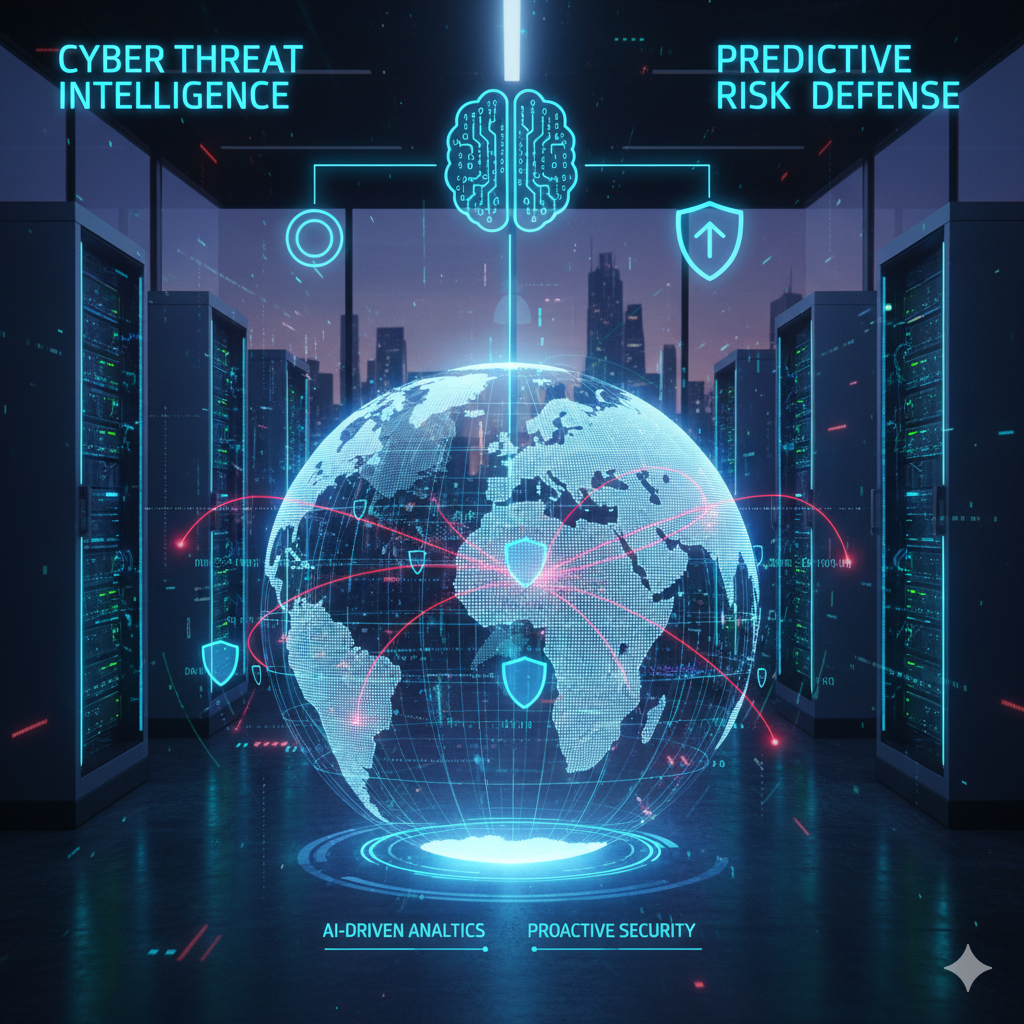
In the rapidly evolving digital landscape of 2026, cyber threat intelligence (CTI) has become the cornerstone of enterprise cybersecurity, transforming raw data into actionable insights that predict and neutralize threats before they strike. As organizations face AI-powered attacks, nation-state actors, and sophisticated ransomware, predictive risk defense emerges as the proactive shield, leveraging machine learning (ML) and advanced analytics to forecast vulnerabilities and automate responses. According to industry forecasts, cyber threats will intensify with agentic AI enabling scalable attacks, making traditional reactive measures obsolete. Businesses ignoring cyber threat intelligence risk devastating breaches, with average costs exceeding millions, and downtime crippling operations. Enterprises adopting predictive models report up to 96% accuracy in threat detection, reducing response times dramatically. At Informatix.Systems, we provide cutting-edge AI, Cloud, and DevOps solutions for enterprise digital transformation, empowering clients to shift from defense to anticipation. This article explores cyber threat intelligence frameworks, predictive risk defense techniques, and 2026 trends. Readers will gain strategies for threat hunting, platform selection, and integration with DevSecOps, essential for CISOs and security leaders targeting resilient operations.
What is Cyber Threat Intelligence?
Cyber threat intelligence (CTI) collects, processes, and analyzes data on adversaries, motives, and attack methods to deliver context-rich insights. It is categorized into strategic (high-level trends), operational (campaign planning), and tactical (technical indicators) levels, enabling proactive security. Organizations use CTI to understand threat actors like nation-states or cybercriminals, moving beyond alerts to informed decisions. Gartner defines it as evidence-based knowledge on threats, mechanisms, and advice. At Informatix.Systems, we provide cutting-edge AI, Cloud, and DevOps solutions for enterprise digital transformation, integrating CTI into SOC workflows.
Strategic CTI Applications
Operational CTI Benefits
The Evolution of Predictive Risk Defense
Predictive risk defense harnesses AI/ML to anticipate threats via pattern recognition, anomaly detection, and simulations. Unlike reactive tools, it forecasts attacks using historical data and real-time telemetry. By 2026, frameworks like the MITRE CTID model attacker intent, combining global data with AI for resource allocation. ML models like CNNs achieve 96.2% recall in threat prediction. This shift reduces breach impacts, prioritizing high-risk vectors through probabilistic modeling.
Core Predictive Technologies
- Time Series Analysis: Forecasts attack frequencies.
- Behavioral Analytics: Detects deviations from baselines.
Key Types of Cyber Threat Intelligence
CTI spans four types, each serving distinct defense layers.
Strategic CTI guides policy; tactical blocks immediate threats.
Building a Cyber Threat Intelligence Program
A robust CTI program starts with data collection from logs, feeds, and endpoints, followed by AI-driven analysis. Integrate MITRE ATT&CK for TTP mapping.
Steps include:
- Assess current maturity.
- Select platforms like ThreatConnect for automation.
- Train teams on intel-driven hunting.
Informatix.Systems delivers tailored CTI programs via AI and Cloud solutions.
Program Maturity Levels
Predictive Analytics in Cyber Risk Management
Predictive analytics processes vast datasets to model risks, using FAIR for quantification: Risk = Loss Event Frequency × Loss Magnitude. It flags anomalies in user behavior, predicting insider threats. Case studies show ML reducing false positives by 50%.
Risk Quantification Models
| Model | Approach | Strengths |
|---|---|---|
| FAIR | Monetary | Financial prioritization |
| Monte Carlo | Simulations | Uncertainty handling |
| NIST 800-30 | Qualitative | Compliance focus |
AI and Machine Learning in Threat Intelligence
AI excels in real-time IoC processing and behavioral anomaly detection. Models like Random Forest predict with 94% accuracy. Agentic AI simulates attacks, automating responses. By 2026, it will dominate SOCs, cutting detection times. At Informatix.Systems, we provide cutting-edge AI, Cloud, and DevOps solutions for enterprise digital transformation.
ML Algorithms for Prediction
Threat Hunting Methodologies
Threat hunting proactively seeks hidden adversaries using hypothesis, intel, or entity-based methods. Hypothesis-driven follows MITRE ATT&CK. Hunters analyze IoAs over IoCs for stealthy APTs. Tools like SIEM integrate intel feeds.
Hunting Techniques
- Hypothesis-Based: Test educated guesses.
- Intel-Based: IoC correlation.
- UEBA-Driven: Behavioral anomalies.
Integrating DevSecOps with Predictive Defense
DevSecOps embeds security in pipelines via SAST, DAST, and SCA. Automate vulnerability scans and secrets rotation. Immutable infrastructure prevents drift; CI/CD gates block risky code. Informatix.Systems specializes in DevOps security pipelines.
Pipeline Security Steps
Cloud-Native Threat Intelligence Strategies
Cloud environments demand runtime protection with CSPM and NTA. Behavioral ML detects microservice anomalies. Integrate EDR for hybrid visibility. 2026 trends emphasize API security.
Cloud Defense Tools
Leveraging MITRE ATT&CK for Intelligence
MITRE ATT&CK maps TTPs, enabling threat modeling and detection rules. It improves response by 30% via technique prioritization. Combine with intel for vuln management, prioritize CVEs by attack paths.
Zero Trust and Predictive Risk Frameworks
Zero Trust verifies continuously, enhanced by predictive analytics for dynamic access. Frameworks quantify risks pre-breach. 2026 sees unified SOCs with AI exposure management.
Zero Trust Pillars
- Identity verification.
- Micro-segmentation with ML predictions.
Threat Intelligence Sharing and Collaboration
Sharing via ISACs or STIX/TAXII accelerates defense. Platforms like Anomali STAXX enable secure exchanges. Communities like OTX crowdsource IoCs, boosting collective resilience.
2026 Cyber Threat Trends and Predictions
Expect AI-driven attacks, quantum risks, and supply chain exploits. Defenses counter with predictive SOCs and post-quantum crypto. Unified visibility across edge/IoT is critical.
Real-World Predictive Defense Success
A healthcare firm used ML to predict ransomware, averting downtime via anomaly alerts. Financial sectors report 92% threat detection via GBM models. Enterprises integrating CTI see 40% faster MTTR. Cyber threat intelligence and predictive risk defense redefine enterprise security for 2026, blending AI, frameworks like MITRE ATT&CK, and DevSecOps for proactive resilience. Key takeaways include platform integration, threat hunting, and quantified risk models to outpace evolving threats. Ready to fortify your defenses? Contact Informatix.Systems today for cutting-edge AI, Cloud, and DevOps solutions tailored to your enterprise digital transformation. Schedule a free consultation at https://informatix.systems now.
FAQs
What is cyber threat intelligence?
Evidence-based knowledge on threats, categorized as strategic, operational, or tactical, for proactive defense.
How does predictive risk defense work?
AI/ML analyzes patterns to forecast attacks, using models like FAIR for quantification.
Why integrate AI in threat intelligence?
Achieves 95% anomaly detection, automates responses, and predicts vectors.
What are the top threat hunting techniques?
Hypothesis-based, intel-driven, and UEBA for proactive adversary pursuit.
Which platforms lead in 2026?
CrowdStrike, Mandiant, and ThreatConnect for endpoint and SOC integration.
How does DevSecOps enhance prediction?
Automates SCA and secrets management in pipelines.
What role does MITRE ATT&CK play?
Maps TTPs for detection and prioritization.
Can cloud-native environments use CTI?
Yes, via NTA and runtime ML for microservices.
No posts found
Write a review