- 3/8, North Pirerbag
- 60 Feet Main Road
- Mirpur, Dhaka 1216
- +880-967-8247365
- support@informatix.systems

Cyber Threat Intelligence for Digital Security Strategy
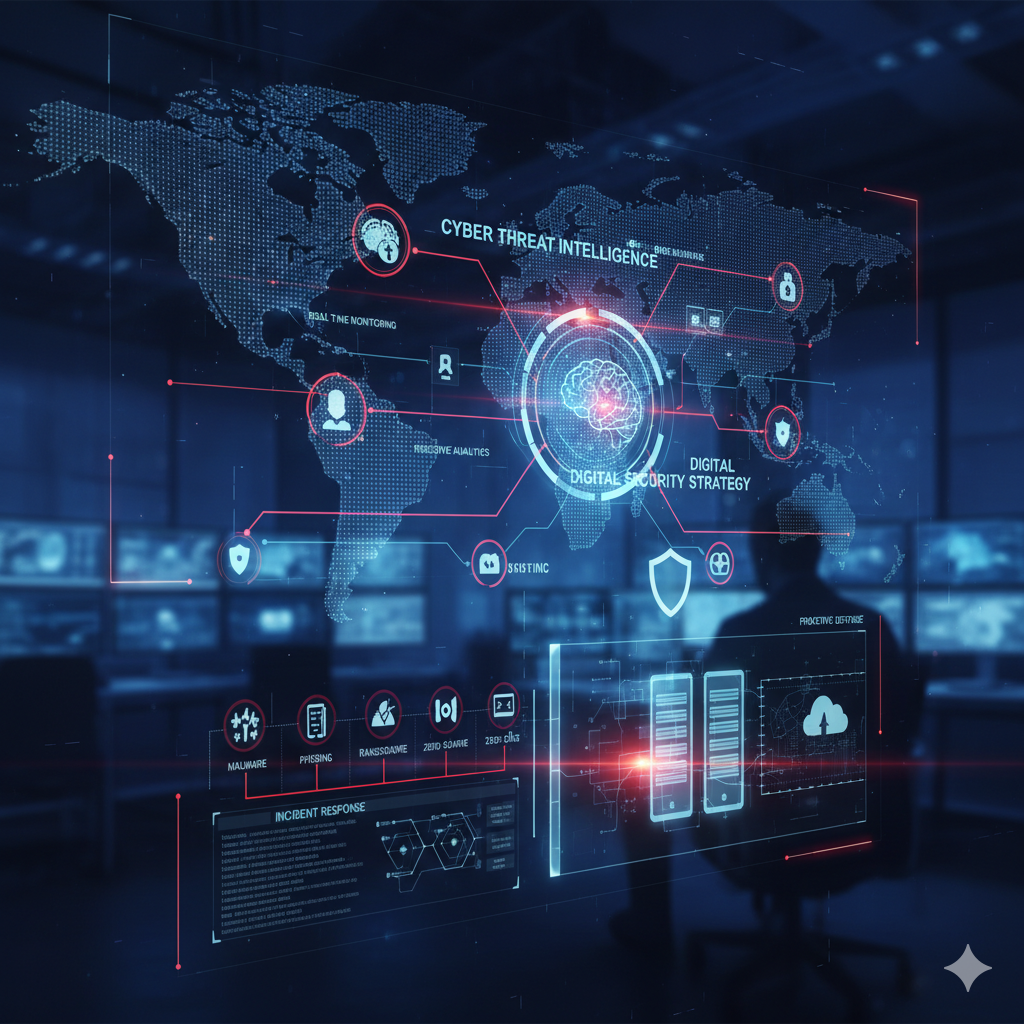
In today's hyper-connected digital landscape, cyber threats evolve at an unprecedented pace, targeting enterprises with sophisticated attacks powered by AI and nation-state actors. Cyber threat intelligence (CTI) emerges as the cornerstone of any robust digital security strategy, transforming raw data into actionable insights that enable organizations to anticipate, detect, and neutralize risks before they escalate. According to industry leaders, CTI shifts security teams from reactive firefighting to proactive defense, reducing breach costs by up to 50% through early threat visibility. For enterprises undergoing digital transformation, the business stakes are immense. A single ransomware incident can halt operations, erode customer trust, and incur millions in recovery fees. CTI provides context on adversary motives, tactics, techniques, and procedures (TTPs), allowing CISOs to prioritize vulnerabilities aligned with real-world exploits. In 2026, with AI-driven attacks projected to surge, organizations ignoring CTI risk will fall behind in the arms race against cybercriminals, at Informatix.Systems, we provide cutting-edge AI, Cloud, and DevOps solutions for enterprise digital transformation. Our tailored CTI integrations empower Bangladesh-based firms and global clients to build resilient defenses, leveraging cloud-native tools for real-time threat monitoring. This article dives deep into CTI's role in digital security strategies, offering actionable frameworks, tools, and best practices for 2026 and beyond.
What Is Cyber Threat Intelligence?
Cyber threat intelligence (CTI) involves collecting, processing, and analyzing data on threats, adversaries, and attack methods to deliver context-rich insights for security decisions. It categorizes threats into strategic, operational, tactical, and technical types, each serving distinct enterprise needs. Strategic CTI offers high-level overviews for executives, focusing on geopolitical risks and industry trends via reports and briefs. Operational CTI details threat actor campaigns, enabling SOC teams to disrupt attacks. Tactical CTI provides TTPs for immediate defenses, while technical CTI delivers IOCs like IPs and hashes for automated blocking.
Core Components of CTI
- Adversary Profiling: Maps motives, capabilities, and infrastructure.
- Indicator Enrichment: Contextualizes IOCs with behavioral data.
- Predictive Analytics: Forecasts emerging risks using AI patterns.
Enterprises benefit from CTI by aligning intelligence with business assets, ensuring resource allocation targets high-impact threats.
Types of Cyber Threat Intelligence
CTI spans four primary types, each tailored to stakeholder levels and use cases. Strategic intelligence informs boardroom decisions on long-term risks.
Operational CTI tracks active campaigns, such as ransomware groups targeting supply chains. Tactical intelligence focuses on exploitable TTPs, like phishing vectors. Technical CTI feeds SIEMs with granular IOCs for endpoint protection.
At Informatix.Systems, we provide cutting-edge AI, Cloud, and DevOps solutions for enterprise digital transformation, customizing CTI types to fit DevSecOps pipelines.
Cyber Threat Intelligence Lifecycle
The CTI lifecycle follows a structured six-phase process: direction, collection, processing, analysis, dissemination, and feedback. This iterative model ensures intelligence remains relevant and actionable.
Direction and Planning
Define priorities based on assets and threats, such as prioritizing cloud vulnerabilities for hybrid environments.
Collection
Gather data from open sources, dark web, and internal logs using feeds like MITRE ATT&CK.
Processing and Enrichment
Normalize IOCs and apply AI for de-duplication, reducing noise by 70%.
Analysis
Correlate data into insights, using frameworks like the Diamond Model for adversary relationships.
Dissemination
Deliver via dashboards, alerts, or APIs integrated into SOAR platforms.
Feedback
Measure utilization and refine requirements, closing the loop for continuous improvement.
Integrating CTI into Digital Security Strategy
Effective integration embeds CTI across security stacks, from SIEM to EDR. Start with gap assessments, then automate feeds into workflows for real-time application.
Key Integration Steps:
- Map CTI to NIST or MITRE frameworks.
- Automate IOC ingestion via APIs.
- Align with business impact models for prioritization.
Challenges include data overload; overcoming with AI filtering. In DevSecOps, CTI scans pipelines for vulnerabilities pre-deployment. At Informatix.Systems, we provide cutting-edge AI, Cloud, and DevOps solutions for enterprise digital transformation, streamlining CTI integration.
Essential CTI Tools and Technologies 2026
2026 demands AI-powered platforms like Threat Intelligence Platforms (TIPs) with ML for anomaly detection. Top tools include multi-engine scanners and MITRE-mapped sandboxes.
Leading Platforms:
- AI-Driven TIPs: Automate enrichment and playbooks.
- Unified Threat Libraries: Normalize data for actionability.
- Dark Web Monitors: Track leaks and actor chatter.
| Tool Category | Examples | Key Features |
|---|---|---|
| TIPs | Recorded Future, Flare | IOC correlation, ATT&CK mapping |
| SIEM Integration | Splunk, Elastic | Real-time alerting |
| AI Analytics | Google Threat Intelligence | Behavioral graphs |
Frameworks for CTI Maturity
Popular frameworks include MITRE ATT&CK for TTP mapping and the Diamond Model for relational analysis. Emerging 2026 models like MITRE CTID predict adversary intent.
Implementation Best Practices:
- Kill Chain: Breaks attacks into stages for targeted defenses.
- Pattern Recognition: ML identifies anomalies in logs.
Real-World CTI Case Studies
Financial firms used CTI to block phishing via employee training and filters, slashing successes by 80%. Healthcare providers mitigated ransomware by profiling actors and patching exploits early. Retailers detected supply chain attacks through vendor monitoring. Energy sectors protected infrastructure with predictive intel.
Outcomes Across Sectors:
Best Practices for CTI Programs
Leverage internal data first, then enrich with external feeds. Automate heuristics for zero-days and tune for low false positives.
Proven Techniques:
- Regular scans for remote admin tools.
- Balanced signature-heuristic detection.
- Stakeholder feedback loops.
AI and Future Trends in CTI 2026
AI agents automate attacks, but defenders counter with predictive models and agentic AI. Trends: unified SOCs, exposure management, quantum-safe crypto.
2026 Predictions:
CTI in DevSecOps and Cloud
Embed CTI in CI/CD for vulnerability scanning and threat modeling. Automate alerts and predictive modeling.
Integration Steps:
At Informatix.Systems, we provide cutting-edge AI, Cloud, and DevOps solutions for enterprise digital transformation.
Challenges and Solutions in CTI Adoption
Overcome silos with cross-team training and data overload via AI prioritization. Budget constraints? Start with open-source feeds.
Common Hurdles:
Cyber threat intelligence fortifies digital security strategies by enabling proactive defense, optimizing resources, and adapting to 2026's AI-fueled threats. From lifecycle mastery to AI integrations, enterprises mastering CTI achieve resilience and competitive edges. Ready to elevate your security? Contact Informatix.Systems today for a free CTI assessment and deploy cutting-edge AI, Cloud, and DevOps solutions tailored for your digital transformation.
FAQs
What is the difference between strategic and tactical CTI?
Strategic CTI provides executive-level trends, while tactical focuses on immediate TTPs for SOC actions.
How does the CTI lifecycle improve security?
It ensures structured intel flow, reducing blind spots through feedback.
What are the top CTI tools for 2026?
AI TIPs like Flare and Google Threat Intelligence for real-time analysis.
How to measure CTI program success?
Use MTTD, MTTR, and actionability KPIs.
Can CTI integrate with DevSecOps?
Yes, via automated feeds and pipeline scanning.
What are the 2026 CTI trends?
Agentic AI, unified data, and predictive modeling.
Why is AI crucial for CTI?
It detects anomalies and predicts threats faster than humans.
How does CTI reduce breach costs?
Early detection cuts dwell time, minimizing damage.
No posts found
Write a review