- 3/8, North Pirerbag
- 60 Feet Main Road
- Mirpur, Dhaka 1216
- +880-967-8247365
- support@informatix.systems

Cyber Threat Intelligence for Hyper-Connected Systems
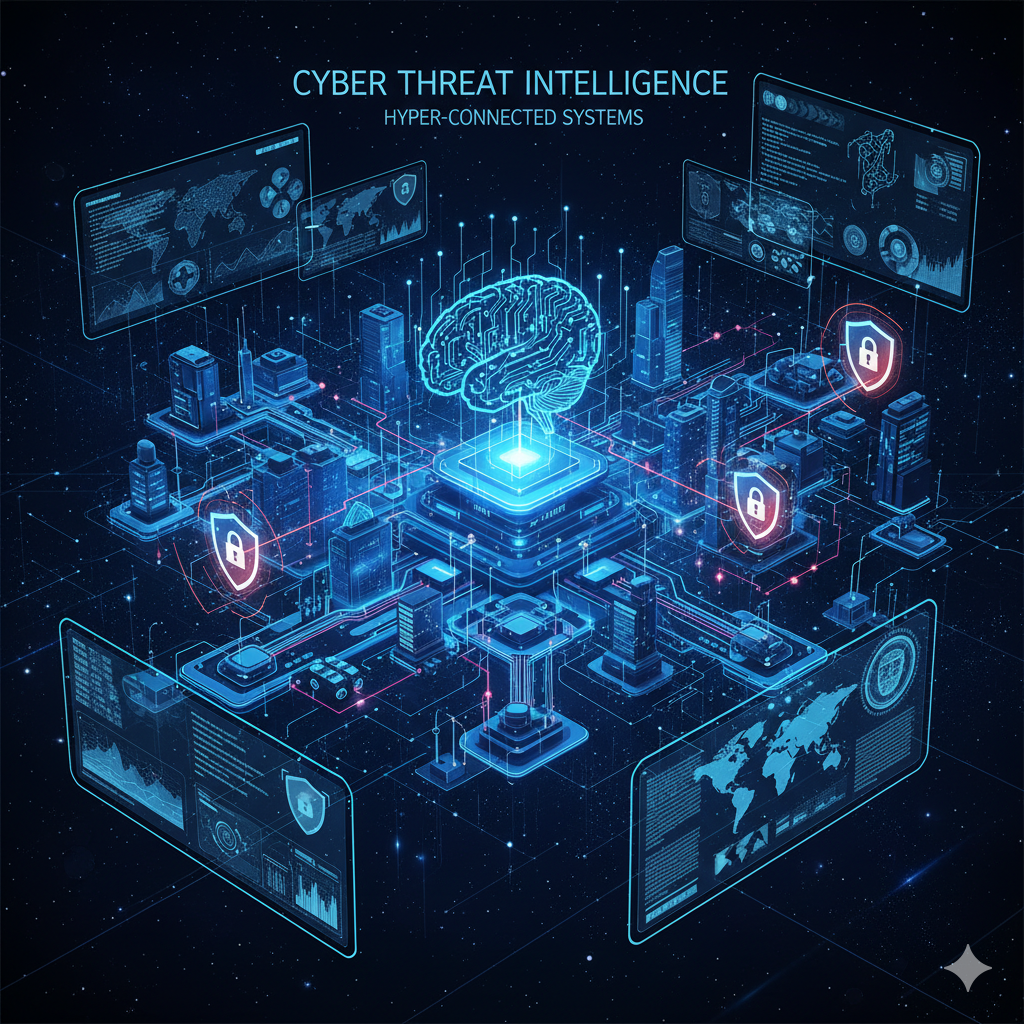
In the hyper-connected era of 2026, enterprises operate across vast ecosystems of IoT devices, edge computing nodes, multi-cloud environments, and AI agents, creating unprecedented attack surfaces. Cyber threat intelligence (CTI) emerges as the critical enabler for navigating this complexity, transforming disparate threat data into predictive, actionable insights tailored to interconnected systems. Unlike traditional security, CTI for hyper-connected systems anticipates adversary movements across distributed networks, fusing external feeds with internal telemetry to detect subtle anomalies in real-time. Business imperatives are stark: with over 75 billion IoT devices projected by 2026, supply chain compromises affect 30% of breaches, and AI-powered attacks evade legacy defenses. Organizations leveraging CTI reduce breach costs by 40-50%, achieving mean time to detect (MTTD) under 24 hours and response (MTTR) in minutes. This intelligence categorizes threats as strategic (geopolitical risks), operational (campaign intents), and tactical (IoCs), while advanced analytics predict TTPs in hyper-connected topologies like 5G/6G networks and autonomous systems. At Informatix.Systems, we provide cutting-edge AI, Cloud, and DevOps solutions for enterprise digital transformation, delivering bespoke CTI platforms that secure hyper-connected infrastructures. This comprehensive guide explores CTI frameworks, integration strategies, 2026 trends, and practical implementations, empowering CISOs to build resilient defenses amid exponential connectivity.
Defining Hyper-Connected Systems
Hyper-connected systems encompass IoT meshes, edge-to-cloud pipelines, and agentic AI networks where data flows seamlessly but vulnerabilities propagate rapidly.
Core Components
- IoT and Edge Devices: Billions of sensors generating petabytes of telemetry.
- Multi-Cloud Architectures: Hybrid environments spanning AWS, Azure, and GCP.
- AI Agents: Autonomous entities executing workflows across ecosystems.
Unique Challenges
Cyber threat intelligence must address lateral movement in these systems, where a single compromised edge node threatens core assets.
CTI Fundamentals in Connected Ecosystems
Cyber threat intelligence cycles through planning, collection, processing, analysis, dissemination, and feedback, adapted for hyper-scale data.
Intelligence Lifecycle Adaptation
- Planning: Prioritize threats to critical paths like supply chains.
- Collection: Aggregate from OSINT, dark web, endpoint logs.
- Analysis: AI enriches with context from connected telemetry.
Types Tailored to Connectivity
- Strategic CTI: Ecosystem-wide risk forecasts.
- Operational CTI: Cross-domain campaign tracking.
- Tactical CTI: Real-time IoCs for edge mitigation.
AI-Powered CTI Evolution
Agentic AI transforms cyber threat intelligence into proactive radar systems, predicting storms via TTP operationalization.
Key AI Capabilities
- Autonomous Collection: Agents scour sources, verify data.
- Predictive Modeling: Forecast attacks on AI models and pipelines.
- Automated Response: Generate detection rules for SIEM/EDR.
At Informatix.Systems, we provide cutting-edge AI, Cloud, and DevOps solutions for enterprise digital transformation.
Defending AI in Hyper-Connected Setups
Monitor model poisoning, jailbreaks, adversarial inputs, and emerging CTI frontiers.
Threat Hunting in Distributed Networks
Proactive hunting uses hypotheses, intel-led, and behavior-driven methods across hyper-connected fabrics.
Methodologies
- Hypothesis-Driven: Test AI-generated risk models.
- Intelligence-Led: Deploy IoCs ecosystem-wide.
- Entity Behavior Analytics (EBA): Baseline normal flows in IoT meshes.
MITRE ATT&CK for Connectivity
Map 14 tactics to edge/IoT scenarios, simulating hyper-connected breaches.
Supply Chain Threat Intelligence
Supply chains amplify risks in hyper-connected systems; CTI monitors upstream code tampering and downstream API exploits.
Monitoring Strategies
- Dependency Scanning: Track malicious packages.
- Vendor Risk Scoring: Fuse CTI with third-party telemetry.
- Island-Hopping Detection: Trace compromises across ecosystems.
Bullet Points for Action:
- Implement SBOMs with CTI overlays.
- Automate vendor threat feeds.
- Simulate supply chain attacks quarterly.
IoT and Edge CTI Frameworks
Edge devices demand lightweight CTI for constrained environments.
Edge-Specific Intelligence
- Zero-Trust Edge: Continuous verification via micro-CTI bursts.
- Neuromorphic Processing: AI chips for on-device threat analytics.
Implementation Steps
- Deploy edge gateways with CTI agents.
- Correlate local logs with cloud intel.
- Enable over-the-air threat updates.
Cloud-Native CTI Integration
Multi-cloud hyper-connectivity requires unified cyber threat intelligence across providers.
Cloud Threat Vectors
- Misconfigurations propagating via APIs.
- Serverless function exploits.
- Container escape in Kubernetes meshes.
Analytics Tools
| Tool | Focus | Hyper-Connected Fit |
|---|---|---|
| Prisma Cloud | CSPM + CTI | Multi-cloud visibility |
| Lacework | Behavioral ML | Polyglot environments |
| Orca Security | Agentless scanning | Edge-to-cloud |
DevSecOps and CTI Pipelines
Embed cyber threat intelligence in CI/CD for shift-left in hyper-connected DevOps.
Pipeline Integration
- Pre-Commit Hooks: CTI-driven vuln scans.
- Runtime Protection: Dynamic TTP blocking.
- Feedback Loops: Post-deploy intel refinement.
At Informatix.Systems, we provide cutting-edge AI, Cloud, and DevOps solutions for enterprise digital transformation.
Best Practices
- Automate threat feeds into IaC templates.
- Use GitOps for CTI playbook deployment.
- Measure via DORA metrics enhanced with CTI KPIs.
Collective Defense and Sharing
ISACs, MISP, and AI-mediated platforms enable hyper-connected threat sharing.
Platforms
- OTX/AlienVault: Community IoCs.
- MISP: STIX/TAXII for ecosystems.
- Anomali: Enterprise federation.
Benefits:
- 360° visibility across sectors.
- Reduced zero-day impacts by 60%.
2026 Trends in Hyper-Connected CTI
Agentic AI, quantum threats, and deception engineering define the landscape.
Emerging Vectors
- AI vs. AI Battles: Autonomous attacks/defenses.
- Identity as Infrastructure: Zero-trust for agents.
- Deception at Scale: Honeypots for hyper-surfaces.
Measuring CTI ROI in Connected Systems
Track MTTD/MTTR, ALE reductions, and connectivity-specific metrics like edge breach propagation time.
KPIs
- Propagation Delay: Time for threats to spread.
- Ecosystem Coverage: % of nodes with CTI visibility.
- ROI Formula: (Avoided Losses - CTI Costs) / Costs × 100 (often 300%+).
Real-World Wins
- Industrial OT Convergence: AI analytics thwarted PLC manipulations.
- Enterprise AI Defense: CTI detected model poisoning in supply chains.
- Global Telco: Reduced 5G edge incidents by 55% via shared intel.
Regulatory Compliance and CTI
2026 regs like the EU AI Act mandate CTI for high-risk hyper-connected systems.
Frameworks
- NIST 2.0: Connectivity risk models.
- ISO 27001x: Enhanced for IoT/edge.
Cyber threat intelligence for hyper-connected systems stands as the linchpin for 2026 resilience, harnessing AI agents, TTP focus, and ecosystem integrations to outpace threats in IoT, edge, and cloud realms. Enterprises adopting these strategies achieve predictive defense, slashed MTTR, and superior ROI. Elevate your hyper-connected security today. Partner with Informatix.Systems for cutting-edge AI, Cloud, and DevOps solutions. Visit https://informatix.systems or contact us for a free CTI maturity assessment.
FAQs
What defines hyper-connected systems for CTI?
Interlinked IoT, edge, cloud, and AI agents form expansive attack surfaces requiring ecosystem-wide intelligence.
How does agentic AI enhance CTI?
Automates collection, prediction, and response, shifting teams to oversight in hyper-scale environments.
Why prioritize supply chain CTI?
30% of breaches stem from vendors; monitors tampering across connected pipelines.
What are the top threat hunting methods for the edge?
Hypothesis-driven with EBA, aligned to MITRE ATT&CK for distributed anomalies.
How to integrate CTI into DevSecOps?
Embed feeds in pipelines for automated scans and dynamic protections.
What 2026 trends impact hyper-connected CTI?
AI autonomy, deception engineering, identity-centric defenses.
How to measure CTI success in connected ecosystems?
MTTD/MTTR, propagation delays, 300%+ ROI on avoided losses.
Which platforms excel for sharing in hyper-systems?
No posts found
Write a review