- 3/8, North Pirerbag
- 60 Feet Main Road
- Mirpur, Dhaka 1216
- +880-967-8247365
- support@informatix.systems

Cyber Threat Intelligence for Intelligent Enterprise Defense
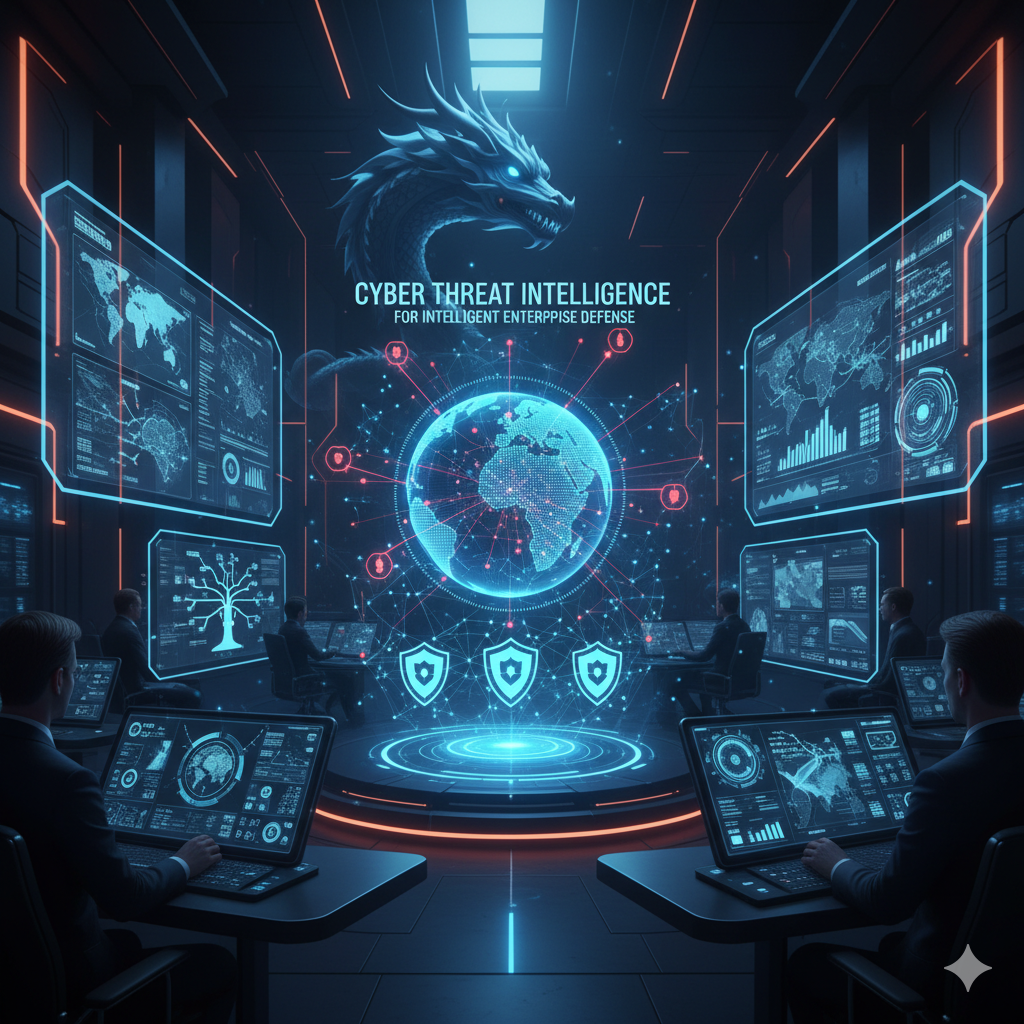
In 2026, cyber threat intelligence (CTI) powers intelligent enterprise defense, evolving from reactive threat feeds to AI-augmented, unified intelligence ecosystems that deliver proactive resilience across sprawling digital enterprises. Traditional CTI encompasses strategic geopolitical campaigns, operational adversary TTPs mapped to MITRE ATT&CK, tactical tool infrastructures, and technical IOCs like malicious domains and hashes, but intelligent enterprise defense fuses this with internal asset telemetry, vulnerability management, and business context for machine-speed decision-making. As agentic AI lowers attack barriers enabling polymorphic ransomware, AI model poisons, and supply chain manipulations amid $12 trillion projected losses—enterprises confront 49% threat intelligence maturity gaps, demanding consolidated platforms that automate enrichment, correlate signals, and trigger autonomous responses. Business transformation demands this intelligence CISOs achieve 70% MTTD reductions, consolidate fragmented tools into single sources of truth, and align CTI with GRC/IAM workflows, elevating security from cost to strategic imperative. With 91% planning budget increases for AI automation and data fusion, enterprises shift to continuous exposure management (CTEM) and identity threat detection/response (ITDR), treating identity as critical infrastructure, at Informatix.Systems, we provide cutting-edge AI, Cloud, and DevOps solutions for enterprise digital transformation, enabling seamless CTI operationalization that turns intelligence into enterprise-wide resilience. This definitive guide explores maturity models, platform consolidation, workflow integrations, and 2026 trends like vendor unification and business-aligned intelligence, equipping leaders to build predictive, scalable defenses against AI-amplified threats.
CTI Maturity in Enterprises
Enterprise CTI maturity progresses from basic feeds (Level 1) to advanced AI fusion (Level 5), with only 49% achieving advanced status despite 87% planning significant 2026 progress. Key enablers include automation and internal/external data fusion.
Maturity Progression
- Siloed IOC feeds.
- Workflow integrations.
- Predictive AI orchestration.
Benchmarking drives investment.
Unified Intelligence Platforms
Vendor consolidation creates "single sources of truth," reducing tool sprawl by 40%. Platforms unify OSINT, dark web, and internal telemetry for holistic visibility.
Consolidation Benefits:
- Reduced complexity/costs.
- Consistent enrichment.
- Enterprise-scale APIs.
91% prioritize unified platforms.
AI-Augmented CTI Workflows
Automation handles 80% of triage/enrichment, freeing analysts for judgment. AI correlates TTPs with assets, generating real-time risk scores.
AI Workflow Enhancements
| Function | Manual | AI-Augmented |
|---|---|---|
| Enrichment | Hours | Seconds |
| Correlation | Analysts | ML ensembles |
| Prioritization | Subjective | Probabilistic |
Machine-speed analysis essential.
Internal-External Data Fusion
36% fuse external CTI with endpoint/vuln data for peer benchmarking and risk posture insights. Creates contextualized enterprise intelligence.
Fusion Use Cases:
- Asset-specific TTP mapping.
- Benchmarking vs. peers.
- Predictive exposure modeling.
Transforms raw data into foresight. At Informatix.Systems, we provide cutting-edge AI, Cloud, and DevOps solutions for enterprise digital transformation.
Workflow Integrations Beyond SOC
25% extend CTI to IAM, fraud, GRC: identity risk scoring, vendor assessments, compliance automation. Broadens intelligence impact.
Extended Integrations:
Enterprise-wide value creation.
Continuous Threat Exposure Management
CTEM fuses CTI with vuln mgmt for real-time prioritization, assuming breaches are inevitable. Validates exploits via threat context.
CTEM Components:
- Asset discovery automation.
- TTP-contextual scoring.
- Autonomous remediation.
Shifts from prevention to resilience.
Identity as Critical Infrastructure
ITDR matures with CTI-fused continuous scoring for humans/AI agents. Identity risk intelligence from breaches/infostealers integrated.
ITDR Intelligence:
- Holistic personal/corporate profiles.
- Synthetic identity detection.
- Zero-trust enforcement.
Strategic priority parity.
Supply Chain Intelligence Expansion
CTI monitors maintainer coercion, dependency poisons, and SBOM gaps across ecosystems. Collective ISACs share live TTPs.
Chain Coverage:
- Upstream code signals.
- Downstream API tampering.
- Vendor compromise feeds.
Preempts systemic risks.
Business-Aligned Intelligence
58% use CTI for risk assessments, guiding board decisions. Translates threats to P&L impacts.
Alignment Tactics:
- Revenue-critical asset prioritization.
- Scenario planning workshops.
- Investment justification models.
Security as a business enabler. At Informatix.Systems, we provide cutting-edge AI, Cloud, and DevOps solutions for enterprise digital transformation.
Platform Consolidation Strategies
Migrate from point solutions to unified engines: evaluate API coverage, MITRE mapping, and scalability. Phased POCs minimize disruption.
Top Platforms:
Vendor rationalization roadmap.
Collective Defense Ecosystems
ISACs evolve to real-time TTP sharing and collective models. UK "Defend As One" exemplifies public-private coordination.
Ecosystem Benefits:
- 60% faster global response.
- Shared behavioral intel.
- Industry-specific signals.
Norm rather than exception.
Quantum-Resistant Intelligence
CTI forecasts harvest-now-decrypt risks, guides PQC migrations. Hybrid classical-quantum platforms are emerging.
Skills for Enterprise CTI Teams
SANS CTI Summit training: AI augmentation, fusion engineering, business translation. GCTI certifications.
Team Competencies:
- ML ops for intel.
- MITRE CTID mastery.
- Executive communication.
Maturity Assessment Roadmaps
Recorded Future-style assessments identify gaps and prescribe investments. Annual benchmarking against peers.
Roadmap Phases:
- Current state audit.
- Gap prioritization.
- Phased technology adoption.
Predictive posture achievement.
Regulatory Intelligence Alignment
DORA/NIS2/SEC disclosures automated via CTI pipelines. Compliance becomes an intelligence byproduct.
Enterprise Transformations
Firms consolidating platforms achieved 4x prioritization; fusion adopters reduced MTTD 65%. 7x ROI validated.
2027 Enterprise Horizons
Neuromorphic CTI, sovereign intelligence alliances, bio-digital fusion. Mature leaders define standards. Cyber threat intelligence drives intelligent enterprise defense in 2026 through AI augmentation, platform unification, and business alignment, transforming fragmented operations into predictive resilience ecosystems. These strategies deliver maturity, efficiency, and strategic supremacy. Build intelligent defense with Informatix.Systems. Visit https://informatix.systems today for AI, Cloud, DevOps mastery elevate your enterprise intelligence.
FAQs
Enterprise CTI maturity status?
49% advanced; 87% plan progress.
Key 2026 trends?
Unification, AI automation, fusion.
Budget priorities?
Workflow extensions?
ITDR role?
Collective defense benefits?
Maturity assessment?
Business alignment?
No posts found
Write a review