- 3/8, North Pirerbag
- 60 Feet Main Road
- Mirpur, Dhaka 1216
- +880-967-8247365
- support@informatix.systems

Cyber Threat Intelligence Services vs In-House CTI
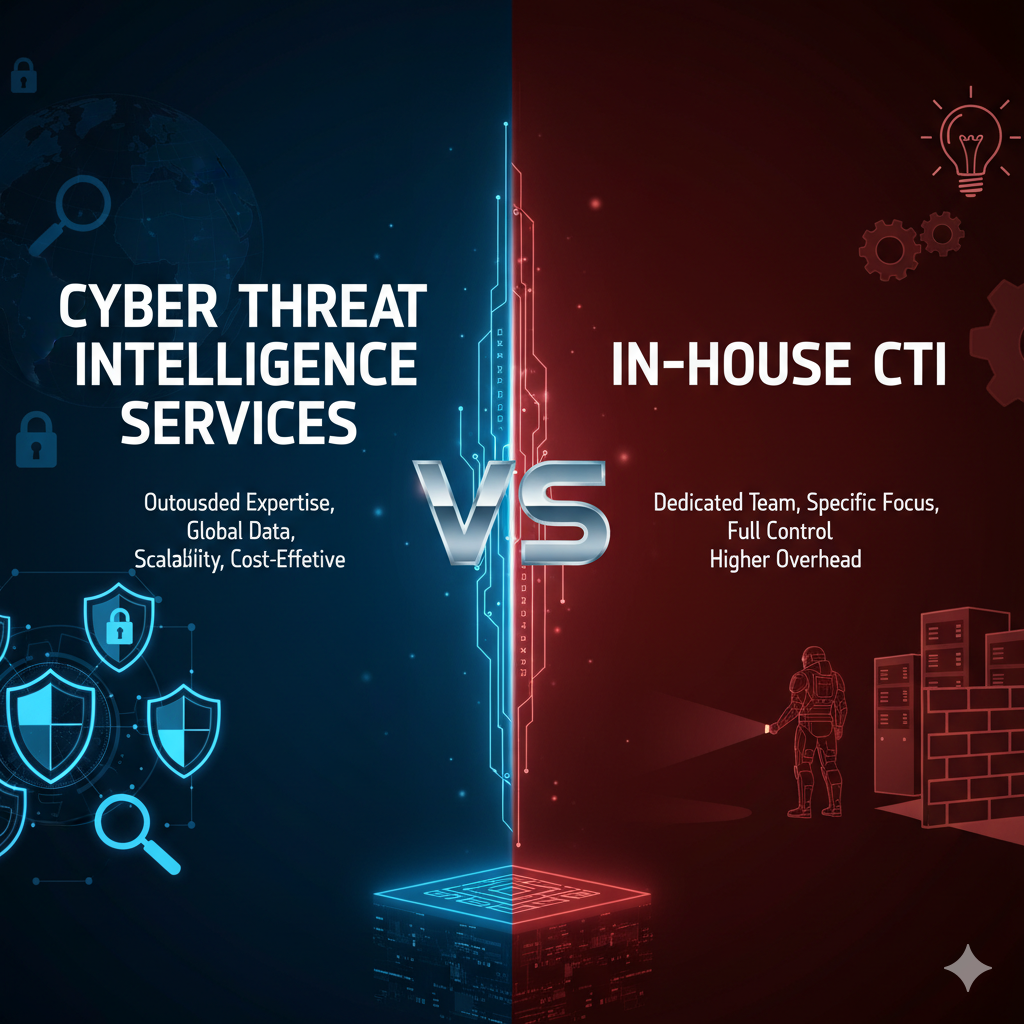
In today's hyper-connected digital landscape, cyber threats evolve at an unprecedented pace, with AI-driven attacks and nation-state actors targeting enterprises relentlessly. Cyber Threat Intelligence (CTI) has emerged as a cornerstone of modern cybersecurity, providing actionable insights into threats, actors, and vulnerabilities to enable proactive defense. Enterprises face a critical decision: invest in building an in-house CTI team or leverage Cyber Threat Intelligence Services from specialized providers. This choice impacts not just security posture but also operational efficiency, costs, and scalability, especially as 2026 projections highlight agentic AI threats, predictive intelligence, and unified platforms demanding advanced capabilities. The business stakes are immense. A 2025 Vulcan Cyber study revealed 74% of organizations maintain some in-house CTI, yet many struggle with resource constraints, alert fatigue, and outdated intel, leading to prolonged breach detection times averaging 277 days. Outsourced CTI services, conversely, offer access to global threat feeds, expert analysts, and AI-augmented tools, reducing costs by 40-60% compared to in-house builds while enhancing threat visibility by up to 90%. For enterprises in dynamic sectors like finance, healthcare, and manufacturing, the wrong choice risks millions in downtime, regulatory fines, and reputational damage.Systems, we provide cutting-edge AI, Cloud, and DevOps solutions for enterprise digital transformation, including tailored Cyber Threat Intelligence Services that empower organizations with proactive intelligence to anticipate, detect, and respond to cyber threats with precision. This comprehensive guide dissects Cyber Threat Intelligence Services vs In-House CTI, drawing on 2026 trends, cost analyses, case studies, and hybrid models to guide your decision. Whether scaling for AI-powered ransomware or zero-trust architectures, understanding these models ensures resilience in an era where cybercrime costs are forecasted to exceed $10 trillion annually.
What is Cyber Threat Intelligence?
Cyber Threat Intelligence (CTI) encompasses evidence-based knowledge about cyber threats, including threat actors, tactics, techniques, and procedures (TTPs), derived from diverse sources like open-source intel, dark web monitoring, and internal logs. It transforms raw data into actionable insights for threat detection, prevention, and response.
Core Components of CTI
CTI frameworks like MITRE ATT&CK structure intelligence across key pillars:
- Data Collection: Aggregates from threat feeds, SIEM logs, and OSINT.
- Analysis and Contextualization: Evaluates relevance to specific environments.
- Dissemination: Delivers reports, alerts, and integrations for SOC teams.
Types of CTI include strategic (high-level trends), tactical (TTPs), operational (campaigns), and technical (IOCs like hashes). In 2026, predictive CTI powered by AI fusion of internal/external data will dominate, enabling preemptive defenses.
In-House CTI: Building Your Own Team
Building an in-house CTI capability offers deep customization but demands significant investment. Around 74% of enterprises maintain dedicated teams for tailored intel aligned to business needs.
Advantages of In-House CTI
- Custom Alignment: Intelligence directly maps to internal assets and priorities.
- Data Control: Full ownership of sensitive internal logs and proprietary analysis.
- Cultural Integration: Seamless dissemination across security layers.
Key Challenges
However, in-house models face scalability hurdles:
- Talent Shortages: Skills gaps in OT/IT, CTI, and AI analysis persist.
- High Turnover: Analysts often view roles as easy jobs, leading to complacency.
- Tool Overload: Managing platforms without full ROI realization.
At Informatix.Systems, we provide cutting-edge AI, Cloud, and DevOps solutions for enterprise digital transformation, helping bridge these gaps with hybrid CTI integrations.
Cyber Threat Intelligence Services Explained
Cyber Threat Intelligence Services, or managed CTI, involve outsourcing to MSSPs like CrowdStrike or Recorded Future, delivering expert-driven insights via subscriptions. Providers process billions of data points daily for real-time, tailored alerts.
How Managed CTI Works
Services follow a lifecycle:
- Threat ingestion from global feeds.
- AI-enriched analysis.
- Customized reporting and API integrations.
Top platforms like Stellar Cyber and IBM X-Force offer unified intel with endpoint correlation.
Primary Benefits
- Expert Access: 24/7 teams with APT profiling and zero-day monitoring.
- Scalability: Handles volume spikes without hiring.
- Cost Predictability: Monthly fees vs. CapEx-heavy builds.
Cost Comparison: Services vs In-House
In-house CTI incurs steep upfront and ongoing costs, often 2-3x higher than services. Small firms face $60K-$80K annual salaries per analyst, plus $10K+ in tools.
Outsourcing yields 40-60% savings by eliminating HR, real estate, and tech overheads. For medium enterprises, managed models cut SOC costs by 50%.
Pros and Cons of Each Model
In-House CTI Pros and Cons
Pros:
Cons:
- Resource Drain: High costs and scalability issues.
- Expertise gaps in emerging threats like agentic AI.
CTI Services Pros and Cons
Pros:
Cons:
2026 CTI Trends Impacting the Decision
2026 forecasts emphasize AI-augmented CTI, with 36% of enterprises fusing internal/external data for predictive modeling. Key shifts:
- Agentic AI Attacks/Defenses: Automates vulnerability discovery.
- Unified Platforms: XDR integrations reduce silos.
- Regulatory Push: Zero-trust mandates demand mature intel.
Services excel here, offering machine-speed analysis amid budget tightening.
Real-World Case Studies
Financial Sector: A bank using managed CTI blocked phishing waves, reducing incidents by 90% via employee training and filters. Healthcare Ransomware Mitigation: Outsourced intel profiled actors, preventing encryption and enabling quick recovery. Energy Infrastructure: CTI enhanced vulnerability management, averting disruptions. Banking leaders with services achieved 90% threat visibility. Informatix.Systems delivers similar outcomes through our Cyber Threat Intelligence Services.
The Hybrid CTI Model: Best of Both Worlds
Hybrid approaches, outsourcing heavy lifting while retaining in-house distribution, emerge as optimal, with integration boosting resilience by 81% per AHP studies. Benefits:
When to Choose In-House CTI
Opt for in-house if:
- Handling highly regulated, proprietary data (e.g., defense).
- Long-term investment justifies talent building.
- Core competency in security research.
When to Choose CTI Services
Services suit:
- SMBs/Mid-Market: Limited budgets/resources.
- Rapid scaling needs amid 2026 threats.
- Focus on core business.
Top CTI Providers for 2026
Implementing CTI: Steps for Success
- Assess Needs: Define intel requirements.
- Select Model: Hybrid for most.
- Integrate Tools: API/SIEM links.
- Train Teams: On intel consumption.
- Measure ROI: Via MTTD/MTTR metrics.
At Informatix.Systems, we provide cutting-edge AI, Cloud, and DevOps solutions for enterprise digital transformation, streamlining CTI implementation. Cyber Threat Intelligence Services often outperform in-house CTI in cost, scalability, and access to cutting-edge intel, especially for 2026's AI-driven threats, yet hybrids maximize resilience. Enterprises save 40-60%, gain predictive edges, and focus on innovation. Choose based on maturity, budget, and risks. Secure your future with Informatix.Systems' Cyber Threat Intelligence Services. Contact us today at https://informatix.systems for a free consultation and tailored CTI roadmap.
FAQs
What is the average cost of in-house CTI vs services?
In-house runs $150K-$250K annually for mid-sized teams; services cost $100-$200/user/month, saving 40-60%.
Can small businesses afford CTI services?
Yes, predictable pricing makes managed CTI accessible, outperforming under-resourced in-house efforts.
What are the 2026 CTI trends?
AI prediction, data fusion, and workflow integrations dominate.
Is hybrid CTI the future?
Absolutely, 81% resilience boost via integrated approaches.
How does CTI improve breach response?
Reduces detection time via proactive IOCs and TTPs.
Do CTI services handle custom threats?
Yes, with tailored feeds and analyst support.
What's the ROI of outsourced CTI?
Up to 90% visibility gains and 50% SOC savings.
How to evaluate CTI providers?
Check data volume, integrations, and case studies like Recorded Future.
No posts found
Write a review