- 3/8, North Pirerbag
- 60 Feet Main Road
- Mirpur, Dhaka 1216
- +880-967-8247365
- support@informatix.systems

Cyber Threat Intelligence Services vs Threat Feeds
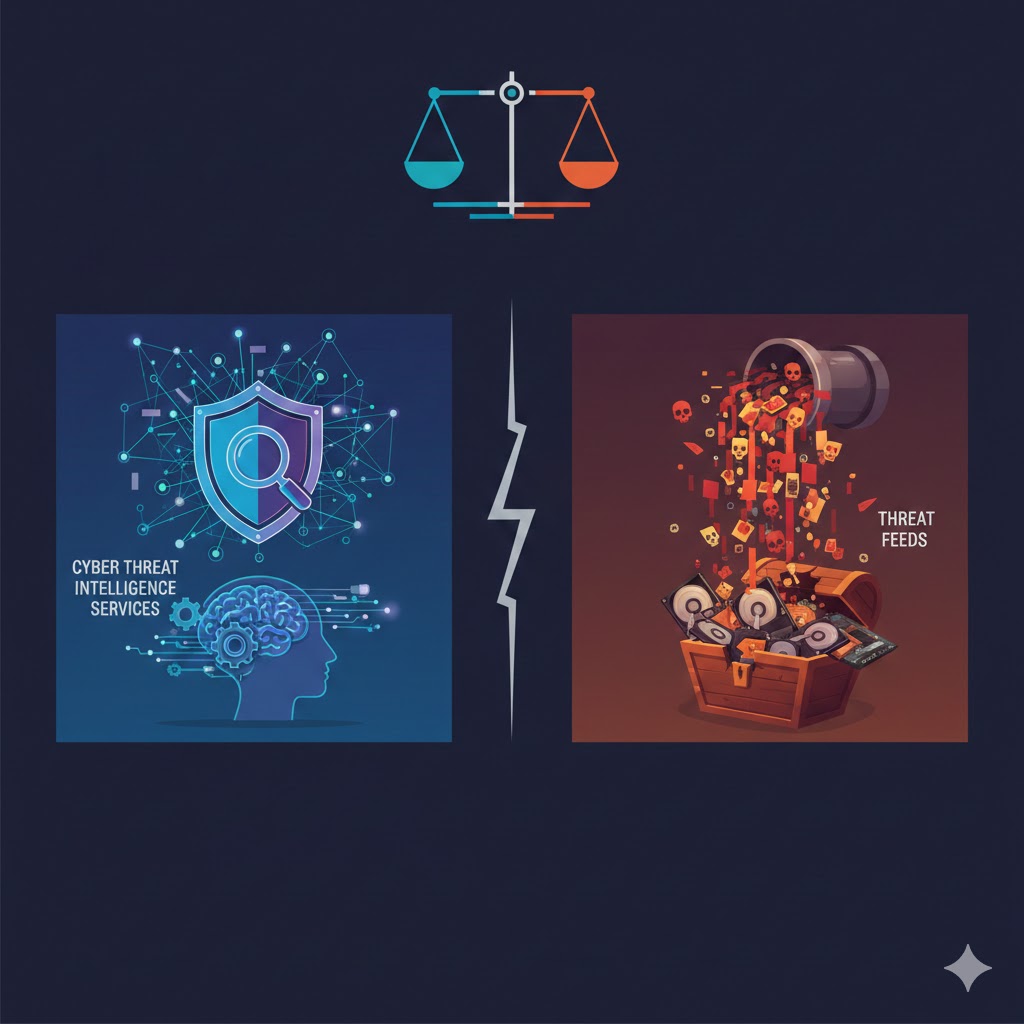
In the rapidly evolving cybersecurity landscape of 2026, enterprises face increasingly sophisticated threats from nation-state actors, ransomware groups, and AI-powered attacks. Cyber Threat Intelligence Services (CTI Services) and Threat Feeds represent two core approaches to staying ahead, but they differ fundamentally in depth, context, and actionable value. While Threat Feeds deliver raw streams of indicators like malicious IPs and hashes, CTI Services provide analyzed insights, adversary profiling, and tailored strategies that integrate seamlessly into security operations. The business stakes are immense: the global Cyber Threat Intelligence market is projected to reach USD 32.9 billion by 2035, growing at 13.5% CAGR, driven by AI analytics and regulatory demands. Enterprises using CTI Services reduce incident response times by up to 58%, minimizing downtime and financial losses that average millions per breach. Threat Feeds, though cost-effective for basic blocking, often overwhelm SOC teams with unfiltered data, leading to alert fatigue and missed threats. At Informatix.Systems, we provide cutting-edge AI, Cloud, and DevOps solutions for enterprise digital transformation, helping organizations transition from reactive feeds to proactive CTI Services. This comprehensive guide dissects the differences, benefits, implementation strategies, and 2026 trends, empowering CISOs to make informed decisions. Whether scaling defenses against APTs or optimizing budgets, understanding Cyber Threat Intelligence Services vs Threat Feeds is crucial for resilient operations.
Defining Cyber Threat Intelligence Services
Cyber Threat Intelligence Services encompass the full lifecycle of collecting, analyzing, and disseminating threat data into strategic, actionable insights for enterprises.
Core Components of CTI Services
CTI Services integrates multiple intelligence types: strategic (high-level trends for executives), tactical (TTPs for SOC teams), operational (campaign tracking), and technical (IOCs with context). Providers like CrowdStrike and Mandiant deliver enriched data via platforms that automate investigations and prioritize risks.
- Data Collection: Aggregates from dark web, endpoints, and global sensors.
- Analysis: AI-driven enrichment with attribution and impact scoring.
- Delivery: Custom dashboards, reports, and API integrations.
Evolution in 2026
By 2026, CTI Services will emphasize AI-powered predictive analytics, reducing false positives by 50% and enabling proactive hunting. At Informatix.Systems, we provide cutting-edge AI, Cloud, and DevOps solutions for enterprise digital transformation, embedding CTI into hybrid environments.
Understanding Threat Feeds
Threat Feeds are automated streams of raw threat indicators updated in real-time or batches, focusing on volume over context.
Types of Threat Feeds
Real-time Feeds deliver instant IOCs like malicious domains; static feeds update hourly/daily for stability. Open-source options like CISA AIS coexist with commercial feeds from Recorded Future.
| Feed Type | Update Frequency | Examples | Best For |
|---|---|---|---|
| Real-time | Continuous | CrowdStrike Falcon | APT Defense |
| Static | Hourly/Daily | AlienVault OTX | SMB Budgets |
| Commercial | Enriched | FireEye | Enterprise Scale |
Data Included in Feeds
Feeds provide IPs, hashes, URLs, and email indicators but lack adversary motivation or response guidance.
Key Differences: Services vs Feeds
CTI Services transform raw data into intelligence; Threat Feeds supply the raw data.
Contextual Depth
Services offer TTP analysis and actor profiling; feeds deliver isolated IOCs, requiring in-house expertise.
Integration and Scalability
Services plug into SIEM/SOAR with automation; feeds demand manual normalization.
Benefits of Cyber Threat Intelligence Services
CTI Services empower proactive defense, outperforming feeds in ROI.
Enhanced Detection and Response
Organizations block threats pre-breach, with tailored IOCs cutting response times. A financial firm using Mandiant CTI thwarted phishing, reducing incidents by 70%.
Strategic Decision-Making
Executives gain threat landscape overviews for budgeting and compliance. Market growth to $37B by 2032 underscores demand. At Informatix.Systems, we provide cutting-edge AI, Cloud, and DevOps solutions for enterprise digital transformation.
Limitations of Threat Feeds
Despite accessibility, feeds fall short for complex threats.
Data Overload and False Positives
Unfiltered IOCs flood SIEMs, overwhelming analysts.
Integration Challenges
Poor compatibility increases costs; quality varies widely.
Market Trends for 2026
AI integration and cloud-native CTI dominate, with 15% CAGR projected.
Top Providers in 2026
CrowdStrike, Palo Alto, and Mandiant lead with AI features.
| Provider | Strengths | 2026 Focus |
|---|---|---|
| CrowdStrike | Real-time feeds + analysis | APT Hunting |
| Mandiant | Incident response | AI Attribution |
| Recorded Future | Predictive intel | Cloud Integration |
Cost Comparison
Feeds cost $10K–$50K/year; Services $100K+ but yield 3x ROI via reduced breaches.
Implementation Best Practices
For CTI Services
Align with intel requirements; centralize via platforms.
For Threat Feeds
Filter for relevance; use AI deduplication. At Informatix.Systems, we provide cutting-edge AI, Cloud, and DevOps solutions for enterprise digital transformation.
Real-World Case Studies
Healthcare provider using CTI mitigated ransomware; energy firm protected infrastructure.
Retail Supply Chain: Early CTI detection saved millions.
Choosing the Right Solution
Evaluate based on industry, scale, and budget. Hybrid approaches combine feeds with services.
Future Outlook: 2026 and Beyond
AI, zero-trust, and regulations drive CTI adoption over feeds. Cyber Threat Intelligence Services surpass Threat Feeds by delivering context, automation, and ROI for 2026 threats. Enterprises prioritizing analyzed insights over raw data achieve resilient postures. Partner with Informatix.Systems today for tailored CTI implementations. Contact us at https://informatix.systems to transform your security.
FAQs
What are Cyber Threat Intelligence Services?
Analyzed threat data with context for proactive defense.
How do Threat Feeds differ from CTI Services?
Feeds provide raw IOCs; services add analysis and TTPs.
What is the market size for CTI in 2026?
Can Threat Feeds replace CTI Services?
No, due to a lack of context and overload risks.
Top benefits of CTI Services?
Faster response, better decisions, reduced costs.
Best practices for feed integration?
Filter data, use AI, align with SIEM.
Providers for 2026 enterprises?
CrowdStrike, Mandiant, Palo Alto.
ROI of CTI Services?
Up to 58% faster MTTR; 3x security savings.
No posts found
Write a review