- 3/8, North Pirerbag
- 60 Feet Main Road
- Mirpur, Dhaka 1216
- +880-967-8247365
- support@informatix.systems

Emerging AI-Driven Cyber Threat Intelligence Trends Strategies 2025
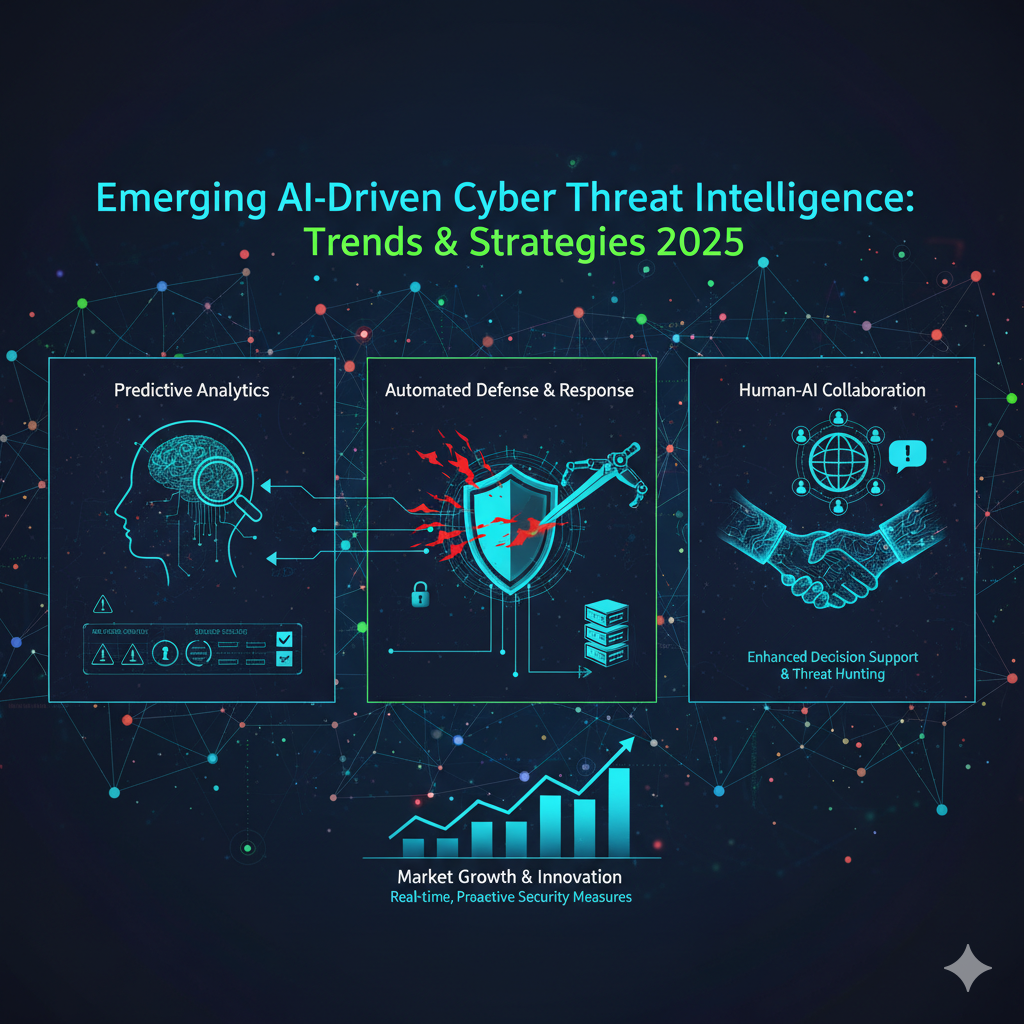
As the world transitions deeper into digital-first operations, the cybersecurity battlefield has become more dynamic than ever. The rapid evolution of threats, ransomware-as-a-service, deepfake-driven intrusions, and AI-assisted malware has challenged conventional defense strategies. By 2025, AI-driven Cyber Threat Intelligence (CTI) will be the center of gravity for enterprise security operations, transforming static defense systems into proactive, predictive, and autonomous deterrent frameworks. The traditional detect and respond model can no longer keep up with multi-vector attacks that adapt faster than human analysts can process. Artificial Intelligence and Machine Learning (ML) are reshaping this narrative. AI analyzes billions of interactions, correlates anomalies in real time, and forecasts emerging cyber-attacks with unmatched accuracy. Predictive threat modeling, automated data enrichment, and continuous learning have brought about a revolution in cyber defense that is not just reactive but intelligently preemptive. Modern enterprises recognize that success in 2025’s digital ecosystem depends on accurate, automated, and contextualized threat intelligence. CTI is now infused with AI-driven analytics that empower Security Operations Centers (SOCs) to evolve into autonomous security ecosystems, at Informatix.Systems, we provide cutting-edge AI, Cloud, and DevOps solutions for enterprise digital transformation. Our AI-driven cyber threat intelligence platforms leverage predictive analytics, real-time automation, and intelligent orchestration to give organizations the foresight to act before threats materialize. This article delves into the emerging AI-driven cyber threat intelligence trends and strategies shaping cybersecurity in 2025, outlining how enterprises are harnessing innovation to stay ahead of adversaries in an automation-dominated world.
Understanding AI-Driven Cyber Threat Intelligence
What Is Cyber Threat Intelligence (CTI)?
CTI is the process of collecting, analyzing, and applying information about potential or ongoing cyber threats to enhance preparedness and defense. AI-driven CTI merges advanced analytics with AI’s cognitive capabilities, allowing systems to identify attack vectors, threat actor behaviors, and vulnerabilities in minutes rather than days.
Core Functions Include:
- Continuous data collection from global threat sources.
- Behavior-based anomaly detection using ML algorithms.
- Predictive modeling for proactive risk mitigation.
- Automated incident response and remediation workflows.
AI-driven CTI transforms raw data into actionable insights, delivering the agility modern organizations need in 2025’s threat landscape.
Why Cyber Threat Intelligence Needs AI
The complexity of global cyber threats now exceeds human analytical capacity. With thousands of data feeds, indicators of compromise (IoCs), and threat vectors emerging daily, AI provides the intelligence necessary for strategic defense.
AI’s Advantages in CTI:
- Speed: Real-time classification of millions of data points.
- Scalability: Handles high-volume, multi-cloud threat monitoring.
- Accuracy: Identifies patterns invisible to traditional systems.
- Adaptability: Learns and evolves autonomously based on threat shifts.
- Predictive Foresight: Anticipates attack methodologies before execution.
Informatix.Systems integrates these benefits into its solutions, delivering intelligence infrastructures that detect, learn, respond, and adapt without human delay.
Top AI-Driven Cyber Threat Intelligence Trends for 2025
Predictive Threat Intelligence
AI uses predictive analytics and deep learning to forecast emerging attack vectors, correlating data from historical intrusions and global telemetry.
Autonomous SOCs (Security Operations Centers)
Next-generation SOCs evolve into self-optimizing systems, powered by algorithms that automate alert triage, incident analysis, and countermeasure deployment.
Explainable AI (XAI)
Ensures transparency and accountability in AI-led cybersecurity decisions—critical for compliance and strategic trust.
Cloud-Native Threat Intelligence
AI integrates seamlessly into multi-cloud infrastructures, providing unified visibility across public, private, and hybrid clouds.
AI-Driven Threat Attribution
AI classifies threat actors, motives, and attack patterns with precision, accelerating forensic analytics. These trends highlight how AI transcends traditional security boundaries, creating self-defensive intelligence ecosystems.
Machine Learning Models Powering AI CTI
Supervised Learning
Analyzes labeled datasets of known threats to identify recurring anomaly patterns.
Example: Detecting phishing campaigns or credential misuse based on prior attack data.
Unsupervised Learning
Finds hidden relationships in unknown data to reveal new threats.
Example: Identifying zero-day exploits or advanced persistent threats (APTs).
Deep Neural Networks (DNNs)
Process massive volumes of structured and unstructured threat data, correlating patterns across cloud and endpoint ecosystems.
Reinforcement Learning (RL)
AI agents autonomously optimize defense policies by receiving feedback from simulated and real-time security outcomes. The fusion of these models allows SOCs powered by Informatix.Systems to predict complex attack behaviors before exploitation, ensuring zero-trust, real-time action.
AI and the Rise of Predictive SOC Automation
Predictive SOC Explained
A predictive SOC is an Artificial Intelligence-driven operations center that proactively identifies potential disruptions using real-time analytics and machine learning.
Core Capabilities of Predictive SOCs:
- Continuous behavioral monitoring and learning.
- Real-time risk prioritization.
- AI-driven playbooks for automated mitigation.
- Dynamic incident correlation for faster response.
At Informatix.Systems, our predictive SOC frameworks leverage AI and DevSecOps convergence to drive automation, optimize resource usage, and mitigate threats before escalation.
Integration of AI with Cloud and DevOps
AI-Cloud Convergence
Cloud-native security architectures host AI algorithms capable of elastic scaling across environments, enabling threat intelligence continuity even in distributed systems.
DevOps Security (DevSecOps)
Integration of CTI into DevOps pipelines ensures security from code to deployment.
AI Applications Include:
- Auto remediation during software build processes.
- ML-driven vulnerability scanning during CI/CD stages.
- Continuous compliance auditing with predictive analytics.
At Informatix.Systems, we embed AI security frameworks directly into DevSecOps workflows to ensure security-by-design across agile enterprise environments.
Federated AI and Collective Threat Intelligence
Federated AI enables organizations to share intelligence collaboratively without exposing raw data. This is a monumental breakthrough for cross-enterprise and cross-border intelligence synchronization.
Benefits of Federated AI:
- Preserves privacy and compliance with GDPR and ISO standards.
- Enhances model accuracy through shared learning.
- Strengthens collective defense capabilities.
By 2025, global collaboration in AI-fueled CTI networks ensures mutual benefit without data exposure risks. Informatix.Systems delivers federated solutions that align secure collaboration with enterprise-level independence.
Ethical and Regulatory Implications of AI in CTI
Ethical Concerns
Organizations must maintain transparency in AI decision-making to preserve trust and legal compliance.
Key AI Governance Guidelines for 2025:
- Explainability of AI decisions.
- Bias mitigation in predictive algorithms.
- Adherence to international cybersecurity ethics frameworks (ISO 42001, NIST AI RMF).
- Continuous human oversight in critical AI operations.
Security must not only be intelligent but also accountable. Informatix.Systems incorporate explainability and auditability into every AI model deployed within enterprise ecosystems.
Challenges in Implementing AI-Driven CTI
- Data Overload: Enterprises process massive datasets needing efficient labeling and normalization.
- False Positives: Excessive alerts caused by incomplete contextual data.
- AI Bias: Uneven training data can distort AI decisions.
- Interoperability: Integrating legacy systems with modern AI-driven platforms.
- Resource Limitations: Scaling AI compute resources across hybrid infrastructures.
At Informatix.Systems, our cloud-optimized AI infrastructure solves these challenges through adaptive modeling, real-time data filtering, and federated orchestration frameworks.
Key Performance Indicators for AI Cyber Intelligence
| Metric | Description | Importance |
|---|---|---|
| Detection Accuracy (DA%) | Precision of AI in identifying true threats. | Ensures reliability of automation. |
| Mean Time to Detect (MTTD) | Average identification time for cyber incidents. | Measures operational efficiency. |
| False Positive Reduction (FPR) | Frequency of irrelevant alerts filtered out. | Reduces SOC fatigue. |
| Automation Coverage Rate (ACR) | Percentage of workflows executed autonomously. | Defines AI maturity. |
| ROI on Security Integration | Quantifies risk reduction and value creation. | Validates investment success. |
These indicators ensure measurable, performance-driven security outcomes within AI CTI ecosystems.
Future of AI Cyber Threat Intelligence Beyond 2025
Quantum-Predictive AI
Post-quantum AI analytics capable of forecasting quantum-computing attacks.
Cognitive AI Collaboration
Inter-AI communication allows autonomous decision coordination across industries.
Self-Healing Cyber Networks
AI-driven adaptive remediation eliminates human reliance during breach recovery.
Zero-Trust AI Governance
AI-enforced policies validate every connection, user, and transaction continuously.
Universal Federated Intelligence Platforms
Global ecosystem enabling shared model collaborations for real-time global threat prevention. AI will evolve from reactive assistance to fully autonomous protection ecosystems, enabling proactive cyber stability globally.
Informatix.Systems: Innovating AI-Powered Threat Intelligence
At Informatix.Systems, we provide cutting-edge AI, Cloud, and DevOps solutions for enterprise digital transformation. Our AI-Driven Threat Intelligence Platforms are engineered to deliver real-time visibility, adaptive automation, and seamless multi-cloud cybersecurity orchestration.
Key Solutions Include:
- Predictive AI and ML Modeling for Threat Detection
- Autonomous SOC Optimization
- Cloud-Native AI Security Integration
- DevSecOps-Powered Cyber Defense Architectures
- Ethical AI Governance Frameworks
We empower enterprises to lead in innovation, resilience, and regulatory compliance across global markets. By 2025, the strategic advantage in cybersecurity hinges on intelligence driven by AI, automation, and collaboration. AI-driven Cyber Threat Intelligence enables organizations to transition from reaction-oriented security to predictive and autonomous cyber ecosystems capable of anticipating and mitigating threats in real time. At Informatix.Systems, we drive this evolution with AI, Cloud, and DevOps-driven security solutions that redefine cyber resilience and decision-making for enterprises worldwide. Predict faster. Defend smarter. Evolve continuously with Informatix.Systems.
FAQ
What is AI-driven Cyber Threat Intelligence?
AI-driven CTI uses machine learning and automation to predict, identify, and mitigate threats before they cause harm.
How does AI improve cybersecurity accuracy?
AI analyzes large datasets with adaptive learning to reduce false positives and enhance detection speed.
Can AI-driven CTI integrate with cloud environments?
Yes, cloud-native AI integration ensures continuous monitoring and analysis across hybrid infrastructures.
What is Explainable AI (XAI)?
XAI enhances transparency by allowing humans to understand why AI systems make certain cybersecurity decisions.
What industries benefit most from AI-driven CTI?
Finance, healthcare, government, and manufacturing sectors with complex digital infrastructures.
How does Informatix.Systems implement AI in security?
Through predictive analytics, DevSecOps integration, and federated threat intelligence systems.
What challenges exist in AI cybersecurity adoption?
Interoperability, data bias, and compliance issues are among the main hurdles, alleviated with adaptive AI governance.
What will cybersecurity look like beyond 2025?
Autonomous, predictive, self-healing systems that integrate globally through federated AI intelligence platforms.
No posts found
Write a review