- 3/8, North Pirerbag
- 60 Feet Main Road
- Mirpur, Dhaka 1216
- +880-967-8247365
- support@informatix.systems

Emerging CTI and SOC Automation Strategies Strategies 2029
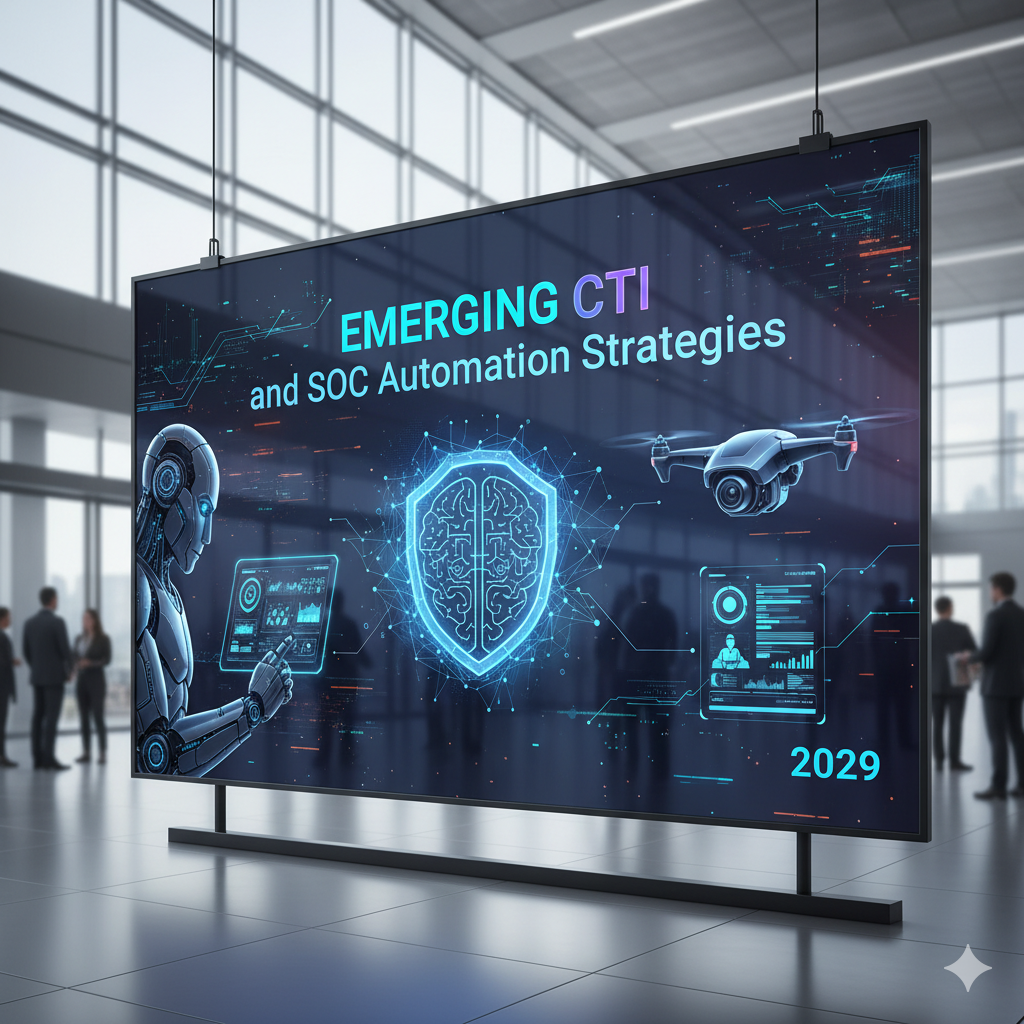
In the high-speed world of digital business transformation, cyber threats move faster than human response. Security teams face thousands of daily alerts, fragmented visibility, and an overwhelming volume of threat data across hybrid and multi-cloud environments. The traditional Security Operations Center (SOC) model heavily reliant on human analysts and manual incident management, is no longer sustainable. By 2029, enterprise security will be driven by the convergence of Cyber Threat Intelligence (CTI) and SOC automation strategies, forming an ecosystem capable of detecting, analyzing, and responding to incidents autonomously. The integration of Artificial Intelligence (AI), Machine Learning (ML), and automation frameworks has ushered in a new era called the Autonomous SOC, a model that predicts and mitigates threats at machine speed. This shift is not just technological, it’s strategic. A unified CTI and SOC automation framework provides enterprises with real-time situational awareness, predictive analytics, and orchestrated defense mechanisms that reduce Mean Time to Detect (MTTD) and Mean Time to Respond (MTTR) drastically. At Informatix.Systems, we provide cutting-edge AI, Cloud, and DevOps solutions for enterprise digital transformation. Our predictive SOC automation and CTI platforms enable organizations to anticipate threats before they escalate, ensuring operational continuity and compliance. This article dives deep into Emerging CTI and SOC Automation Strategies for 2029, examining how intelligent automation, predictive analytics, and secure cloud orchestration redefine enterprise resilience in a hyperconnected world.
Understanding CTI and SOC Automation
What Is Cyber Threat Intelligence (CTI)?
CTI is the process of collecting and analyzing data about existing and potential threats to inform security decisions. It enables prediction and prioritization through contextual awareness and actionable insights.
Key Components of CTI:
- Threat data aggregation from global sources
- Attack attribution and adversary profiling
- Predictive modeling for proactive defense
- Integration with SOC workflows for real-time intelligence
What Is SOC Automation?
SOC automation refers to using AI, ML, and Security Orchestration, Automation, and Response (SOAR) technologies to automate repetitive SOC operations like incident triage, threat correlation, and remediation.
Core Objectives:
- Reduce analyst fatigue and false positives
- Accelerate incident detection and containment
- Enable 24/7 real-time cyber vigilance
- Empower predictive and adaptive defense mechanisms
Together, CTI and SOC automation form the brain and the nervous system of modern enterprise defense.
Why CTI and SOC Integration Is Critical by 2029
The Explosion of Data and Alerts
Enterprises process billions of logs per day from endpoints, networks, cloud servers, and IoT devices, making human-driven SOCs inefficient.
Sophistication of Adversarial Tactics
Attackers now use AI to evade traditional detection mechanisms, requiring predictive and automated counter-action.
Shortage of Skilled Cybersecurity Professionals
Automation mitigates workforce shortages by offloading repetitive tasks to algorithms.
Business Continuity and Compliance
Integrating CTI into SOC operations ensures consistent compliance with frameworks like NIST, ISO 27001, and GDPR, supporting both operational and legal obligations.
By merging predictive CTI data and autonomous SOC workflows, enterprises gain real-time, context-aware situational awareness for superior defense acceleration.
Architecture of Modern SOC Automation Platforms
Threat Analytics Engine
Processes structured and unstructured data, correlating multiple indicators of compromise (IOCs) detected from networks and threat feeds.
Security Orchestration Layer
Automates communication between devices, platforms, and software for synchronized response across IT ecosystems.
Intelligence Integration Module
Incorporates CTI data, enriching detections with external threat context like adversary Tactics, Techniques, and Procedures (TTPs).
Automation and Playbook System
Pre-configured workflows handle automatic containment, firewall updates, or credential isolation upon detection of anomalies.
Continuous Feedback Loop
The system learns from past incidents, training ML models for better prediction and faster recovery in future incidents.
This loop converts static defense tools into adaptive SOC architectures.
AI and ML at the Core of CTI and SOC Automation
Artificial Intelligence is the engine that powers next-generation SOCs.
Applications of AI and ML in SOC Contexts
- Anomaly Detection: ML identifies subtle deviations from normal operations.
- Behavioral Analytics: AI profiles entities, users, devices, and cloud instances for insider and external threat detection.
- Predictive Threat Modeling: Deep learning predicts attack pathways before they materialize.
- Adaptive Response Learning: Reinforcement algorithms test mitigation tactics and optimize playbooks.
Key Benefits for Enterprises
- Faster Decision-making: Automation executes responses without human delay.
- Fewer False Positives: Behavioral models refine detection accuracy.
- Scalable Resilience: Cloud AI adapts across infrastructures dynamically.
At Informatix.Systems, our AI-integrated CTI and SOC frameworks leverage deep learning and real-time analytics to ensure predictive accuracy and consistent uptime for enterprise security operations.
Emerging CTI Automation Strategies
Federated Learning for Cross-Industry Intelligence
Allows information sharing across industries without violating data privacy. Multiple SOCs can train a global AI model collaboratively.
Predictive Intelligence Pipelines
CTI integrates predictive engines capable of forecasting adversarial intent, allowing preventive rather than reactive operations.
Unified Threat Contextualization
Merges CTI insights with internal telemetry to populate dynamic threat intelligence graphs in real time.
Dark Web Monitoring Integration
Analyzes threat chatter in underground forums and correlates with enterprise vulnerabilities for early alerts.
Cognitive Adversarial Simulation
AI systems run real-world attack simulations to train SOCs against evolving threats autonomously. These strategies combine prediction, collaboration, and learning into automated cyber anticipation frameworks.
SOC Automation Trends Transforming Enterprise Security
Autonomous Detection and Response
AI-driven SOCs automatically isolate affected endpoints and initiate remediation across distributed environments.
Cloud-Native SOC Platforms
Cloud-based SOCs provide infinite scalability and seamless integration with DevOps pipelines to secure CI/CD environments.
SOAR Optimization
Advanced orchestration automates over 70% of incident workflows, freeing analysts for strategic tasks like threat hunting.
Adaptive Cyber Defense
Dynamic AI systems continuously evolve detection rules based on live threat telemetry.
Self-Healing Infrastructure
Integrating sensors and automated controls enables recovery from attacks with minimal human oversight. By 2029, the modern SOC will function as a fully automated, predictive cyber defense organism.
Integrating DevOps with SOC and CTI
DevSecOps Convergence
Embedding CTI insights into development cycles ensures vulnerabilities are mitigated before software deployment.
Continuous Threat Validation
SOC automation validates DevOps environments in real time, ensuring every update remains threat-resistant.
Infrastructure as Code (IaC) Security Automation
CTI intelligence governs IaC deployments, preventing misconfigurations that lead to breaches.
At Informatix.Systems, our DevOps-integrated SOC frameworks ensure agility, security, and continuous monitoring across development ecosystems.
Measuring SOC and CTI Automation Effectiveness
Key Performance Indicators (KPIs):
- Mean Time to Detect (MTTD) and Mean Time to Respond (MTTR)
- Automation Efficiency Rate (AER%)
- Analyst Productivity Index (API)
- Incident Containment Accuracy (ICA%)
- False Positive Reduction Rate (FPR%)
Organizations implementing Informatix.Systems’ intelligence-driven tools report up to 70% operational efficiency improvement in security operations.
Future-Proofing CTI and SOC Automation Beyond 2029
- Quantum-Resistant SOC Frameworks: AI-powered encryption analytics counter next-gen cryptographic attacks.
- Zero-Trust Integrated SOC Models: Continuous verification embedded into all automation pipelines.
- Edge Intelligence Deployment: Autonomous defense at distributed edge points for 5G and IoT.
- Explainable AI (XAI): Ensuring transparency in SOC decision-making for compliance auditing.
- Autonomous Threat Simulation Agents: AI adversaries continuously stress-test enterprise defenses.
These advances signal the evolution toward self-optimizing, context-aware SOC ecosystems.
Informatix.Systems: Powering the Future of Autonomous Cyber Defense
At Informatix.Systems, we provide cutting-edge AI, Cloud, and DevOps solutions for enterprise digital transformation. Our SOC and CTI automation architectures combine predictive intelligence, cloud-native integration, and cognitive analytics to redefine enterprise security.
Our Expertise Includes:
- AI-powered threat detection and orchestration platforms
- Cloud-hosted SOAR integrations
- Predictive CTI automation pipelines
- DevSecOps-ready continuous security infrastructure
We help global enterprises transition to AI-driven, adaptive intelligence SOCs that secure operations faster and smarter. Emerging CTI and SOC automation strategies in 2029 redefine cybersecurity as a predictive, intelligent ecosystem. AI, automation, and federation are transforming SOC operations from manual firefighting into proactive threat anticipation. By integrating advanced CTI insights, autonomous playbooks, and cloud intelligence pipelines, enterprises are achieving unmatched resilience, accuracy, and scalability. At Informatix.Systems, we believe that future-ready security demands intelligence that learns, automates, and evolves. Strengthen your organization’s cybersecurity posture, adopt AI-powered CTI and SOC automation today for a safer tomorrow. Protect proactively. Automate intelligently. Evolve continuously, with Informatix.Systems.
FAQs
What is SOC automation?
SOC automation uses AI and orchestration technologies to manage repetitive security tasks, enabling faster detection and response.
How does CTI enhance SOC efficiency?
CTI provides external threat intelligence that enriches SOC alerts with context, improving accuracy and prioritization.
What tools are used for SOC automation?
Key tools include Security Information and Event Management (SIEM), SOAR systems, and AI-powered analytics suites.
What benefits do AI and ML bring to SOC environments?
They enhance scalability, reduce false positives, predict attacks, and streamline remediation through adaptive playbooks.
Can small enterprises implement SOC automation affordably?
Yes. Cloud-based AI SOC-as-a-Service offerings by Informatix.Systems make advanced automation available to mid-sized organizations.
What KPIs measure CTI and SOC success?
MTTD, MTTR, False Positive Rate, and Automation Efficiency are key benchmarking indicators.
What role will AI play in SOCs of 2029?
AI will fully automate correlation, prediction, and response, transforming SOCs into autonomous cyber defense ecosystems.
How does Informatix.Systems help enterprises achieve SOC automation?
We design AI-driven CTI ecosystems that integrate machine learning, cloud automation, and continuous DevOps monitoring for predictive security transformation.
No posts found
Write a review