- 3/8, North Pirerbag
- 60 Feet Main Road
- Mirpur, Dhaka 1216
- +880-967-8247365
- support@informatix.systems

Emerging Future of CTI Automation Strategies 2027
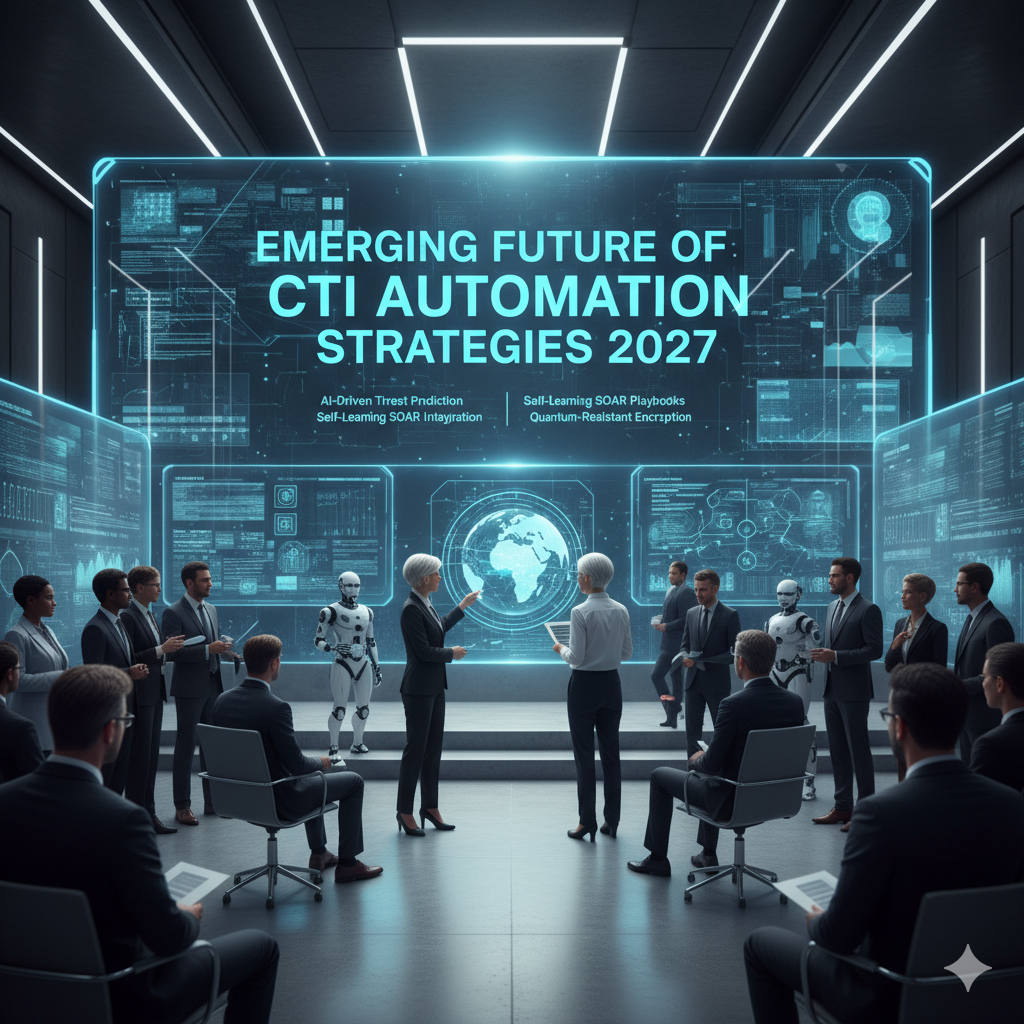
The cybersecurity landscape is undergoing a seismic transformation as automation, artificial intelligence, and predictive analytics converge to redefine how enterprises respond to threats. By 2027, the evolution of Cyber Threat Intelligence (CTI) automation will no longer be a futuristic concept; it will be a business-critical reality driving proactive defense, faster incident response, and autonomous decision-making. Informatix.Systems research indicates that the global appetite for CTI-driven automation is expanding as organizations battle sophisticated threat actors leveraging AI-enabled cyberattacks. Traditional manual intelligence processing no longer keeps pace with the velocity, volume, and variety of emerging threats. Enterprises now need smart, adaptive solutions that scale rapidly, share intelligence dynamically, and integrate securely across ecosystems, at Informatix.Systems, we provide cutting-edge AI, Cloud, and DevOps solutions for enterprise digital transformation, empowering organizations to build resilient, automated, and intelligent CTI operations. As we look toward 2027, CTI automation will extend beyond reactive analytics toward an era of autonomous, context-aware threat mitigation blended seamlessly with enterprise operations. This in-depth guide explores the future of CTI automation strategies by 2027, highlighting trends, frameworks, next-gen architectures, predictive intelligence methods, and ethical dimensions that will shape the global cybersecurity fabric.
The Evolution of CTI Automation
From Reactive to Predictive Intelligence
Over the past decade, CTI has transitioned from collecting static indicators of compromise (IOCs) to leveraging predictive analytics that anticipate attack vectors before they manifest. With AI-driven systems, automation now evolves from automation of action to automation of reasoning.
Drivers of the CTI Evolution
- Escalating frequency and complexity of cyber threats
- Cloud-native infrastructures demand real-time intelligence sharing
- AI advancements enabling contextual pattern detection
- Integration across Security Operations Centers (SOCs), SIEMs, and threat feeds
By 2027, CTI systems will unify predictive analytics, knowledge graphs, and large language models to deliver tactical, operational, and strategic intelligence autonomously.
Core Components of Future CTI Automation
Next-Generation Data Ingestion
Modern CTI depends on heterogeneous data sources:
- OSINT (Open Source Intelligence)
- Dark web monitoring
- Security telemetry from IoT, edge, and cloud devices
- Behavioral analytics from user activity and endpoint detection
Automated normalization, validation, and enrichment of these sources allow intelligent systems to self-learn and prioritize credible intelligence.
Threat Enrichment via AI
AI models enhance raw data with attributes like threat actor profiling, context scoring, and campaign correlation. Techniques like:
- Deep learning for pattern recognition
- NLP for multilingual data interpretation
- Clustering algorithms for threat correlation
At Informatix.Systems, our AI-driven data pipelines strengthen CTI workflows to deliver actionable insights with minimal human intervention.
Predictive Threat Modeling and Simulation
Understanding Predictive CTI
Predictive CTI anticipates threats by modeling adversarial behavior, attack surface changes, and vulnerability life cycles. By 2027, CTI platforms will leverage digital twin simulations of enterprise networks to forecast and neutralize potential incidents.
Techniques Powering Predictive CTI
- Reinforcement learning to enhance defense decision-making
- Probabilistic scenarios for risk prioritization
- Adversarial neural networks simulating threat evolution
Predictive CTI reduces false positives and enhances preparedness through continuous model learning.
Automation Frameworks and Integration Models
The Rise of SOAR and XDR Convergence
Security Orchestration, Automation, and Response (SOAR) tools now integrate seamlessly with eXtended Detection and Response (XDR) ecosystems to accelerate reaction time.
Key Elements:
- Automated policy enforcement
- Cross-system workflow orchestration
- Unified dashboards for real-time intelligence
Unified CTI Integration Pipelines
At Informatix.Systems, our integration models fuse SIEM data streams, threat feeds, and automated workflows using APIs, microservices, and containerized architectures.
Cloud-Native CTI: Building for Scale and Resilience
Why Cloud Matters in CTI Automation
By 2027, 90% of CTI operations will be cloud-native, enabling scalability, self-healing, and distributed correlation across geographies.
Benefits:
- Elastic compute for high-volume threat processing
- Globally replicated intelligence sharing
- Cost-efficient automation with serverless functions
Informatix.Systems Cloud Advantage
Our cloud-first platforms deploy CTI automation pipelines using Kubernetes, multi-cloud orchestration, and predictive security analytics to ensure continuous adaptability.
Role of Generative AI in CTI Intelligence
LLMs Transforming Threat Analysis
Generative AI models such as large language models (LLMs) can:
- Interpret unstructured reports
- Generate contextual summaries
- Provide predictive advisories for mitigation
Automated Narrative Intelligence
AI agents autonomously produce tactical bulletins, adversary profiles, and synthetic datasets for model training, enabling faster decision cycles across SOCs.
Human-in-the-Loop CTI Automation
Balancing Automation and Human Oversight
As automation advances, retaining expert supervision ensures strategic accuracy, ethical compliance, and cognitive auditing.
Human Expertise Adds Value Through:
- Contextual judgment in ambiguous threat cases
- Strategy alignment with enterprise risk frameworks
- Interpretability and ethical assurance
At Informatix.Systems, we emphasize hybrid operational models bridging AI-driven automation with skilled analyst collaboration.
Metrics and KPIs for Measuring CTI Automation Success
Key CTI Automation Indicators
- Mean Time to Detect (MTTD)
- Mean Time to Respond (MTTR)
- Automation efficiency ratio
- Training accuracy of AI threat models
- Reduction of manual alert fatigue
Data-Driven CTI Governance
Continuous feedback loops and performance benchmarking solidify CTI automation’s business value and ROI.
Regulatory, Ethical, and Governance Challenges
The Trust Framework for Automated Intelligence
Automating CTI raises ethical considerations involving:
- Data privacy and compliance with GDPR and NIST
- Bias mitigation in predictive models
- Explainability and regulatory auditability
Informatix.Systems advocates transparent AI pipelines, ensuring accountability and policy adherence in automation practices.
The Road to Autonomous CTI Systems by 2027
The Autonomous Intelligence Milestone
By 2027, CTI systems will transition toward self-learning, self-remediating, and adaptive orchestration frameworks capable of securing hybrid digital ecosystems independently.
Strategic Steps for Enterprises
- Establish integrated CTI data ecosystems.
- Develop AI competency centers for predictive intelligence.
- Deploy cloud-native and edge-integrated CTI platforms.
- Invest in explainable AI and accountability structures.
At Informatix.Systems, we envision and build these capabilities today, helping enterprises future-proof their CTI strategy against the evolving 2027 landscape. CTI automation by 2027 represents a decisive shift toward intelligent, autonomous, and predictive threat management ecosystems. As global cyber warfare grows more complex, enterprises must act now to develop resilient operations that leverage the synergy of AI, analytics, and automation. At Informatix.Systems, we empower organizations with future-ready CTI automation solutions combining cloud, intelligent analytics, and secure DevOps integration frameworks that redefine enterprise defense. The future of cybersecurity is not reactive; it is autonomous, ethical, and adaptive, and 2027 marks the dawn of that transformation.
FAQs
What is CTI automation?
CTI automation refers to the use of artificial intelligence, automation scripts, and security orchestration to collect, analyze, and act on threat intelligence data in real time.
Why is CTI automation critical for enterprises by 2027?
Because of the exponential growth in AI-powered attacks and data complexity, automation ensures speed, accuracy, and scalability in cybersecurity operations.
How does AI improve CTI operations?
AI models provide contextual insights, reduce false positives, and generate predictive intelligence that anticipates potential cyber risks before impact.
What are some examples of CTI automation tools?
Popular solutions include SOAR, XDR, SIEM integration systems, and AI-assisted analysis dashboards used across modern SOCs.
How do cloud-native designs enhance CTI automation?
They allow elastic scaling, distributed intelligence sharing, and efficient cost optimization while maintaining global threat visibility.
What ethical challenges exist in CTI automation?
Automation must address data sovereignty, model bias, and explainability to ensure fair and transparent intelligence processing.
How is Informatix Systems shaping this future?
At Informatix.Systems, we deliver intelligent, AI-driven, and cloud-based CTI solutions that automate security intelligence for enterprise resilience and digital transformation.
What should enterprises prioritize to prepare for 2027’s CTI landscape?
Investing in AI competence, automation pipelines, and ethical governance frameworks ensures readiness for the next evolution of threat intelligence.
No posts found
Write a review