- 3/8, North Pirerbag
- 60 Feet Main Road
- Mirpur, Dhaka 1216
- +880-967-8247365
- support@informatix.systems

Future of CTI Automation 2026
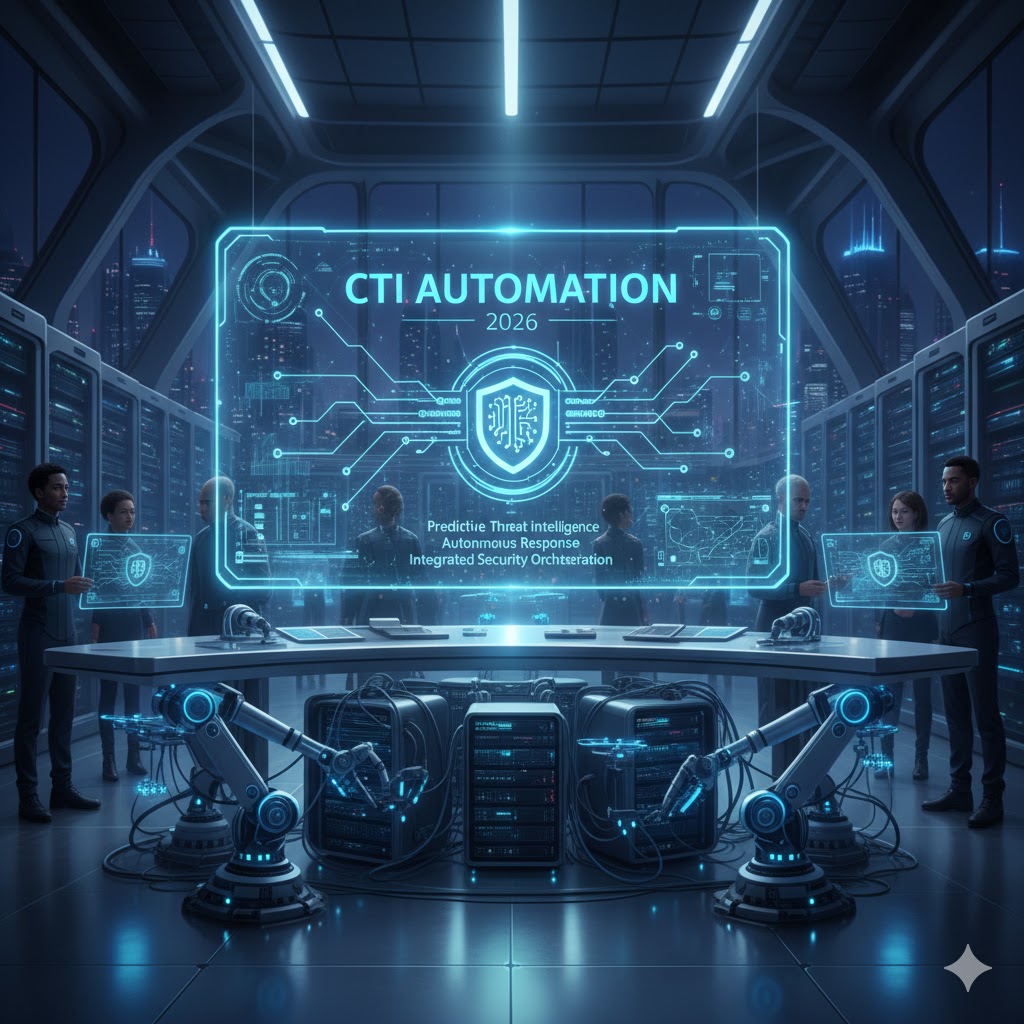
In 2026, cybersecurity has transitioned from reactive defense to proactive, intelligent automation powered by Cyber Threat Intelligence (CTI). As cyberattacks become faster and more sophisticated, manual response mechanisms are no longer sufficient to protect today’s hybrid and multi-cloud ecosystems. Enterprises require automation that not only detects and mitigates threats instantly but also learns and evolves autonomously. CTI automation represents the next major leap in cybersecurity efficiency. It delivers an integrated system of real-time analytics, AI-driven orchestration, and autonomous response to continuously analyze global attack surfaces. The result: enhanced visibility, rapid detection, reduced dwell times, and smarter, data-backed defensive strategies. By 2026, nearly 80% of security operations are anticipated to rely on AI-powered CTI and automation technologies. These solutions integrate machine learning (ML), natural language processing (NLP), SOC orchestration, and big data analytics into an adaptive ecosystem. The outcome isn’t just defense, it’s prevention through predictive learning and contextual intelligence, at Informatix.Systems, we provide cutting-edge AI, Cloud, and DevOps solutions for enterprise digital transformation. Our automated CTI frameworks unify AI diagnostics, Cloud-native analytics, and DevSecOps automation to enable enterprises to anticipate, prevent, and neutralize cyberattacks at machine speed. This deep-dive into The Future of CTI Automation 2026 explores technological trends, AI integration, security automation, and strategic best practices shaping global threat intelligence in an era of predictive cybersecurity.
The Evolution of CTI Automation
From Manual Reaction to Autonomous Intelligence
- Early 2010s: Reactive CTI based on manually curated reports.
- 2020–2023: Emergence of machine learning-driven contextual threat data.
- 2024–2026: Full integration of AI, robotic process automation (RPA), and adaptive SOAR platforms.
CTI automation has evolved from basic correlation tools to self-learning, fully automated intelligence hubs that enable real-time risk visualization across distributed networks.
The Building Blocks of Automated Cyber Threat Intelligence
Foundational Components of CTI Automation:
- AI & Machine Learning: Core engines for behavioral and anomaly detection.
- Threat Intelligence Feeds: Automated ingestion from multiple trusted and open-source CTI data streams.
- Security Orchestration: Integrates CTI with SOAR to coordinate real-time responses.
- Automation Engines: Execute authentication, isolation, and remediation tasks autonomously.
- Cognitive Analytics Dashboards: Provide visual correlation across threat vectors.
At Informatix.Systems, our architecture integrates these components, aligning analytics and automation into seamless enterprise-ready CTI ecosystems.
AI Integration: The Core of CTI Automation
AI and ML power the automation that underpins modern CTI frameworks.
Key AI Use Cases in CTI:
- Predictive Analytics: Anticipates attack probability and impact through pattern recognition.
- Cognitive Risk Scoring: Dynamically assigns real-time threat severity based on contextual data.
- Machine Vision and NLP: Monitors dark web discussions, phishing forums, and malware repositories.
- Automated Decision Engines: Suggest or autonomously trigger next-step remediation actions.
AI-driven CTI allows real-time response orchestration, enabling global security teams to focus on strategic tasks while automation manages repetitive operations.
SOC and SOAR Integration with CTI Automation
SOC (Security Operations Center) automation transforms raw CTI data into actionable response strategies.
Integration Advantages:
- End-to-End Visibility: SOCs gain centralized dashboards powered by integrated CTI workflows.
- SOAR Automation: Incident playbooks execute automatic containment, remediation, and escalation.
- Adaptive Intelligence: SOCs evolve through machine learning, minimizing false positives.
- 24/7 Resilience: Continuous network monitoring across hybrid environments.
Informatix.Systems designs autonomous SOC ecosystems, merging CTI, AI, and DevSecOps automation into unified orchestration frameworks.
Predictive Threat Modeling in Automated CTI
Predictive modeling transforms cyber defense into an anticipatory intelligence architecture.
Predictive Model Capabilities:
- Time-Series Forecasting: Anticipates future attack peaks.
- Anomaly Detection Engines: Identify potential breaches in real-time data streams.
- Pattern Correlation: Connects user behaviors, attack methods, and TI data.
- Graph Analytics: Maps relational structures between attackers, tools, and IoCs.
Predictive CTI automation, driven by AI and big data, allows security intelligence to evolve preemptively rather than reactively, neutralizing potential attacks at their earliest signal.
Automation Across the Cyber Kill Chain
Key Stages of Automated Defense:
- Reconnaissance: AI monitors anomalies and web domain activity.
- Weaponization: Automation identifies new payloads through sandbox detonation.
- Delivery & Exploitation: AI isolates compromised endpoints using adaptive firewalls.
- Installation & Command Control: Predictive CTI terminates malware communication channels.
- Execution & Exfiltration: Automated SOAR triggers containment and recovery.
CTI automation disrupts the kill chain well before the exfiltration stage, keeping enterprises resilient against large-scale, adaptive cyberattacks.
Cloud-Native CTI Automation for Multi-Environment Security
The Power of Cloud-Native Threat Intelligence:
- Unified security across hybrid ecosystems (AWS, Azure, GCP, on-prem).
- Elastic scalability for multi-cloud data intelligence.
- AI integration for identity and API anomaly detection.
- Regulatory compliance through continuous audit automation.
At Informatix.Systems, we leverage cloud-native CTI automation to harmonize analytics, eliminating blind spots across distributed infrastructures.
Data Enrichment and Threat Correlation AI
The strength of CTI lies in contextual data enrichment, linking unstructured data to actionable intelligence.
Enrichment Use Cases:
- IoC Enrichment: Combines metadata with behavioral tagging to improve accuracy.
- Threat Actor Profiling: Builds AI-driven behavioral maps for persistent attackers.
- Cross-Source Correlation: Synchronizes government, private, and open-source feeds.
- Event Linking: Establishes contextual relationships between disparate security logs and patterns.
Informatix.Systems’ CTI oracles serve as intelligence hubs that enrich raw data through contextual advancements, ensuring precision threat awareness.
Zero Trust Alignment Through Automated CTI
CTI automation supports Zero Trust Security by enforcing never trust, always verify principles.
Automating Zero Trust in Practice:
- Identity Risk Assessment: AI validates user and device integrity continuously.
- Adaptive Access Enforcement: Permissions dynamically adjusted per risk signals.
- Real-Time Policy Response: Automated alignment between governance frameworks and CTI updates.
Through automated CTI, enterprises gain self-adaptive access controls, a key hallmark of Zero Trust maturity.
Ethical AI and Governance in CTI Automation
AI-driven CTI requires adherence to ethical governance to ensure transparency.
Governance Standards in 2026:
- Explainable AI (XAI): Ensures accountability behind automated decisions.
- Regulatory Alignment: Compliance with frameworks such as ISO 42001, NIST, and GDPR.
- Transparency and Bias Control: AI engines are regularly audited for fairness and performance accuracy.
- Ethical Automation: Human oversight retained in escalation scenarios.
At Informatix.Systems, our AI Governance architecture ensures that automation enhances enterprise trust while maintaining robust oversight protocols.
Federated CTI and Global Intelligence Sharing
The sophistication of cyber threats demands global collaboration through federated data models.
Federated AI-Enhanced CTI Networks:
- Collective learning across multiple organizations without sharing proprietary data.
- Blockchain-enabled interoperability for data authenticity.
- Cross-sector collaboration among Defense, Finance, and Healthcare industries.
Informatix.Systems enable federated CTI interoperability through secure, decentralized models, improving speed and confidence in real-time defense information sharing.
Anticipated CTI Automation Innovations (2026–2030)
Key Forecasts:
- Autonomous Defense Systems: AI agents responding to threats with zero human involvement.
- Quantum-Secure Encryption Models: Countering post-quantum cybersecurity risks.
- Digital Twin SOCs: Virtual environments replicating enterprise ecosystems for simulation-based defense automation.
- Self-Healing Infrastructure: Predictive recovery led by intelligent orchestration.
- Generative AI Threat Models: Using adversarial networks to emulate, predict, and block future exploits.
CTI automation will soon transcend response to create self-defending security ecosystems. The Future of CTI Automation in 2026 marks the confluence of AI, automation, and security analytics, ushering in an era of proactive, adaptive, and autonomous cyber defense. By replacing reactive processes with real-time intelligence orchestration and predictive insight, enterprises achieve faster response, greater accuracy, and scalable cyber resilience. At Informatix.Systems, we integrate AI-driven CTI, Cloud, and DevOps automation into enterprise operations, enabling organizations to predict threats, automate responses, and build sustainable security intelligence pipelines. Partner with Informatix.Systems today to modernize your CTI infrastructure and stay ahead of evolving adversaries through automation-driven defense innovation.
FAQs
What is CTI automation?
CTI automation integrates AI and SOAR technologies to manage threat intelligence collection, analysis, and response without manual intervention.
How does AI improve CTI efficiency?
AI automates event correlation, enhances detection accuracy, and enables predictive defense models.
Can CTI automation replace human analysts?
No. It augments human analysts by optimizing decision-making and automating repetitive cybersecurity tasks.
How does Informatix.Systems implement CTI automation?
We deploy AI, Cloud, and DevOps-integrated solutions to ensure real-time, scalable, and adaptive threat intelligence systems.
What’s the role of predictive analytics in CTI automation?
It forecasts attacker intent and activity patterns, helping organizations preempt and neutralize threats.
How does CTI support Zero Trust models?
CTI continuously validates user identities and access privileges using AI-driven analytics.
What are future innovations in CTI for 2026 and beyond?
Expect quantum-secure encryption, federated AI, and self-healing autonomous SOCs as global digital defense evolves.
Why choose Informatix.Systems for CTI automation?
We deliver cutting-edge AI, Cloud, and DevSecOps-driven CTI frameworks tailored for continuous enterprise resilience and global defense leadership.
No posts found
Write a review