Anmelden | Registrieren
Sign in to get more opportunities
- 3/8, North Pirerbag
- 60 Feet Main Road
- Mirpur, Dhaka 1216
- +880-967-8247365
- support@informatix.systems

Cloud and AI for Healthcare Transformation
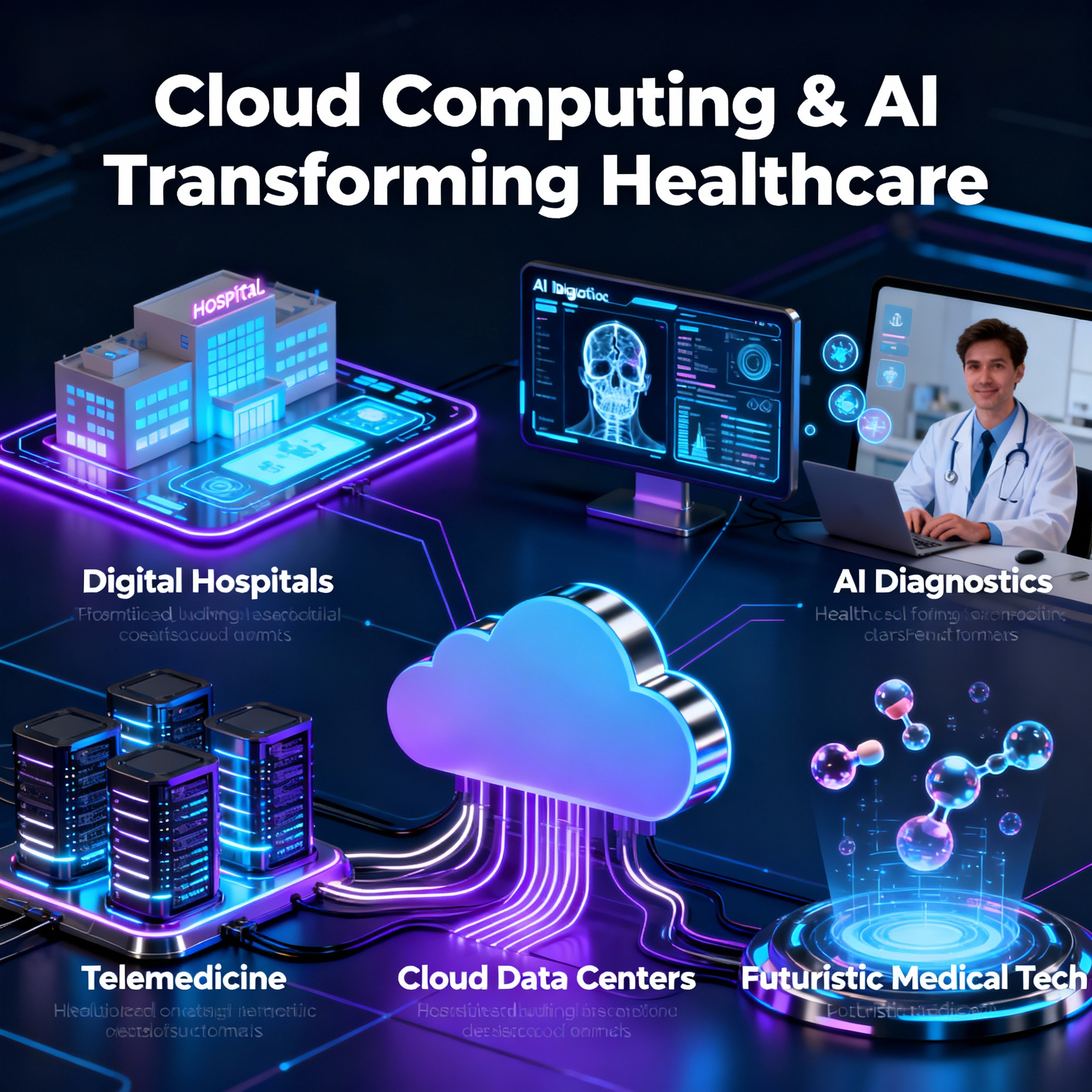
Traditional healthcare IT environments faced persistent issues with scalability, data silos, and costly maintenance. The shift to cloud-native systems enables healthcare providers to integrate diverse data sources, scale their operations dynamically, and ensure secure access to medical records.
Benefits include:
- Centralized data management for electronic health records (EHRs)
- Interoperability across hospitals, laboratories, and insurance systems
- Reduced IT costs through pay-as-you-go models
- Enhanced disaster recovery and business continuity
The Role of AI in Modern Medicine
AI algorithms analyze complex data sets to uncover trends, patterns, and predictive insights that were previously invisible to human analysts. AI applications in healthcare include:
- Early disease detection through medical imaging
- Predictive analytics for patient outcomes
- Drug discovery and genomic research
- Personalized care recommendations based on patient data
Why Cloud and AI Integration Matters in Healthcare
The Symbiotic Advantage
The integration of cloud infrastructure and AI capabilities enables real-time analytics, global scalability, and efficient data sharing. Together, they enhance medical decision-making, streamline operations, and democratize access to health data.
Key advantages:
- Faster deployment of healthcare applications
- Seamless scalability for fluctuating workloads
- Global data accessibility with built-in compliance
- Continuous learning from aggregated datasets
Empowering the Healthcare Workforce
AI-powered virtual assistants and machine learning models relieve administrative burdens, allowing clinicians to focus more on patient care. Cloud-based collaboration tools further connect healthcare professionals across geographies to improve multidisciplinary case management.
Transforming Patient Care through AI and Cloud
Personalized Medicine and Predictive Healthcare
AI models leverage vast clinical and genomic data to enable precision medicine—customized treatments that account for an individual’s genetic profile, lifestyle, and environmental factors.
Applications include:
- Predictive modeling for chronic disease management
- AI-assisted diagnostics using imaging data
- Virtual health monitoring platforms
- Clinical decision support tools
Enhancing Telemedicine and Remote Care
The post-pandemic healthcare landscape has embraced telehealth as a standard service delivery model. Cloud-native telemedicine systems powered by AI support:
- Real-time remote consultations
- IoT-enabled patient monitoring devices
- Automatic prescription updates and alerts
- AI-based triage and symptom assessment bots
Data Security and Compliance in Healthcare Cloud
Protecting Sensitive Health Information
With millions of patient records stored in the cloud, data security remains a top priority. Healthcare organizations must adhere to stringent regulations such as HIPAA, GDPR, and HITECH to ensure privacy.
Security measures include:
- End-to-end encryption for sensitive health data
- Multi-factor authentication
- Role-based access controls
- AI-driven threat detection and anomaly detection
Compliance as a Foundation for Trust
Cloud providers such as AWS, Microsoft Azure, and Google Cloud offer GDPR- and HIPAA-compliant infrastructure. At Informatix.Systems, we tailor compliance frameworks to each healthcare organization’s unique requirements, ensuring both flexibility and integrity across all data workflows.
Cloud Infrastructure for Healthcare Scalability
Cloud Service Models in Healthcare
Cloud models empower healthcare institutions to select the most suitable deployment approach based on operational and regulatory needs.
- Public Cloud: Ideal for scalability and non-sensitive applications
- Private Cloud: Best for high-security workloads
- Hybrid Cloud: Combines both models for flexibility and control
Advantages for Healthcare Organizations
- Elastic scalability for peak patient loads
- Automated scaling for AI workloads
- Cost optimization via dynamic provisioning
- Rapid deployment of digital health solutions
AI-Driven Clinical Analytics and Insights
Predictive and Prescriptive Analytics
AI-powered analytics transform healthcare data into actionable insights:
- Predictive analytics anticipate patient admissions, readmissions, or disease progression.
- Prescriptive analytics suggest optimal treatment plans supported by historical data.
Real-Time Clinical Intelligence
Using AI models on cloud platforms enables healthcare providers to make real-time decisions, enhancing:
- Patient triage and emergency management
- Bed capacity optimization
- Disease outbreak forecasting
At Informatix.Systems, our AI analytics frameworks integrate seamlessly with existing hospital systems, delivering continuous intelligence across clinical and administrative departments.
Enhancing Operational Efficiency in Healthcare
Automating Administrative Workflows
AI technologies streamline routine tasks such as scheduling, billing, and claims processing through:
- Natural language processing (NLP) chatbots
- Intelligent document processing
- Automated insurance verification
AI for Supply Chain Optimization
Cloud-based AI tools track drug inventory, predict shortages, and automate procurement—drastically reducing waste and ensuring medication availability.
The Role of Edge and IoT in Cloud Healthcare
Healthcare at the Edge
Edge computing enables real-time decision-making close to data sources, minimizing latency in critical care scenarios.
Applications include:
- Remote ICU monitoring
- AI-driven diagnostic imaging devices
- Wearable health sensors integrated with cloud APIs
IoT-Enabled Health Ecosystems
IoT devices—smartwatches, glucose monitors, heart sensors—generate massive amounts of real-time patient data fed into cloud platforms for continuous analysis and actionable insights.
Challenges in Cloud and AI Adoption
Common Barriers
Despite the proven advantages, many healthcare institutions face roadblocks such as:
- Data integration complexity across legacy systems
- Limited AI readiness among healthcare IT teams
- Concerns over vendor lock-in and interoperability
- Costs associated with data migration and training
Overcoming Adoption Challenges
At Informatix.Systems, we mitigate these pain points by providing:
- Custom cloud migration strategies
- Comprehensive data governance frameworks
- AI adoption roadmaps
- Ongoing DevOps support and optimization
Case Studies: Cloud and AI Success in Healthcare
Predictive Diagnostics
A large hospital network leveraged Informatix.Systems’ AI engines to detect sepsis risk 6 hours earlier than traditional systems, reducing ICU admissions by 20%.
Cloud-Native Telemedicine
A telehealth provider migrated to a scalable hybrid cloud, achieving a 40% improvement in performance and secure integration with wearable IoT devices for patient monitoring.
Automated Insurance Claims
By integrating AI-driven document recognition, an insurer reduced claim processing time from 10 days to 2 hours—boosting customer satisfaction and efficiency.
Future of Cloud and AI in Healthcare
Trends to Watch
- Generative AI in clinical documentation and drug design
- Blockchain-based health record management
- Quantum computing for complex medical modeling
- Virtual hospitals powered by intelligent automation
As healthcare evolves, AI+Cloud convergence will drive not only digital accuracy but also ethical, sustainable, and patient-centered innovation globally.
Building the Digital Healthcare Future
The synergy of cloud computing and AI represents a turning point for modern healthcare. It supports better decision-making, operational efficiency, and personalized patient care while ensuring compliance and security.
At Informatix.Systems, we empower healthcare organizations to leverage cloud, AI, and digital engineering for smarter, faster, and more reliable healthcare delivery. We help you transform patient outcomes through intelligent innovation, scalable infrastructure, and secure data management.
Ready to lead your healthcare ecosystem into the future?
Contact Informatix.Systems today to discover how our enterprise cloud and AI solutions can accelerate your digital healthcare transformation.
FAQ
What are the key benefits of using cloud in healthcare?
Cloud provides scalability, remote access, cost efficiency, and improved data sharing for healthcare institutions.
How does AI improve patient care?
AI enhances diagnostics, predicts disease trends, personalizes treatments, and automates administrative workflows.
Is patient data secure in the cloud?
Yes, cloud systems used in healthcare are designed for HIPAA, GDPR, and ISO compliance with advanced encryption and access controls.
How can healthcare organizations transition to cloud successfully?
A hybrid cloud approach supported by expert partners like Informatix.Systems ensures smooth migration and continuous performance optimization.
What role does AI play in telemedicine?
AI powers chatbots, patient triage, virtual assistants, and health analytics that enhance remote patient care experiences.
Can cloud and AI reduce healthcare costs?
Absolutely. Automating workflows and optimizing IT operations with AI and cloud reduces infrastructure, maintenance, and staffing costs.
How does Informatix.Systems help healthcare clients?
We design cloud-native and AI-powered healthcare frameworks, offering secure, compliant, and scalable solutions customized for each organization.
Keine Beiträge gefunden.
Rezension verfassen