- 3/8, North Pirerbag
- 60 Feet Main Road
- Mirpur, Dhaka 1216
- +880-967-8247365
- support@informatix.systems

How Docker & Containers Can Boost Website Performance
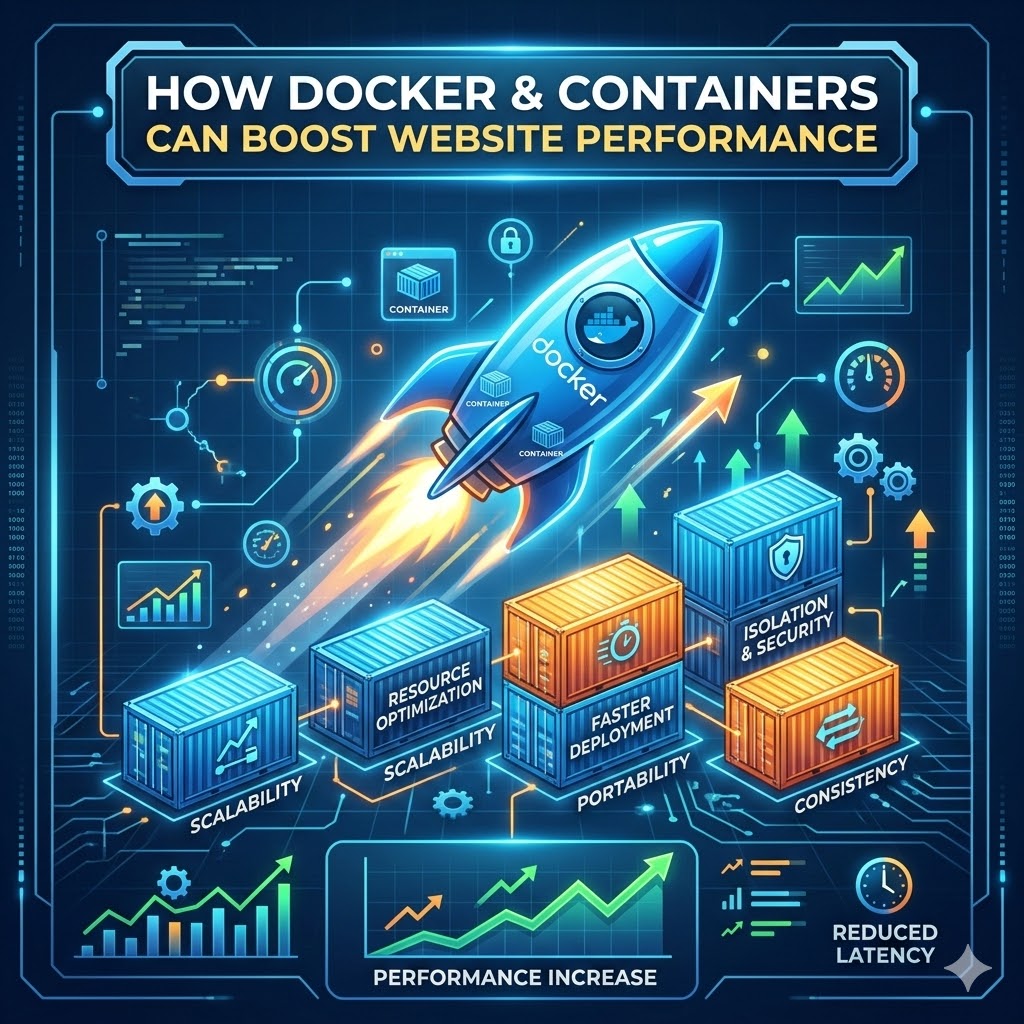
In the rapidly evolving world of web development, performance is paramount. Users expect fast, responsive websites, and search engines prioritize speed in their rankings. As businesses strive to meet these demands, traditional deployment methods often fall short. Enter Docker and containerization a game-changing approach that offers unparalleled benefits for website performance.
What Are Docker and Containers?
Docker is an open-source platform that automates the deployment, scaling, and management of applications within lightweight, portable containers. These containers encapsulate an application and its dependencies, ensuring consistency across various environments from development to production. Containers are standardized units of software that package up code and all its dependencies so the application runs quickly and reliably from one computing environment to another. Unlike virtual machines, containers share the host system's kernel and isolate the application processes from each other.
How Docker Enhances Website Performance
Faster Deployment and Scalability
Docker streamlines the deployment process by allowing developers to package applications and their dependencies into containers. This encapsulation ensures that the application runs consistently across different environments, reducing the it works on my machine problem. As a result, websites can be deployed more rapidly, and scaling becomes more straightforward.
-
Rapid Scaling: Docker enables the quick creation of multiple container instances to handle increased traffic, ensuring that websites remain responsive during peak loads.
-
Efficient Resource Utilization: Containers are lightweight and share the host system's kernel, leading to better resource utilization compared to traditional virtual machines.
Enhanced Isolation and Security
Each Docker container operates in its isolated environment, ensuring that applications do not interfere with each other. This isolation enhances security by containing potential vulnerabilities within individual containers, preventing them from affecting the entire system.
-
Reduced Attack Surface: By isolating applications, Docker minimizes the risk of widespread system breaches.
-
Consistent Environments: Developers can create identical development, testing, and production environments, reducing inconsistencies and potential issues.
Improved Continuous Integration and Deployment (CI/CD)
Docker integrates seamlessly with CI/CD pipelines, allowing for automated testing and deployment of applications. This integration leads to faster development cycles and more reliable releases.
-
Automated Testing: Containers can be used to create consistent testing environments, ensuring that tests are reliable and reproducible.
-
Streamlined Deployment: Docker images can be versioned and stored in repositories, making it easy to deploy specific versions of applications.
Optimized Performance Through Microservices Architecture
Docker facilitates the adoption of a microservices architecture, where applications are broken down into smaller, manageable services. Each service runs in its own container, allowing for independent scaling and optimization.
-
Independent Scaling: Individual services can be scaled based on demand, ensuring optimal resource allocation.
-
Performance Tuning: Developers can fine-tune each service for performance without affecting other parts of the application.
Cost Efficiency
By enabling efficient resource utilization and reducing overhead, Docker can lead to significant cost savings.
-
Reduced Infrastructure Costs: The lightweight nature of containers allows for more applications to run on the same hardware, reducing the need for additional resources.
-
Optimized Resource Allocation: Docker's resource management features ensure that applications use only the resources they need, preventing wastage.
Best Practices for Implementing Docker in Web Development
To fully leverage Docker's capabilities, consider the following best practices:
-
Use Multi-Stage Builds: Multi-stage builds allow you to create smaller, more secure images by separating the build environment from the runtime environment.
-
Optimize Dockerfiles: Minimize the number of layers in your Dockerfile and use efficient base images to reduce image size and improve performance.
-
Implement Health Checks: Define health checks for your containers to ensure that they are running as expected and to facilitate automated recovery.
-
Monitor Container Performance: Use monitoring tools to track the performance of your containers and identify potential issues before they affect users.
Real-World Applications and Case Studies
Many leading companies have adopted Docker to enhance their website performance:
-
Netflix: Utilizes Docker to streamline its development and deployment processes, enabling faster delivery of new features.
-
Spotify: Implements Docker to manage its microservices architecture, ensuring scalability and reliability.
-
eBay: Has adopted Docker to improve resource utilization and reduce infrastructure costs.
The Future of Docker in Web Development
As web applications become more complex and user expectations rise, Docker's role in web development will continue to grow. The shift towards microservices and containerization is expected to accelerate, offering developers more flexibility and control over their applications.
Need help ?
Contact our team at support@informatix.systems
No posts found
Write a review