Anmelden | Registrieren
Sign in to get more opportunities
- 3/8, North Pirerbag
- 60 Feet Main Road
- Mirpur, Dhaka 1216
- +880-967-8247365
- support@informatix.systems

Top 10 CI/CD Pipelines Tips for 2025
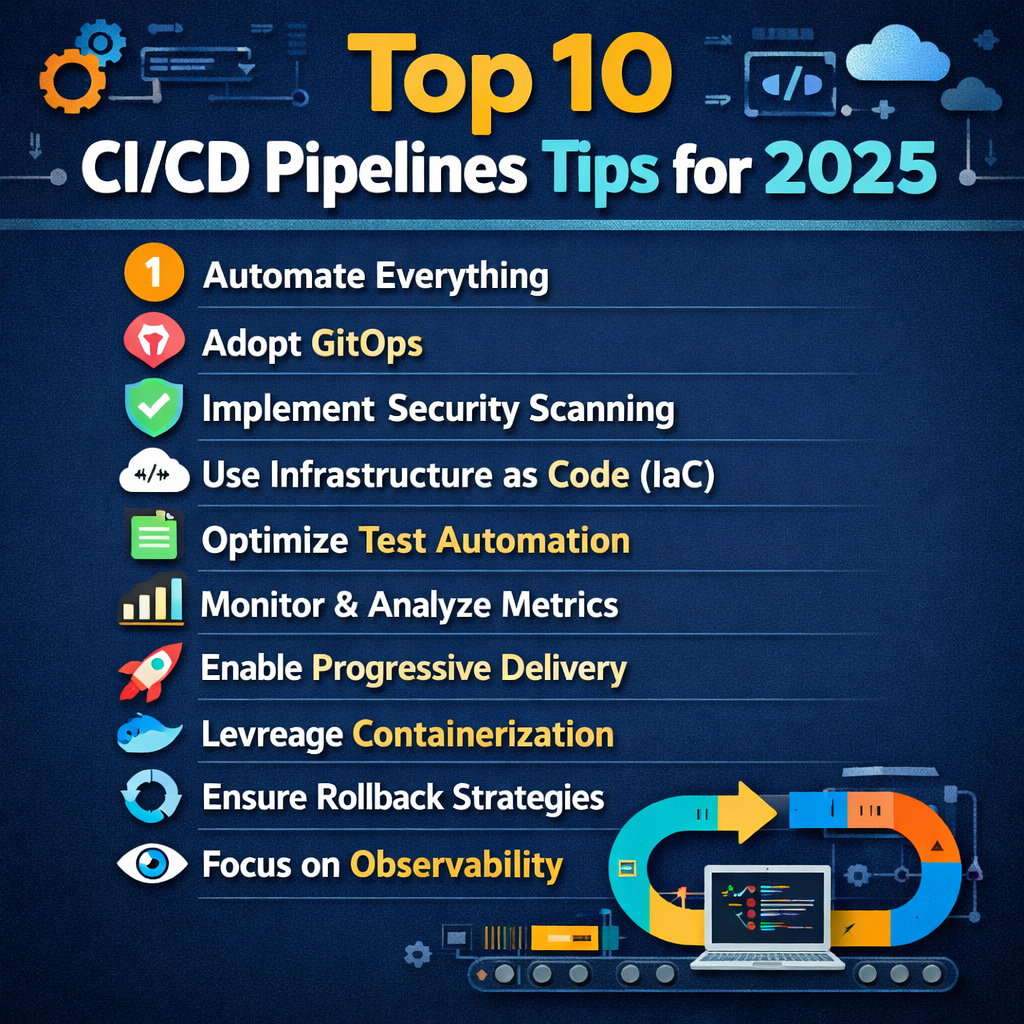
In the fast-paced world of software development, staying competitive requires efficient workflows, faster deployments, and seamless integration. Continuous Integration (CI) and Continuous Delivery (CD) pipelines have become essential components of modern DevOps practices, helping teams automate their workflows and reduce the time between development and production. In 2025, CI/CD pipelines are more powerful than ever, offering new tools, strategies, and optimizations to help businesses thrive.
In this post, we will dive deep into the top 10 CI/CD pipeline tips for 2025 that can elevate your development process, increase automation, and optimize your deployment pipeline.
Automate Everything: From Build to Deployment
Automation is at the heart of any successful CI/CD pipeline. In 2025, automation tools and practices have evolved to handle complex processes seamlessly. Automating every stage of your pipeline—from code commit to deployment—ensures faster and more reliable releases.
-
Benefits: Reduces human error, increases productivity, and speeds up release cycles.
-
Tip: Use automation tools like Jenkins, GitLab CI, or CircleCI to automatically trigger builds, tests, and deployments on each code change.
Use Feature Branching for Parallel Development
Feature branching is a widely used technique in modern CI/CD pipelines. In 2025, it’s crucial to manage features independently through branches, allowing teams to work on multiple features simultaneously without interfering with each other’s work.
-
Benefits: Parallel development and seamless integration of new features.
-
Tip: Use Git or similar version control systems for managing branches. Make sure to merge branches frequently to avoid integration issues.
Implement Comprehensive Testing at Every Stage
Testing is crucial in CI/CD pipelines to ensure code quality and functionality. With advanced CI/CD tools in 2025, integrating testing stages into your pipeline is easier than ever.
-
Benefits: Identifies bugs early in the process, improves software quality.
-
Tip: Implement unit testing, integration testing, and end-to-end testing in your CI/CD pipeline. Tools like Selenium, TestNG, or Mocha can help automate these tests.
Shift Left: Early Testing and Validation
Shift-left testing refers to the practice of moving testing and validation processes earlier in the software development lifecycle. In 2025, teams are increasingly shifting testing to the early stages of development, ensuring faster identification and resolution of issues.
-
Benefits: Saves time and reduces bug fixes later in the process.
-
Tip: Integrate static code analysis, linting, and security checks into your CI pipeline to catch issues early.
Integrate Security with DevSecOps
Security shouldn’t be an afterthought in your CI/CD pipeline. In 2025, it’s more critical than ever to integrate security at every stage of your pipeline, ensuring vulnerabilities are caught before they make it into production.
-
Benefits: Ensures secure software releases and reduces risk.
-
Tip: Incorporate automated security testing using tools like Snyk, Checkmarx, or OWASP Dependency-Check to find vulnerabilities in your code and dependencies.
Utilize Containerization and Microservices
In 2025, containers and microservices are central to modern application development and deployment. Docker, Kubernetes, and container orchestration tools have become essential in the CI/CD pipeline for consistency across different environments.
-
Benefits: Enables portability, consistency, and scalability.
-
Tip: Use Docker for containerizing your applications and Kubernetes for orchestrating containers across different environments.
Implement Canary Deployments for Safer Releases
Canary deployments are a strategy that involves releasing a new feature or version to a small subset of users before gradually rolling it out to the rest of the user base. This reduces the risk of large-scale failures during deployment.
-
Benefits: Allows for safer, gradual rollouts and minimizes the impact of bugs.
-
Tip: Implement canary deployments in your CD pipeline using tools like Spinnaker or Kubernetes to control rollout percentages.
Monitor and Analyze CI/CD Pipeline Metrics
In 2025, monitoring and tracking metrics within your CI/CD pipeline are essential for optimizing the development process. You can gain insights into build times, deployment frequency, and failure rates to improve efficiency.
-
Benefits: Helps identify bottlenecks, optimize processes, and improve efficiency.
-
Tip: Use tools like Prometheus, Grafana, or ELK stack to monitor your pipeline performance and identify areas for improvement.
Use Infrastructure as Code (IaC) for Automated Environment Setup
Infrastructure as Code (IaC) allows you to define and provision infrastructure automatically using configuration files. In 2025, IaC is essential for ensuring consistency and scalability in your deployment pipeline.
-
Benefits: Enables automated environment provisioning, reduces manual errors.
-
Tip: Use tools like Terraform or AWS CloudFormation to automate the creation of your environments and ensure they are identical across all stages of your pipeline.
Optimize for Continuous Feedback
CI/CD pipelines are not just about automation; they are also about feedback. Continuous feedback loops ensure that developers get quick insights into the status of their code and can make necessary adjustments in real-time.
-
Benefits: Ensures rapid feedback, reducing cycle times and enabling faster fixes.
-
Tip: Set up automated notifications and alerts within your CI/CD pipeline using Slack, email, or other messaging tools to provide real-time feedback on build, test, and deployment statuses.
As the software development industry continues to evolve, so do the tools and practices surrounding CI/CD pipelines. In 2025, it’s crucial to adopt strategies that enhance automation, testing, security, and deployment speed. By leveraging the top 10 CI/CD pipeline tips outlined in this post, IT professionals can streamline development workflows, improve code quality, and ensure smoother deployments.
CI/CD pipelines are no longer just a “nice-to-have”; they’re an integral part of modern software development. Whether you’re just starting to implement CI/CD or looking to optimize your existing pipelines, adopting these best practices will set you up for success.
By embracing these tools, strategies, and tips, IT professionals in 2025 can stay ahead of the curve and create more reliable, efficient, and secure software solutions.
Keine Beiträge gefunden.
Rezension verfassen