- 3/8, North Pirerbag
- 60 Feet Main Road
- Mirpur, Dhaka 1216
- +880-967-8247365
- support@informatix.systems

AI and ML in Threat Detection 2026
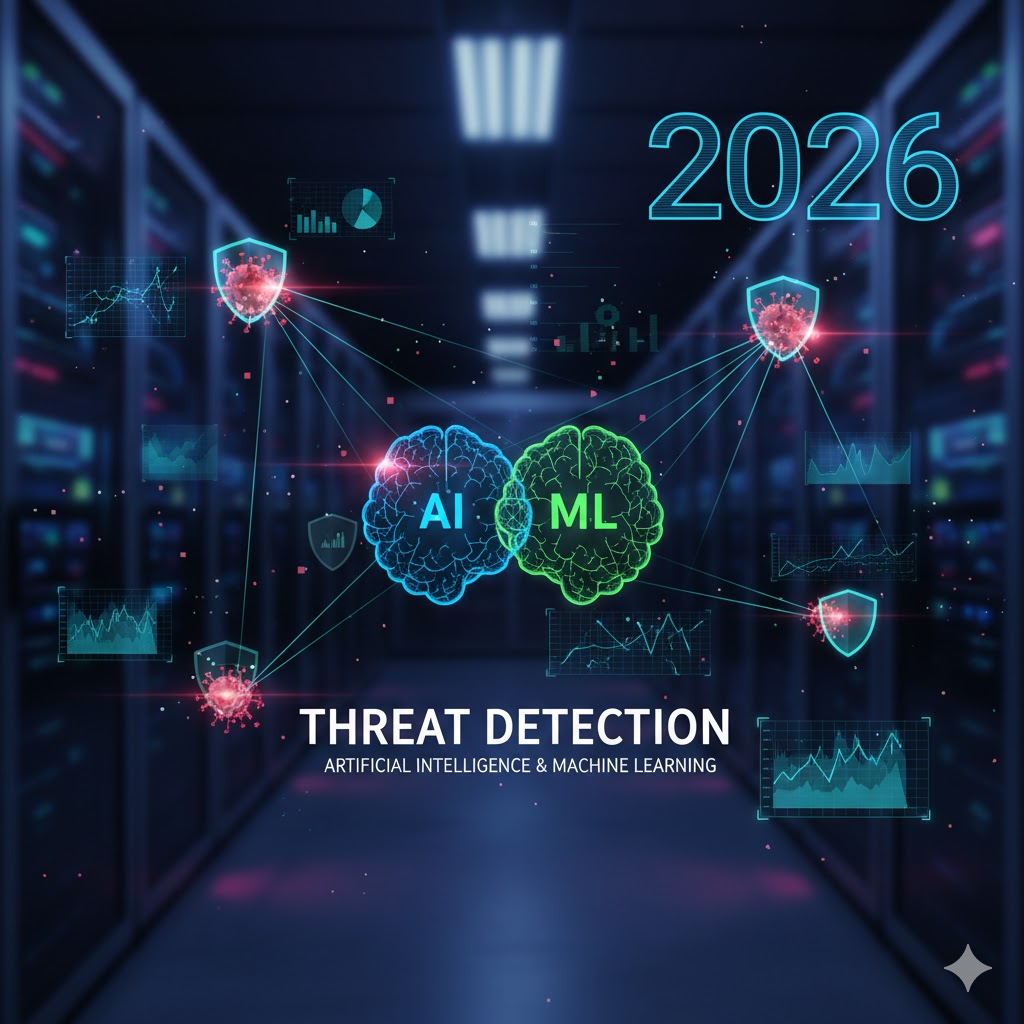
In the digital-first enterprise landscape of 2026, the fusion of Artificial Intelligence (AI) and Machine Learning (ML) has fundamentally reshaped cybersecurity. Traditional threat detection systems, once rule-based and reactive, can no longer contend with the velocity, complexity, and adaptability of AI-enhanced cyberattacks. As adversaries weaponize automation and generative AI, enterprises are answering with intelligent, anticipatory defense strategies grounded in data-driven innovation. AI and ML in threat detection enable organizations to foresee, identify, and neutralize cyber risks before they evolve into breaches. Fueled by massive datasets, contextual threat intelligence, and continuous learning, these models automate detection, accelerate response speed, and minimize false positives. From behavioral pattern recognition to predictive anomaly detection, AI-based defense systems now serve as the primary layer of enterprise digital resilience. In 2026, cybersecurity is no longer a human-intensive operation but a cyber-cognitive ecosystem, where ML analyzes billions of events per second, and AI aids human analysts in decision-making. The evolution of autonomous SOCs, Zero Trust architectures, and cross-platform CTI integration has elevated AI-powered threat detection into a proactive and predictive paradigm at Informatix.Systems, we provide cutting-edge AI, Cloud, and DevOps solutions for enterprise digital transformation. Our threat-detection ecosystems leverage machine learning, cloud-native orchestration, and continuous intelligence correlation to protect global enterprises from evolving threats. This guide explores how AI and ML are pioneering next-generation threat detection in 2026, detailing transformative technologies, predictive analytics, architectures, and governance frameworks.
The Evolution of Threat Detection
From Reactive Defense to Predictive Intelligence
Cybersecurity has shifted drastically, from static monitoring to intelligent, real-time forecasting.
Timeline of Transformation:
- Pre-2020: Signature-based intrusion detection and rule-triggered security alerts.
- 2021–2025: ML begins automating log analysis and anomaly detection in SOCs.
- 2026: Predictive, self-learning AI systems dominate, moving from reaction to preemption.
Today’s AI-driven systems filter out noise, learn continuously, and combat unknown unknowns, threats that haven’t yet been classified or recorded.
The Role of AI in Modern Threat Detection
AI brings contextual awareness and automation to network, endpoint, and cloud defense.
Key AI Capabilities:
- Autonomous Data Analysis: AI processes vast data volumes from SIEM and CTI sources.
- NLP Threat Decoding: AI interprets unstructured data from logs, emails, and social platforms.
- Dynamic Response Orchestration: Implements real-time mitigation and containment operations.
- Explainable Decisioning: Uses explainable AI (XAI) for regulatory transparency.
AI accelerates threat-detection workflows that would otherwise take human teams hours or days to complete.
Machine Learning: The Engine Behind Predictive Cyber Defense
Machine learning allows continuous model improvement without explicit programming.
Core ML Techniques for Threat Detection:
- Supervised Learning: Trains on known threat patterns for high-accuracy recognition.
- Unsupervised Learning: Detects hidden anomalies in unlabeled data.
- Reinforcement Learning: Adapts detection models through trial-and-error simulations.
- Deep Learning (DL): Recognizes complex, non-linear attack sequences.
At Informatix.Systems, our ML-driven SOCs employ multimodal models, combining supervised learning with behavioral analytics to detect subtle evasion tactics used by APTs and ransomware gangs.
Predictive Analytics and Threat Forecasting
AI-powered predictive analytics transform data into preventive defense.
Predictive Threat Modeling Includes:
- Attack Probability Assessment: Quantifies likelihood using time-series data.
- Behavioral DevOps Mapping: Tracks user and system activity across pipelines.
- Event Correlation Engines: Connects seemingly unrelated incidents across environments.
- Anomaly Trend Forecasting: Uses LSTM and RNN models to predict attack escalation rates.
Predictive ML is the backbone of autonomous early warning systems, reducing the cost and impact of breaches by predicting attacks in advance.
Behavioral Analytics and Anomaly Detection
AI-Enhanced Behavioral AI Frameworks
Behavioral analytics helps cybersecurity tools understand normal pattern baselines for users, devices, and workloads. AI detects anomalies that deviate from the baseline.
Real-World Applications:
- Identifying insider threats through login frequency or access anomalies.
- Detecting privilege misuse or espionage activity.
- Monitoring IoT devices for abnormal transmission flows.
- Identifying fraudulent operations in financial transactions.
At Informatix.Systems, our behavioral AI systems incorporate UEBA (User and Entity Behavior Analytics) fused with predictive deep learning to flag high-risk deviations.
AI and ML Across Cloud and Hybrid Environments
Cloud complexity amplifies detection challenges-AI bridges the visibility gap.
Cloud-Specific Implementations:
- API Anomaly Detection: ML analyzes API calls to detect injections or unauthorized access.
- Microservice Behavior Mapping: AI tracks East-West traffic anomalies between containers.
- Hybrid CTI Integration: Real-time alignment of multi-cloud SOC feeds using federated learning.
- Workload Inventory Insight: Automatic discovery of ghost or misconfigured instances.
Informatix.Systems designs multi-layer AI detection engines to unify intelligence across AWS, Azure, and Google Cloud, ensuring zero-blind-spot hybrid protection.
AI-Powered SOCs: The Next Generation of Security Operations
From Manual Control to Cognitive Command
SOCs of 2026 have evolved into proactive, self-learning intelligence hubs.
Key SOC Enhancements:
- SOAR (Security Orchestration, Automation & Response) Integration: Machine-led response execution.
- Autonomous Tier Filtering: AI categorizes incidents by priority and confidence level.
- Adaptable Threat Workflow: Predictive algorithms adjust rules dynamically as threats evolve.
- Anomaly Visualization Dashboards: Provide actionable insight analytics in real-time.
At Informatix.Systems, our AI-based SOC automation reduces detection times from hours to seconds, redirecting human expertise toward strategy rather than triage.
AI Models for Threat Classification
AI models assign threat scores and classify malicious activity types.
Common Models in Production:
- Convolutional Neural Networks (CNNs): Identify malware signatures within network traffic.
- Recurrent Neural Networks (RNNs): Recognize sequential attack chains in logs.
- Autoencoders: Detect encoded or compressed attack payloads.
- Graph Neural Networks (GNNs): Map attacker infrastructure and propagation patterns.
These models not only detect known attacks but also forecast emerging variants and self-adjust weights for continuous accuracy improvement.
Ethical AI and Governance Frameworks
AI must balance speed with accountability.
Governance Principles:
- Explainable AI (XAI): Every decision and flag must be transparent.
- Bias Elimination: Prevent demographic, regional, or sectoral bias in ML datasets.
- Privacy Compliance: Maintain GDPR, SOC 2, and ISO 42001 alignment.
- Human Oversight: SOC review ensures ethical model usage.
At Informatix.Systems, we adopt responsible AI governance, ensuring transparency, auditability, and fairness in every deployment pipeline.
Generative AI in Threat Simulation and Testing
Generative AI is revolutionizing how cybersecurity models prepare for real-world attacks.
Applications:
- Attack Path Simulations: AI replicates adversarial techniques to test resilience.
- Autonomous Penetration Testing: ML identifies unseen vulnerabilities.
- Synthetic Threat Generation: Used for ML model training in rare or complex cases.
- AI-Assisted Red Teaming: Human-machine teams execute realistic defense evaluations.
Predictive simulation ensures enterprises build self-defending networks prepared for advanced attacks.
Integrating CTI with AI-Driven Detection
Effective CTI integration brings external and internal intelligence into one actionable view.
Combined Benefits:
- Global Threat Feed Correlation: Tracks IoCs and IoAs from federated sources.
- Real-Time Contextualization: Aligns detection with global activity patterns.
- Dynamic Risk Scoring: Continuously updates asset threat levels.
- Collaborative Learning Models: Shared AI networks enhance accuracy across peer firms.
At Informatix.Systems, our AI-CTI matrix architecture transforms cloud logging into live contextual defense, empowering enterprises to predict and prevent complex, coordinated attacks.
The Future of AI and ML in Threat Detection (2026–2030)
Emerging Trends:
- Quantum-Resistant AI Detection Algorithms
- Fully Autonomous SOC Ecosystems
- Hybrid Federated AI for Global CTI Collaboration
- Self-Healing AI Networks with Reconfiguration Capability
- Generative Adversarial Defense Agents (GADAs) simulate cybercriminal behavior in real-time.
By 2030, AI-driven predictive security frameworks will fully replace manual triage and rule-based analysis. The convergence of AI, ML, and CTI automation in 2026 has redefined cybersecurity. Predictive analytics, behavioral modeling, and ethical AI frameworks have made cyber defense not just faster but infinitely smarter. Enterprises are now equipped to forecast and prevent attacks—transforming cybersecurity from reactive management to proactive innovation. At Informatix.Systems, we’re shaping this evolution through AI, Cloud, and DevOps-powered predictive intelligence ecosystems designed for future-ready digital defense. Partner with Informatix.Systems today to harness AI and ML technologies that empower real-time visibility, automated protection, and sustainable cyber resilience.
FAQs
What role does AI play in modern threat detection?
AI automates threat identification, contextual analysis, and real-time response while reducing false positives.
How does machine learning differ from traditional rule-based systems?
ML models learn from experience, dynamically adapting to evolving threats without manual rule input.
What industries benefit most from AI-driven security?
Finance, healthcare, manufacturing, defense, and e-commerce industries are reliant on large, dynamic data ecosystems.
Can AI detect zero-day attacks?
Yes. Predictive and anomaly-based AI models identify unclassified patterns indicative of new threats.
How does Informatix.Systems use AI in cybersecurity?
We integrate AI, Cloud, and DevOps automation to provide predictive threat intelligence and defense orchestration.
Is Explainable AI important in threat detection?
Absolutely. Explainable AI ensures trust, transparency, and compliance in automated security decision-making.
What’s next for AI and ML in cybersecurity?
Expect autonomous SOCs, federated global intelligence networks, and quantum-resistant AI algorithms leading 2030 defense innovation.
How does AI improve SOC efficiency?
AI automates triage, augments analysts with contextual intelligence, and executes real-time response orchestration autonomously.
No posts found
Write a review