- 3/8, North Pirerbag
- 60 Feet Main Road
- Mirpur, Dhaka 1216
- +880-967-8247365
- support@informatix.systems

Emerging AI-Powered Cyber Risk Forecasting Strategies 2028
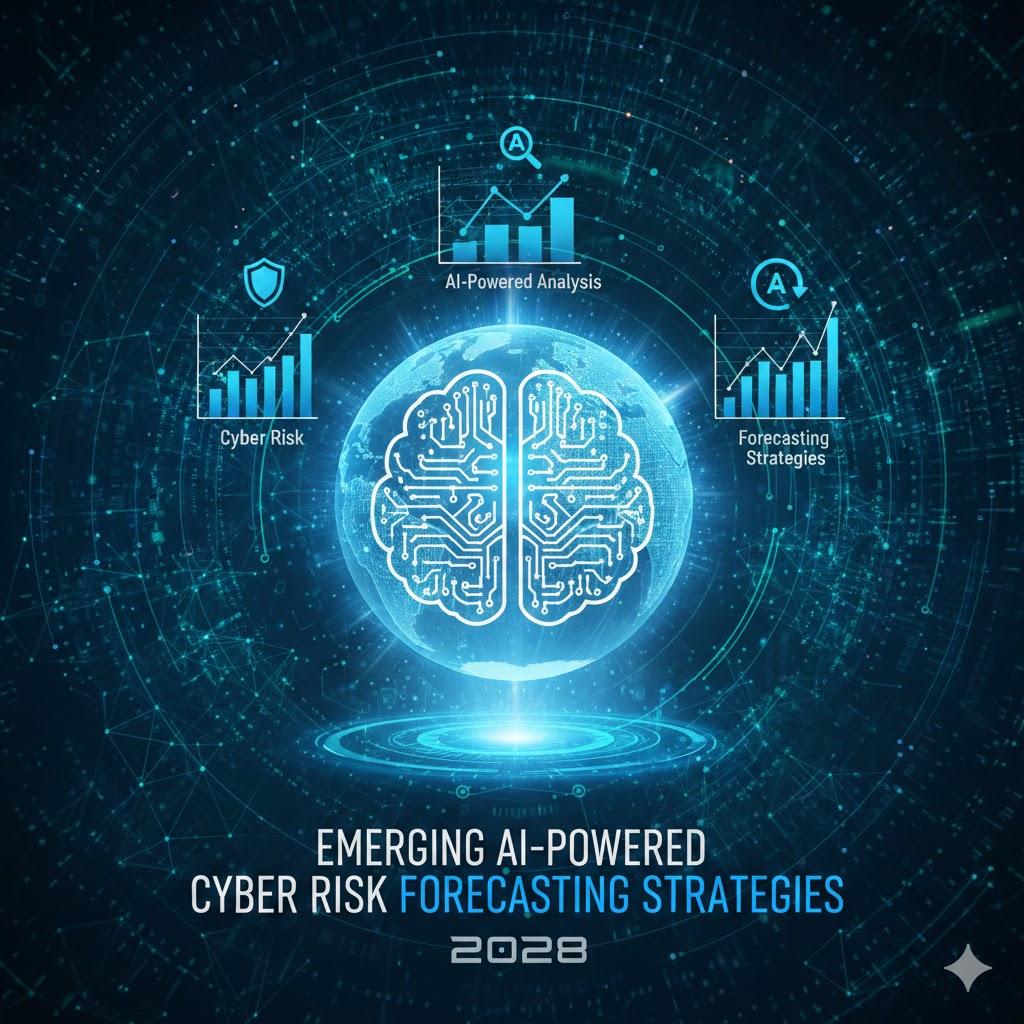
The global digital economy of 2028 operates at the speed of algorithms, driven by automation, interconnected systems, and big data ecosystems. However, the same innovations propelling progress also expose organizations to complex, adaptive, and evolving cyber threats. Business continuity, trust, and survival now depend not on reaction, but on prediction. AI-powered cyber risk forecasting has emerged as the cornerstone of next-generation cybersecurity, combining artificial intelligence, machine learning, and automation to forecast, quantify, and neutralize risks before exploitation. Across industries, enterprises are shifting toward predictive cybersecurity architectures. These systems analyze billions of behavioral signals, model attack trajectories, and simulate possible vulnerabilities in real time. As adversarial tactics become more sophisticated, with generative AI, deepfake exploitation, and autonomous malware, AI-driven risk forecasting delivers the predictive insights required to stay ahead. Unlike conventional protection frameworks focused on incident detection, AI forecasting provides forward-looking intelligence, transforming cybersecurity postures from static defense to dynamic anticipation. In this ecosystem, machine learning (ML) continuously refines attack probability models, natural language processing (NLP) interprets global threat signals, and cloud analytics delivers scalable foresight at Informatix.Systems, we provide cutting-edge AI, Cloud, and DevOps solutions for enterprise digital transformation. Our predictive risk forecasting solutions empower organizations to unify data analytics, cyber intelligence, and AI-powered automation, creating a proactive cyber posture that anticipates threats before they impact operations. This article explores the emerging AI-powered cyber risk forecasting strategies shaping 2028, from multi-domain analytics to autonomous intelligence orchestration, enabling global enterprises to combat tomorrow’s risks today.
The Paradigm Shift: From Detection to Prediction
Traditional cybersecurity relies heavily on post-event detection and containment. By 2028, that model will prove obsolete. AI-driven forecasting shifts the paradigm toward anticipation-based cyber resilience.
Key Transformative Elements
- Reactive → Predictive: AI identifies risk patterns long before they escalate into breaches.
- Manual → Autonomous: Machine learning continuously trains on new threat data.
- Isolated → Connected: Threat forecasting unites cloud, device, and user analytics.
- Linear → Adaptive: Defense systems evolve dynamically as threats mutate.
AI forecasting creates an environment where predictive insight, not reactive response, defines security maturity for the digital enterprise.
The Cyber Risk Landscape in 2028
The cyber threat ecosystem in 2028 is dominated by autonomous, AI-powered attacks and data-driven black markets.
Emerging Threat Vectors
- Generative AI-Driven Attacks: Adversaries use deep learning to build polymorphic malware.
- Quantum Decryption Risks: Quantum computing renders older encryption methods obsolete.
- Data Poisoning: Malicious data injected into AI systems manipulates threat models.
- AI-Enhanced Ransomware: Adaptive payloads identify high-value systems autonomously.
- Cross-Cloud Supply Chain Attacks: Compromises ripple through multi-cloud dependencies.
Organizations require AI forecasting systems capable of real-time detectability, contextual analysis, and preemptive mitigation across hybrid infrastructures.
Foundations of AI-Powered Cyber Risk Forecasting
Forecasting requires layering AI algorithms, contextual analytics, and automation pipelines designed to simulate, predict, and prevent.
Key Technical Components
- Big Data Processing: Massive, continuous ingestion of telemetry and threat data from diverse sources.
- Predictive Machine Learning Models: Neural networks trained on past attack behaviors.
- Behavioral Analytics: Evaluating deviations in system or user activity to identify risks.
- Cognitive Reasoning Engines: AI models that map cause-and-effect relationships across varied threat dimensions.
- Autonomous Orchestration: Automated enactment of preventive policies based on predictive signals.
At Informatix.Systems, our predictive intelligence frameworks combine these capabilities for holistic, real-time cyber foresight.
Machine Learning and Predictive Analytics in Cyber Risk
Machine learning is the analytical engine transforming static risk management into proactive defense engineering.
Core ML Techniques in Risk Forecasting
- Supervised Learning: Learns from known risks to classify vulnerabilities.
- Unsupervised Learning: Detects unknown patterns and latent threats.
- Reinforcement Learning: Continuously optimizes decision-making through adaptive responses.
- Deep Learning: Identifies complex correlations invisible to human analysts.
- Federated Learning: Collaborates on risk modeling across distributed networks without data sharing.
AI models predict the probability, vector, and potential scale of threats, minimizing false positives and reducing response time exponentially.
Predictive Model Architecture: How AI Forecasting Works
AI-based risk forecasting operates as a multi-stage, adaptive architecture that integrates continuous sensing, learning, and action.
Forecasting Architecture Layers
- Data Acquisition Layer: Gathers data from IoT, endpoints, logs, SIEMs, and cloud events.
- Feature Engineering Layer: Transforms raw data into contextual features suitable for ML training.
- AI Training Engine: Uses historical and real-time data for probabilistic modeling.
- Forecasting Layer: Predicts threat likelihood, recomputation frequency, and potential business impact.
- Automation Engine: Triggers mitigation tactics such as patch orchestration or isolation.
- Visualization Interface: Displays risk dashboards tailored for SOCs and executive teams.
This architecture converts static monitoring into predictive reconnaissance, providing businesses with warning signals before compromise.
Cloud-Native Forecasting Infrastructure
By 2028, cloud-native AI architectures dominate enterprise cyber ecosystems. Cloud scalability ensures real-time intelligence dissemination and compute agility.
Benefits of Cloud-Driven Forecasting
- Elastic AI Processing: Dynamically scale analysis during live attack detection.
- Cross-Environment Intelligence Sharing: Synchronize insights across public, private, and edge clouds.
- API-Centric Automation: Integrates predictive analytics directly into DevSecOps workflows.
- Multi-Tenant Data Governance: Ensures secure model training across industries.
At Informatix.Systems, our Cloud AI frameworks merge federated learning and automation, delivering flexible defenses suited to enterprise-scale complexity.
Risk Quantification Through Predictive Analytics
Risk forecasting also empowers organizations with quantitative foresight that translates cyber risk into measurable metrics.
Quantification Framework
- Probability-Based Risk Scoring: Assigns likelihood to each threat vector.
- Attack Impact Modeling: Estimates financial loss and operational disruption.
- Exposure Analysis: Illuminates vulnerable dependencies within cloud or supply chains.
- Scenario Simulation: Runs attack scenarios for stress-tested policy validation.
Forecasting transforms cybersecurity from defensive overhead into data-driven investment intelligence.
Automation in AI-Powered Risk Mitigation
Predictive AI doesn’t stop at forecasting; it automates defensive execution through real-time orchestration.
Core Functions of Automated Forecasting
- Adaptive Incident Response: AI dynamically activates isolation or countermeasures.
- Cognitive SOC Operations: Intelligent playbooks reduce analyst fatigue.
- Automated Policy Reinforcement: System behaviors recalibrated upon predictive triggers.
- Patch and Recovery Automation: AI-driven repair operations based on detected risk progression.
Informatix.Systems develops AI-driven orchestration pipelines that interlink forecasting, CTI feeds, and SOC automation for end-to-end protection.
Ethical AI, Governance, and Compliance
With responsibility comes accountability. In 2028, the need for transparent, ethical AI defense systems is paramount.
Governance Principles
- Explainable AI (XAI): Ensures traceability of predictive decisions.
- Bias Mitigation: AI models trained on diverse datasets to avoid systemic errors.
- AICDS 2028 Compliance: Standardizes global AI cybersecurity auditing.
- Privacy-First Forecasting: Predictive models anonymize datasets to maintain GDPR++ compliance.
At Informatix.Systems, we champion trust-centered AI governance built on compliance, transparency, and identity-protected analytics.
Industry-Specific Cyber Risk Forecasting
AI risk forecasting adapts differently across sectors, optimizing for each industry’s unique threat vector.
Sectoral Applications
- Finance: Predicts digital fraud, insider trading, and fraud automation risks.
- Healthcare: Anticipates ransomware or EHR data exfiltration patterns.
- Manufacturing: Predicts IoT and operational technology (OT) risks along supply chains.
- Government/Defense: Detects nation-state cyber operations and zero-day activity.
Each model in Informatix.Systems’ arsenal is fine-tuned for its corresponding domain, ensuring highly contextual prediction accuracy across industries.
Quantum and Generative AI Innovations in Forecasting
Quantum-age advancements reshape forecasting precision and speed in the 2028 cyber domain.
Future Trends
- Quantum ML Risk Labs: Harnessing quantum processing for real-time simulation and prediction.
- Generative Adversarial Networks (GANs): Building synthetic attack models to train defenses.
- Autonomous AI Decision Engines: Machine-to-machine negotiation for self-governing remediation.
- Swarm Intelligence Networks: Distributed AI nodes coordinating unified predictive operations.
Informatix.Systems invests in AI+Quantum convergence, ensuring businesses are forecast-ready for post-quantum cybersecurity challenges.
Challenges and Strategic Opportunities
Deploying AI-powered forecasting requires balancing technology with trust and operational readiness.
Key Challenges
- Data Integration Complexity: Cross-silo data harmonization.
- AI Transparency Issues: Need for human oversight and explainability.
- Model Drift: Continuous retraining required as threats evolve.
- Skills Gap: Professional readiness in AI security architecture.
Strategic Opportunities
- Enterprise Intelligence Unification: AI unifies threat, risk, and compliance analytics.
- Predictive ROI: Enhanced resource allocation through risk-driven investments.
- Adaptive Scalability: Cloud-native AI grows with enterprise transformation.
AI risk forecasting represents not a cost, but a strategic enabler driving digital trust and operational continuity. The enterprises thriving in 2028 are those that anticipate, adapt, and automate. AI-powered cyber risk forecasting has become the central mechanism for ensuring resilience in an era of predictive innovation. Through machine learning, advanced analytics, and automation, organizations can translate data chaos into security clarity. At Informatix.Systems, our expertise in AI, Cloud, and DevOps delivers scalable forecasting solutions that empower enterprises to detect before damage, act before exploitation, and recover before downtime. The future of cybersecurity is predictive, intelligent, and autonomous, powered by AI foresight.
FAQs
What is AI-powered cyber risk forecasting?
It leverages artificial intelligence and predictive analytics to anticipate and mitigate potential cybersecurity risks before exploitation.
What industries benefit most from AI forecasting?
Finance, healthcare, manufacturing, and government are any sector where data protection and operational uptime are mission-critical.
How accurate are AI forecasting models?
When continuously trained and monitored, precision rates can exceed 95%, reducing false positives significantly.
What technologies drive predictive forecasting?
Machine learning, deep neural networks, NLP, automation orchestration, and cloud-native analytics.
Is AI forecasting compliant with global security standards?
Yes. Informatix.Systems frameworks adhere to GDPR++, DORA+, and AICDS 2028 for fairness, transparency, and data integrity.
Can AI forecasting replace traditional cybersecurity systems?
Not entirely, it enhances them. Forecasting complements detection systems by adding forward-looking intelligence.
How does AI forecasting improve ROI in cybersecurity?
By reducing downtime, minimizing breach costs, and optimizing investments based on predictive probability.
How can Informatix.Systems assist with AI risk forecasting adoption?
We design and deploy AI-driven predictive cybersecurity solutions that integrate seamlessly with cloud, SOC, and CTI operations for comprehensive resilience.
No posts found
Write a review