- 3/8, North Pirerbag
- 60 Feet Main Road
- Mirpur, Dhaka 1216
- +880-967-8247365
- support@informatix.systems

Emerging AI-Powered Cyber Risk Forecasting Strategies 2027
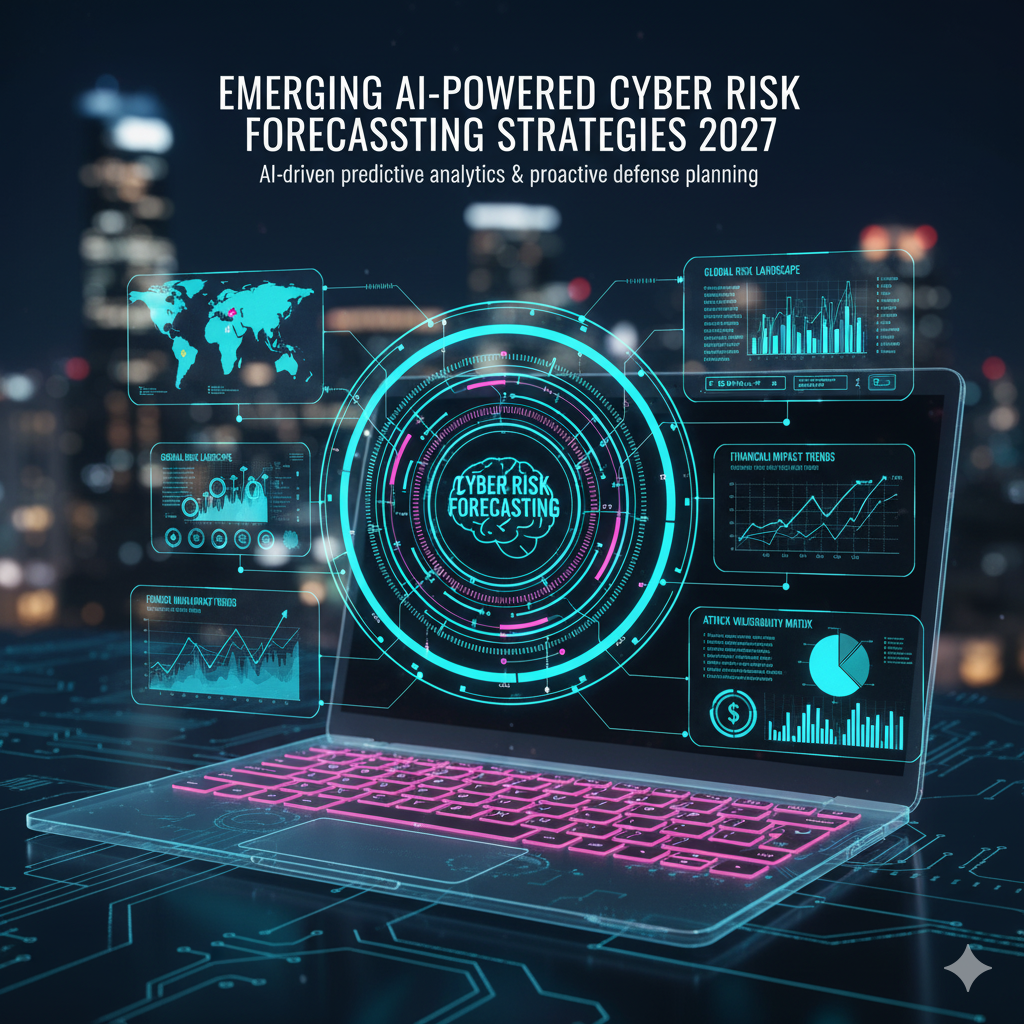
As enterprise operations become increasingly digital, the intensity, velocity, and sophistication of global cyber threats are escalating to unprecedented levels. From ransomware attacks targeting critical infrastructure to advanced persistent threats fueled by state-sponsored hacking groups, organizations worldwide face a digital battlefield that requires intelligent and adaptive defense systems. Traditional cybersecurity approaches built on static rule-based detection and reactive mitigation are no longer sufficient. By 2027, we are witnessing the emergence of a new frontier: AI-powered cyber risk forecasting. This paradigm integrates artificial intelligence, machine learning, predictive analytics, and real-time threat intelligence to anticipate attacks before they occur. These systems continuously learn from millions of threat vectors, simulate potential incidents, and generate predictive models that help businesses anticipate vulnerabilities, financial impacts, and remediation priorities. At Informatix.Systems, we provide cutting-edge AI, Cloud, and DevOps solutions that empower enterprises to implement proactive digital defense frameworks. By aligning forecasting models with enterprise risk postures, organizations can transform cybersecurity from a reactive cost center into a predictive intelligence function that drives strategic resilience and trust. The coming decade will redefine how enterprises perceive cyber defense not as preventing the next breach, but as predicting, modeling, and neutralizing threats before they materialize.
Understanding AI-Powered Cyber Risk Forecasting
The Definition and Purpose
AI-powered cyber risk forecasting applies data modeling, AI algorithms, and historical risk analytics to predict potential cybersecurity incidents. It quantifies exposure probabilities and financial impacts, enabling business leaders to prioritize mitigation investments based on risk probability, not speculation.
Core Components
- Machine learning models analyzing historical attack data.
- Behavioral analytics to detect anomalies in user and network behavior.
- Predictive scoring mechanisms evaluating system vulnerabilities.
- Real-time data ingestion from threat intelligence feeds.
Business Importance
Enterprises gain:
- Predictive visibility into evolving threats.
- Quantifiable metrics linking cybersecurity to financial performance.
- Dynamic risk modeling aligned with compliance standards.
- Enhanced decision-making through AI-driven insights.
Global Cyber Threat Landscape Shaping 2027
By 2027, cybersecurity will operate in an environment defined by automation, data saturation, and AI-driven offense.
Emerging Threat Categories
- Autonomous Malware: Self-learning malicious code capable of adapting mid-attack.
- Generative AI-Driven Phishing: Synthetic identity fraud and deepfake-enabled scams.
- IoT Botnets: Exploiting billions of connected devices for distributed attacks.
- Quantum Decryption Threats: Breaches leveraging post-quantum vulnerabilities.
Regional Dynamics
- North America and Europe: Increased cyber-espionage targeting AI research sectors.
- Asia-Pacific: Rising ransomware syndicates and fintech breaches.
- Middle East: Energy sector cyber disruption and state-level cyber warfare.
Strategic Implications
Businesses must integrate AI forecasting tools to:
- Anticipate attack types by region and industry.
- Simulate financial losses from probable breaches.
- Prioritize critical asset protection via predictive analytics.
How AI Forecasting Differs from Traditional Cyber Risk Management
| Aspect | Traditional Cybersecurity | AI-Powered Forecasting |
|---|---|---|
| Approach | Reactive, event-driven | Predictive, data-driven |
| Data Utilization | Historical only | Real-time + historical + forecast models |
| Response Model | Post-incident response | Pre-incident prevention |
| Decision Support | Manual threat interpretation | Automated risk scoring |
| Business Impact | Limited financial visibility | Quantified risk ROI |
AI transforms cyber defense from detection to anticipation, fundamentally changing corporate resilience metrics.
Machine Learning Models Behind Cyber Threat Prediction
Supervised Learning
Uses labeled datasets to train models for known threat signatures.
Example: Classifying phishing URLs or malware types based on input attributes.
Unsupervised Learning
Discovers hidden patterns or anomalies not previously recorded.
Example: Identifying zero-day attacks through deviation from normal traffic.
Reinforcement Learning
Optimizes decision-making by continuously improving model actions based on outcomes.
Example: Adaptive firewall systems modify defense rules autonomously.
Deep Learning Applications
Neural networks enable context-aware forecasting:
- Sentiment analysis from hacker forums.
- NLP-based detection of social engineering trends.
- Predictive maintenance for enterprise SOC systems.
Integrating Threat Intelligence with Predictive Analytics
AI enhances cyber threat intelligence (CTI) by automating data processing from heterogeneous sources.
Data Sources Integrated
- Dark web monitoring.
- Global incident databases.
- Network telemetry and SIEM logs.
- External CVE vulnerability feeds.
Predictive Outputs
- Threat probability heatmaps.
- Real-time anomaly graphs.
- Predictive risk scores for each asset.
At Informatix.Systems, we build frameworks that unify CTI and predictive analytics into single-vision dashboards, giving CISOs an early warning radar for potential risks.
Building an AI-Based Cyber Risk Forecasting Framework
Data Governance
Quality and heterogeneity of data determine predictive accuracy. Companies must:
- Implement automated data cleaning protocols.
- Establish secure data lakes for cyber threat logs.
Model Training and Validation
Machine learning models must be:
- Regularly retrained with fresh intelligence feeds.
- Benchmarked against emerging global attack datasets.
Integration with Governance, Risk, and Compliance (GRC)
Link AI forecasting results with frameworks like:
- NIST Cybersecurity Framework.
- ISO/IEC 27001 standards.
- GDPR and CCPA compliance modules.
Continuous Model Optimization
Feedback loops ensure ongoing adaptability to new threat landscapes.
AI Forecasting in Action
Financial Sector Risk Detection
A European bank adopted predictive AI tools that scanned 2TB of daily transaction data. Within 90 days, early detection of fraudulent network spikes reduced losses by 35%.
Manufacturing and IoT Security
An industrial manufacturer integrated AI-driven anomaly detection across IoT networks. Predictive insights identified potential machine vulnerabilities weeks before exploit attempts.
Healthcare Infrastructure Protection
Hospitals employed predictive modeling to forecast ransomware risks to patient record systems, improving response readiness and compliance assurance. These results underline the transition from post-attack defense to proactive threat intelligence, aligning operational continuity with smart resilience.
Economic Value and ROI from Predictive Cyber Defense
Tangible Benefits
- Cost reduction from avoided breaches.
- Insurance premium optimization through quantifiable risk profiles.
- Enhanced investor and customer confidence.
Indirect Gains
- Brand reputation protection.
- Streamlined compliance reporting through AI documentation.
- Improved operational uptime and data quality.
Firms using AI-driven forecasting exhibit up to 40% reduction in mean time to detect (MTTD) and mean time to respond (MTTR), proving measurable enterprise ROI.
Challenges and Ethical Considerations
Data Bias and Model Drift
AI systems may inherit biases from unbalanced datasets, leading to skewed predictions.
Adversarial Attacks
Malicious actors can manipulate AI inputs to generate false risk assessments.
Privacy and Compliance
Forecasting tools must comply with data privacy laws such as GDPR and AI accountability mandates.
Ethical Governance
Organizations must uphold transparency in algorithmic decision-making, ensuring fairness and explainability.
At Informatix.Systems, our AI solutions prioritize ethical AI alignment, ensuring tools enhance trust while maintaining compliance and transparency.
The Future of Cyber Risk Forecasting: 2027 and Beyond
Key Predictions
- Autonomous Defense Systems: AI predicting and neutralizing attacks autonomously.
- Quantum-Safe Algorithms: Predictive encryption minimizing post-quantum risks.
- AI-Driven Regulation Integration: Real-time compliance engines powered by predictive analytics.
Human-AI Collaboration
Future SOCs (Security Operation Centers) will function as symbiotic ecosystems, where human analysts interpret AI signals to steer executive-level risk strategy.
Implementing AI-Powered Cyber Forecasting at Informatix.Systems
At Informatix.Systems, we empower enterprises to deploy intelligent cyber defense ecosystems integrating AI, Cloud, and DevOps pipelines. Our modules include:
- AI-driven cyber forecasting simulators.
- Cloud-scale predictive threat engines.
- Smart SOC orchestration for global enterprises.
We help businesses transition from incident response to predictive resilience, ensuring operational continuity, financial protection, and strategic growth in a volatile digital landscape. AI-powered cyber risk forecasting is redefining enterprise cybersecurity. By merging predictive analytics, machine learning, and dynamic risk modeling, organizations gain early insight into probable threats, their financial implications, and mitigation priorities. As 2027 approaches, the enterprises leading in predictive intelligence will stand as the most resilient. Informatix.Systems remains at the forefront of this innovation, equipping organizations with future-ready AI, Cloud, and DevOps solutions. Contact Informatix.Systems today to accelerate your predictive cybersecurity transformation.
FAQs
What is AI-powered cyber risk forecasting?
It is the application of AI and machine learning to predict potential cyber threats, vulnerabilities, and financial risks before they occur.
Why is predictive cybersecurity important for enterprises?
It helps organizations move from reactive defense to proactive prevention, reducing costs and enhancing resilience.
What industries benefit most from AI forecasting?
Banking, healthcare, manufacturing, energy, and government sectors gain a significant advantage from predictive threat intelligence systems.
How does machine learning detect emerging threats?
ML models continuously analyze network behavior, detect anomalies, and compare patterns against evolving threat databases.
Can AI replace human cybersecurity professionals?
No, AI complements human expertise by automating analysis and highlighting priority areas for human review.
How does Informatix Systems contribute to this evolution?
Informatix.Systems designs enterprise-grade AI, Cloud, and DevOps solutions, integrating predictive security into digital transformation projects.
What are the main challenges of AI forecasting?
Data accuracy, ethical alignment, compliance standards, and model drift are key challenges that enterprises must manage strategically.
What will cybersecurity look like in 2027?
Cyber defense will become predictive, autonomous, and quantum-resilient, integrating AI-driven forecasting as a standard enterprise capability.
No posts found
Write a review