- 3/8, North Pirerbag
- 60 Feet Main Road
- Mirpur, Dhaka 1216
- +880-967-8247365
- support@informatix.systems

Advanced Persistent Threats Forecasting 2025
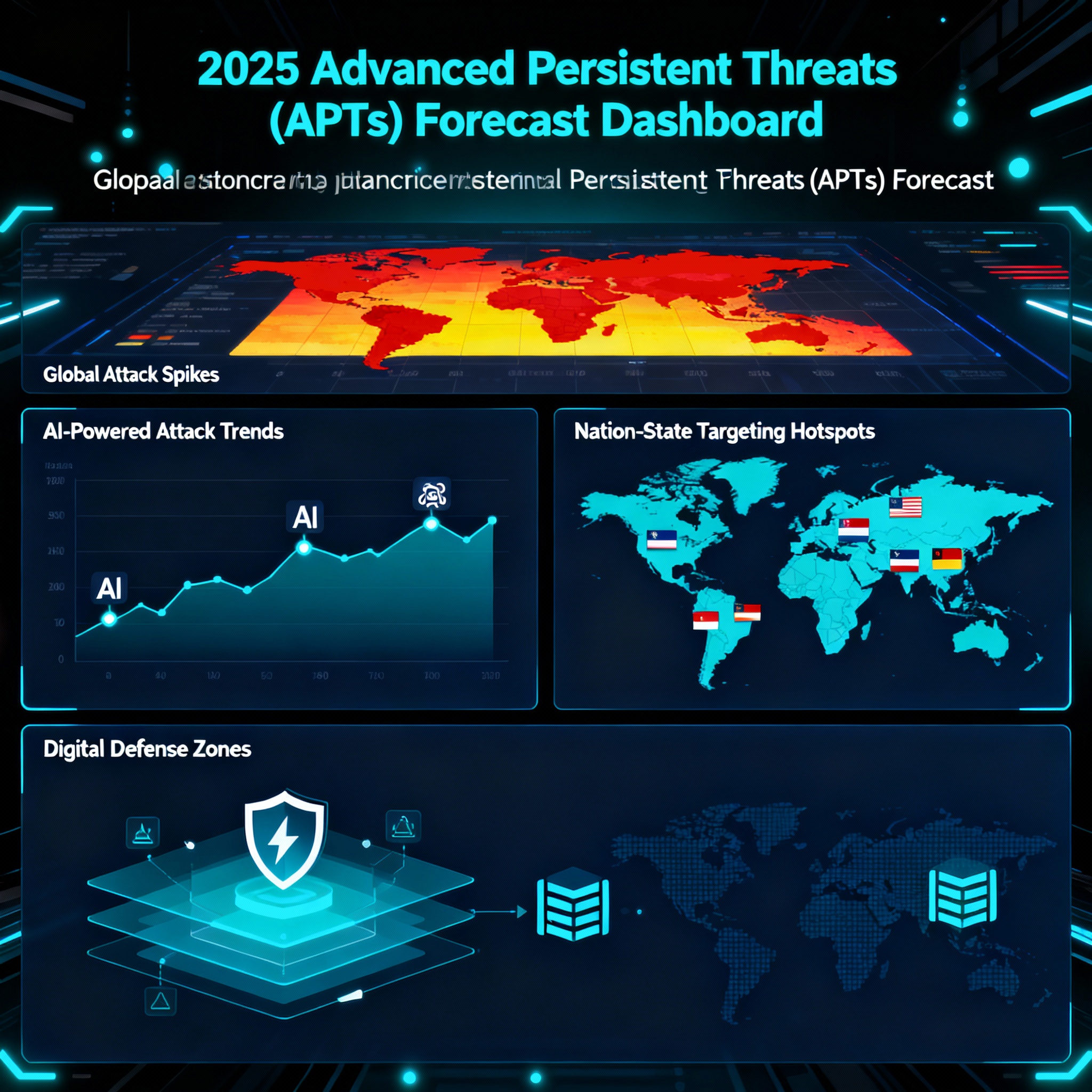
Cybersecurity in 2025 faces one of its most formidable challenges yet: the dominance of Advanced Persistent Threats (APTs). Unlike traditional attacks focused on immediate disruption or payout, APTs are strategic, long-term incursions designed to steal sensitive data, compromise infrastructure, and infiltrate critical operations over extended periods. State-backed cyber groups and well-funded threat actors are leveraging automation, artificial intelligence (AI), and persistent evasion techniques to stay invisible within enterprise networks for months or even years. Forecasting such advanced threats requires more than standard detection methods. Defensive strategies must now evolve into predictive cybersecurity, where intelligence systems can analyze telemetry, recognize subtle anomalies, and anticipate attack trajectories before execution. Predictive APT forecasting combines machine learning, behavioral analytics, and threat intelligence correlation to create self-learning models capable of identifying early indicators of multi-stage attack campaigns. The global impact of APT campaigns such as state-sponsored data espionage, industrial sabotage, and ransomware infiltration has elevated cyber risk to a strategic concern for both governments and private enterprises. Proactively forecasted threat models are critical to maintaining business continuity and data sovereignty in an era of constant digital warfare, at Informatix.Systems, we provide cutting-edge AI, Cloud, and DevOps solutions for enterprise digital transformation. Our predictive threat intelligence and cyber risk forecasting frameworks combine AI algorithms, automated SOC orchestration, and multi-cloud analytics to prevent and mitigate advanced persistent threats before they disrupt operations. This article explores how APT forecasting in 2025 is transforming global cybersecurity paradigms, focusing on key trends, AI-driven methodologies, global threat ecosystems, and the critical importance of collaborative intelligence for proactive cyber resilience.
Understanding Advanced Persistent Threats (APTs)
Definition and Key Characteristics
Advanced Persistent Threats refer to stealthy, coordinated, and long-term cyberattacks targeting specific organizations, usually led by professional or state-sponsored actors.
Typical APT Attributes:
- Advanced: Utilizes custom or zero-day exploits leveraging advanced malware or penetration techniques.
- Persistent: Maintains network access undetected for extended durations.
- Targeted: Focused on specific objectives like espionage, sabotage, or financial theft.
- Adaptive: Employs AI-driven evasion, polymorphism, and lateral movement across ecosystems.
Unlike conventional malware, APTs are multiphase operations designed to gather intelligence while remaining hidden through continuous reinvention.
The Rising Global Threat of APT Campaigns in 2025
APT incidents have reached new heights, affecting every sector, from finance and defense to healthcare and energy.
Global Trends:
- Nation-State Cyber Units: Expanding digital espionage capabilities across global powers.
- Hybrid Warfare Integration: Blending digital attacks with geopolitical conflicts.
- AI-Generated Attacks: Autonomous exploitation using generative adversarial networks (GANs).
- Persistent Cloud Exploitation: APTs targeting hybrid and multi-cloud resources.
- Supply Chain Breaches: The infiltration of vendor networks for indirect entry.
These multi-stage attacks are now coordinated through AI-enhanced command structures that modify behavior based on enterprise response tactics, rendering them more unpredictable than ever.
Phases of an Advanced Persistent Threat
The Standard APT Lifecycle Includes:
- Reconnaissance: Identifying vulnerabilities and gathering intelligence on targets.
- Initial Intrusion: Exploiting spear-phishing, remote code execution, or zero-day flaws.
- Establishment of Foothold: Deploying backdoors or trojans for persistence.
- Privilege Escalation: Gaining administrative access.
- Data Exfiltration: Transferring sensitive information covertly.
- Covering Tracks: Using anti-forensic, encryption, and fileless malware tactics to remain invisible.
AI-driven forecasting helps analysts detect early footprints, such as anomalous command requests, machine-to-machine activities, or subtle privilege escalation indicators.
Predictive Intelligence and APT Forecasting
Predictive APT defense relies on continuous risk modeling and AI algorithms that analyze large-scale telemetry in real time across endpoints, servers, and cloud networks.
Core Principles:
- Proactive Threat Mapping: Continuous scanning of known APT groups, tools, and behaviors.
- Behavioral Analytics: AI models learn normal system baselines to detect deviations.
- Probability Scoring: Generates predictive risk levels of attack occurrence.
- Temporal Correlation Models: Forecasts how threats evolve within a system.
At Informatix.Systems, we integrate predictive intelligence engines using reinforcement learning to build adaptive models capable of detecting coordinated attacker behaviors in advance.
Machine Learning Models in APT Detection and Forecasting
Common ML Techniques Deployed:
- Supervised Learning: Trains models using historical APT data (signature and behavioral indicators).
- Unsupervised Learning: Detects novel and unknown threat anomalies without pre-labelled inputs.
- Reinforcement Learning: Continuously adapts to evolving attacker strategies and defense interactions.
- Deep Learning Networks (DNNs): Discovers complex attack relationships buried within non-linear datasets.
AI-powered APT detection models form the backbone of predictive SOC operations, enabling the identification of undetected patterns invisible to rule-based systems.
Behavioral and Network Analytics in APT Forecasting
In 2025, AI-powered behavioral analytics will provide real-time visibility into network actions, baselines, and anomalies.
Components of Behavioral AI Defense:
- User and Entity Behavior Analytics (UEBA): Identifies discrepancies in typical user actions.
- Network Traffic Analysis (NTA): Monitors suspicious outbound traffic and control signatures.
- Fileless Activity Recognition: Detects in-memory process execution.
- Threat Intelligence Integration: Correlates external APT datasets with internal network activity.
Behavior-driven detection helps organizations move beyond signature-based alerts to intent-based prediction mechanisms.
Role of Global Threat Intelligence in APT Prediction
Collaborative global intelligence plays a crucial role in scanning, analyzing, and forecasting persistent threats.
CTI Network Contributions:
- Shared repositories of APT IoCs and techniques.
- Dark Web monitoring for command-and-control listings.
- Automated STIX/TAXII threat intelligence exchanges.
- Machine-to-machine information sharing among national CERTs.
At Informatix.Systems, we integrate global federated threat intelligence networks to feed AI engines with precise, time-stamped data points for localized APT prediction analytics.
AI-Powered SOC Automation Against APTs
Automating APT defense workflows enables real-time containment and reduces detection latency.
Key Advantages:
- Rapid Forensic Analysis: AI instantly reconstructs attack chains for investigation.
- Orchestrated Response (SOAR): Streamlines detection, response, and reporting.
- Adaptive Playbooks: AI dynamically alters automated responses based on attack context.
- Zero-Downtime Prevention: Autonomous rollback and network isolation.
Informatix.Systems’ SOC automation suite integrates CTI feedback loops, making APT mitigation faster, smarter, and minimally disruptive to enterprise operations.
Cloud Security Vulnerabilities and APT Targeting
Hybrid and multi-cloud environments are frequent APT targets in 2025.
Cloud-Based APT Attack Vectors:
- Compromised IaC (Infrastructure-as-Code) scripts.
- Exploited container vulnerabilities in Kubernetes.
- Data exfiltration through misconfigured APIs or S3 buckets.
- Credential theft in federated identity infrastructure.
Predictive models in cloud APT detection create anomaly baselines across multiple environments, allowing detection of subtle privilege escalations and lateral intrusions.
Ethical AI Governance in Predictive Threat Forecasting
As reliance on AI grows, responsible governance practices ensure transparency and accountability.
Key Governance Practices:
- Explainable AI (XAI): Every AI decision is auditable and interpretable.
- Bias Prevention: Continuously training on diverse datasets.
- Compliance Standardization: Aligning with ISO/IEC 42001 and NIST frameworks.
- Human-in-the-Loop Architecture: Ensures analyst supervision for critical decision-making.
Informatix.Systems adhere to Ethical AI governance models, guaranteeing secure, fair, and compliant implementation of predictive APT detection mechanisms.
Predictive Simulation and APT Readiness Testing
AI-powered cyber simulation frameworks help enterprises prepare for real-world APT threats through dynamic modeling.
Predictive Testing Tools:
- Digital Twin Infrastructures: Replicate enterprise environments for safe attack simulations.
- Generative AI Scenarios: Use predictive adversary models to simulate adaptive attacks.
- Vulnerability Scoring Automation: Ranks weaknesses dynamically based on exploitability.
Simulated exercises ensure human-AI coordination remains strong in analysis and response workflows, fortifying enterprises against advanced, real-time threats.
Future of APT Forecasting (2025–2030)
The future will bring AI systems that self-learn through federated intelligence and quantum-resistant prediction.
Emerging Innovations:
- Autonomous Threat Intelligence Graphs (TIG): AI that self-maps attacker webs and relationships.
- Quantum-Resilient Analytics: Predicting attack vectors in quantum computing eras.
- Adaptive ML Protection Mesh: Real-time self-correction of model drift.
- Global APT Prediction Hubs: Shared platforms for international threat transparency.
- Generative AI Defense Engines: Simulate attacker methods for preemptive mitigation.
APT forecasting will become the core of national cyber command systems and enterprise SOCs worldwide, uniting predictive intelligence with active defense. By 2025, Advanced Persistent Threat Forecasting will have become the cornerstone of global cybersecurity strategy. With AI-driven analytics, predictive automation, and federated intelligence, enterprises can finally predict, prevent, and defuse APTs before damage occurs. AI models deliver continuous learning cycles that enhance threat visibility, reinforce Zero Trust frameworks, and ensure multi-cloud resilience across the global business landscape at Informatix.Systems, we combine AI, Cloud, and DevOps-driven predictive cybersecurity systems to enable enterprises to outsmart APTs through intelligent threat forecasting, proactive automation, and continuous incident intelligence fusion. Partner with Informatix.Systems today to transform your defense posture and elevate your cybersecurity strategy from reactive containment to proactive foresight.
FAQs
What are Advanced Persistent Threats (APTs)?
APTs are long-term, stealthy cyber campaigns typically orchestrated by skilled or state-sponsored actors to infiltrate and control networks over time.
How can AI forecast APTs before they occur?
AI uses predictive analytics, behavioral baselines, and CTI data modeling to detect deviations that suggest early-stage intrusions.
What industries are most vulnerable to APTs?
Finance, healthcare, government, defense, and manufacturing sectors face the highest risks due to their critical data assets.
Why is predictive APT forecasting important?
It shifts defense from reactionary breach response to proactive threat prevention, improving long-term resilience and compliance readiness.
How does Informatix.Systems help organizations counter APTs?
We deliver AI-powered CTI, SOC automation, and predictive analytics systems that continuously learn from evolving APT threats to prevent intrusions.
What role does CTI play in APT forecasting?
CTI provides real-time global context, enabling AI engines to correlate attack indicators and predict likely threat actors or tactics.
What’s next for APT prevention post‑2025?
Expect the rise of autonomous defense ecosystems, quantum‑resilient AI, and global federated intelligence hubs optimizing predictive cyber defense.
No posts found
Write a review