- 3/8, North Pirerbag
- 60 Feet Main Road
- Mirpur, Dhaka 1216
- +880-967-8247365
- support@informatix.systems

CTI and Enterprise Risk Management
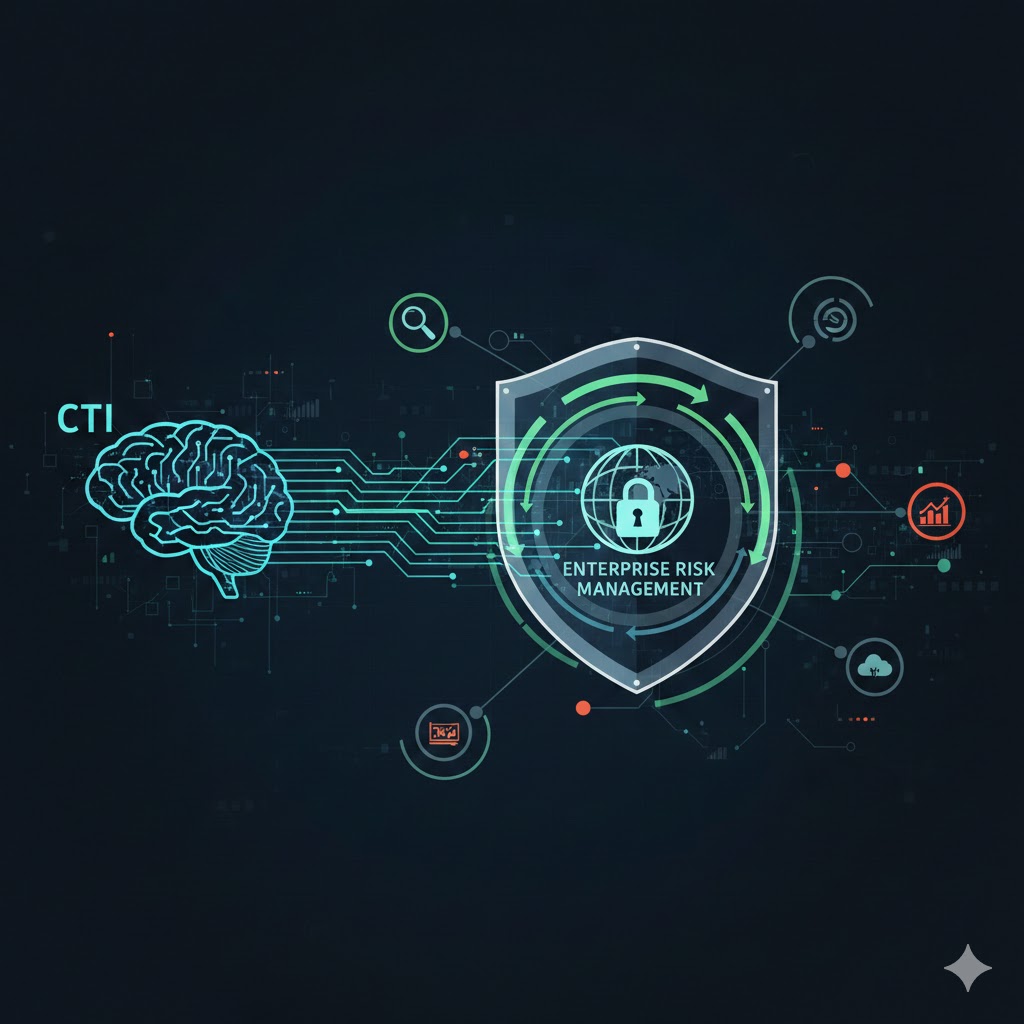
In today's hyper-connected digital landscape, enterprises face unprecedented cyber threats that evolve faster than traditional defenses can counter. Cyber Threat Intelligence (CTI) emerges as the critical bridge between raw threat data and actionable enterprise risk management (ERM) strategies, enabling organizations to anticipate, prioritize, and neutralize risks before they materialize. As cyber attackers leverage AI-driven tactics, supply chain vulnerabilities, and geopolitical tensions, CTI integration with ERM becomes non-negotiable for business continuity and competitive advantage. Enterprise Risk Management (ERM) traditionally encompasses financial, operational, and strategic risks, but cybersecurity threats now dominate boardroom agendas, with breach costs averaging $4.88 million globally in 2025. CTI provides the intelligence backbone, encompassing strategic, tactical, operational, and technical insights to quantify cyber risks within broader ERM frameworks like COSO and ISO 31000. This fusion shifts organizations from reactive firefighting to proactive resilience, aligning threat actor behaviors with business impact assessments. The business imperative is clear: companies integrating CTI into ERM report 30-50% faster incident response and reduced risk exposure. For 2026, as regulations like NIST CSF 2.0 and EU DORA tighten, enterprises must operationalize CTI to navigate third-party risks, AI vulnerabilities, and zero-day exploits. At Informatix.Systems, we provide cutting-edge AI, Cloud, and DevOps solutions for enterprise digital transformation, helping clients embed CTI-driven ERM seamlessly. This comprehensive guide explores CTI and Enterprise Risk Management synergies, from foundational concepts to advanced implementations. Readers will gain frameworks, best practices, tools, case studies, and future trends tailored for C-suite executives, CISOs, and risk officers seeking 2026 readiness.
What is Cyber Threat Intelligence (CTI)?
Cyber Threat Intelligence (CTI) refers to the collection, analysis, and dissemination of data on cyber threats, adversaries, and vulnerabilities to inform security decisions. Unlike raw logs or alerts, CTI delivers contextualized insights into threat actors' tactics, techniques, and procedures (TTPs), indicators of compromise (IoCs), and motivations.
Core Components of CTI
CTI encompasses structured processes:
- Data Collection: From open-source intelligence (OSINT), commercial feeds, and internal telemetry.
- Analysis: Applying frameworks like MITRE ATT&CK to contextualize threats.
- Dissemination: Tailored reports for stakeholders, from tactical IoCs to strategic briefs.
At Informatix.Systems, we provide cutting-edge AI, Cloud, and DevOps solutions for enterprise digital transformation, powering automated CTI pipelines that scale with enterprise needs.
Types of CTI for ERM
CTI categorizes into four primary types, each aligning with ERM maturity levels.
These types ensure comprehensive CTI and Enterprise Risk Management coverage, from macro trends to micro defenses.
Understanding Enterprise Risk Management (ERM)
ERM provides a holistic framework for identifying, assessing, and mitigating risks across an organization. It integrates governance, strategy, and operations per standards like COSO ERM, emphasizing risk appetite alignment.
Key ERM Principles
- Risk Identification: Cataloguing internal/external threats.
- Assessment: Likelihood vs. impact scoring.
- Response: Avoid, accept, mitigate, or transfer.
- Monitoring: Continuous Key Risk Indicators (KRIs).
CTI elevates ERM by injecting cyber-specific intelligence into these cycles.
Synergies Between CTI and ERM
CTI and Enterprise Risk Management converge to create dynamic risk profiles. CTI supplies threat context, while ERM quantifies business impact, enabling prioritized mitigation.
Integration Benefits
- Proactive Prioritization: Focus on high-impact threats via TTP-risk mapping.
- Resource Optimization: 40% reduction in false positives.
- Regulatory Alignment: Supports NIST, ISO 27001 compliance.
Organizations blending CTI into ERM achieve measurable ROI through reduced downtime and fines.
Leading ERM Frameworks Enhanced by CTI
Standard ERM frameworks gain potency with CTI infusion.
COSO ERM Framework
COSO's five components, Governance, Strategy, Performance, Review, Information—integrate strategic CTI for risk-informed decisions.
ISO 31000 Risk Management
This flexible standard uses CTI for context-aware risk treatment plans.
Other Frameworks
| Framework | CTI Integration Point | Maturity Level Boost |
|---|---|---|
| COSO | Strategy & Performance | High |
| ISO 31000 | Risk Assessment | Medium-High |
| NIST RMF | Monitor Phase | High |
| RIMS RMM | All Attributes | Progressive |
At Informatix.Systems, we provide cutting-edge AI, Cloud, and DevOps solutions for enterprise digital transformation, customizing these frameworks.
CTI Maturity Models for Enterprises
CTI Capability Maturity Model (CTI-CMM) benchmarks programs across four levels: Pre-Foundational, Foundational, Advanced, and Optimized.
Progression Path
- CTI0/CTI1: Ad-hoc IoC sharing.
- CTI2: Repeatable tactical intelligence.
- CTI3+: Strategic insights with action recommendations.
Align CTI maturity with ERM via shared KRIs like threat detection rate and response time.
Implementing CTI in ERM Processes
Successful CTI and Enterprise Risk Management integration follows a 10-step lifecycle.
Step-by-Step Guide
- Define Intelligence Requirements: Align with ERM risk appetite.
- Build Collection Pipelines: OSINT, feeds, internal sources.
- Analyze and Enrich: Use AI for TTP mapping.
- Disseminate Actionably: Dashboards, alerts.
- Measure and Iterate: Track KPIs quarterly.
Best Practices:
Top CTI Tools and Platforms for 2026
Select platforms unify feeds, analytics, and ERM integrations.
Leading Solutions
- Stellar Cyber TIP: AI-native, Open XDR integration.
- Recorded Future: AI-augmented insights.
- Exabeam: Unified threat library.
| Platform | Key Features | ERM Fit |
|---|---|---|
| Stellar Cyber | Feed aggregation, AI analytics | High |
| Recorded Future | Workflow integration | Enterprise |
| Mandiant | ATT&CK mapping | Advanced |
Key Metrics and KPIs
Track CTI in ERM success with:
- Threat Detection Rate: % threats caught.
- Mean Time to Respond (MTTR): Hours post-alert.
- Risk Reduction Score: Pre/post-CTI exposure.
- False Positive Rate: <5% target.
Dashboards visualize KRIs like vulnerability prioritization.
Real-World Case Studies
Financial Sector Phishing Defense
A bank used strategic CTI to train employees and filter 90% of phishing, averting credential theft.
Healthcare Ransomware Mitigation
CTI profiling blocked encryption via IoC blocking and playbooks.
Energy Infrastructure Protection
Tactical CTI reduced disruptions by 70% through vulnerability prioritization.
Lessons: CTI-ERM alignment yields rapid ROI.
Compliance and Regulatory Alignment
CTI supports ERM compliance in HIPAA, CMMC, DFARS, and FFIEC.
Overcoming Implementation Challenges
Common hurdles:
- Siloed Teams: Foster CISO-CRO collaboration.
- Data Overload: AI triage reduces fatigue.
- Skill Gaps: Training via platforms like Informatix.Systems.
Solutions:
- Start small with tactical CTI.
- Scale to enterprise dashboards.
At Informatix.Systems, we provide cutting-edge AI, Cloud, and DevOps solutions for enterprise digital transformation.
Future Trends: CTI and ERM in 2026
2026 heralds AI-agentic CTI, zero-trust supply chains, and GRC consolidation.
- AI-Augmented CTI: Autonomous threat hunting.
- Unified Platforms: ERM-CTI fusion.
- Quantum-Resistant Intelligence: Prep for post-quantum risks.
Enterprises adopting now lead in resilience. CTI and Enterprise Risk Management integration represents the evolution from siloed security to holistic resilience, delivering quantifiable risk reduction, compliance excellence, and strategic agility. By leveraging maturity models, frameworks, tools, and metrics outlined here, organizations position themselves for 2026's threats. Ready to fortify your ERM with advanced CTI? Contact Informatix.Systems today for a personalized consultation on our cutting-edge AI, Cloud, and DevOps solutions for enterprise digital transformation. Transform risks into opportunities. Schedule your demo now at https://informatix.systems.
FAQs
What is the primary role of CTI in ERM?
CTI provides threat context to prioritize risks, shifting ERM from static to dynamic.
How do I measure CTI-ERM ROI?
Track MTTR reduction, false positive rates, and risk score improvements.
Which ERM framework best integrates CTI?
COSO and NIST RMF excel due to their monitoring emphases.
What are the 2026 CTI trends for enterprises?
AI automation, unified platforms, and supply chain focus.
How does CTI address third-party risks?
Via continuous monitoring and vulnerability prioritization.
Can small enterprises implement CTI-ERM?
Yes, start with cloud-native platforms and tactical feeds.
What compliance standards require CTI?
How to build CTI maturity?
Follow CTI-CMM: from ad-hoc to optimized intelligence.
No posts found
Write a review