- 3/8, North Pirerbag
- 60 Feet Main Road
- Mirpur, Dhaka 1216
- +880-967-8247365
- support@informatix.systems

CTI and Enterprise Security Posture
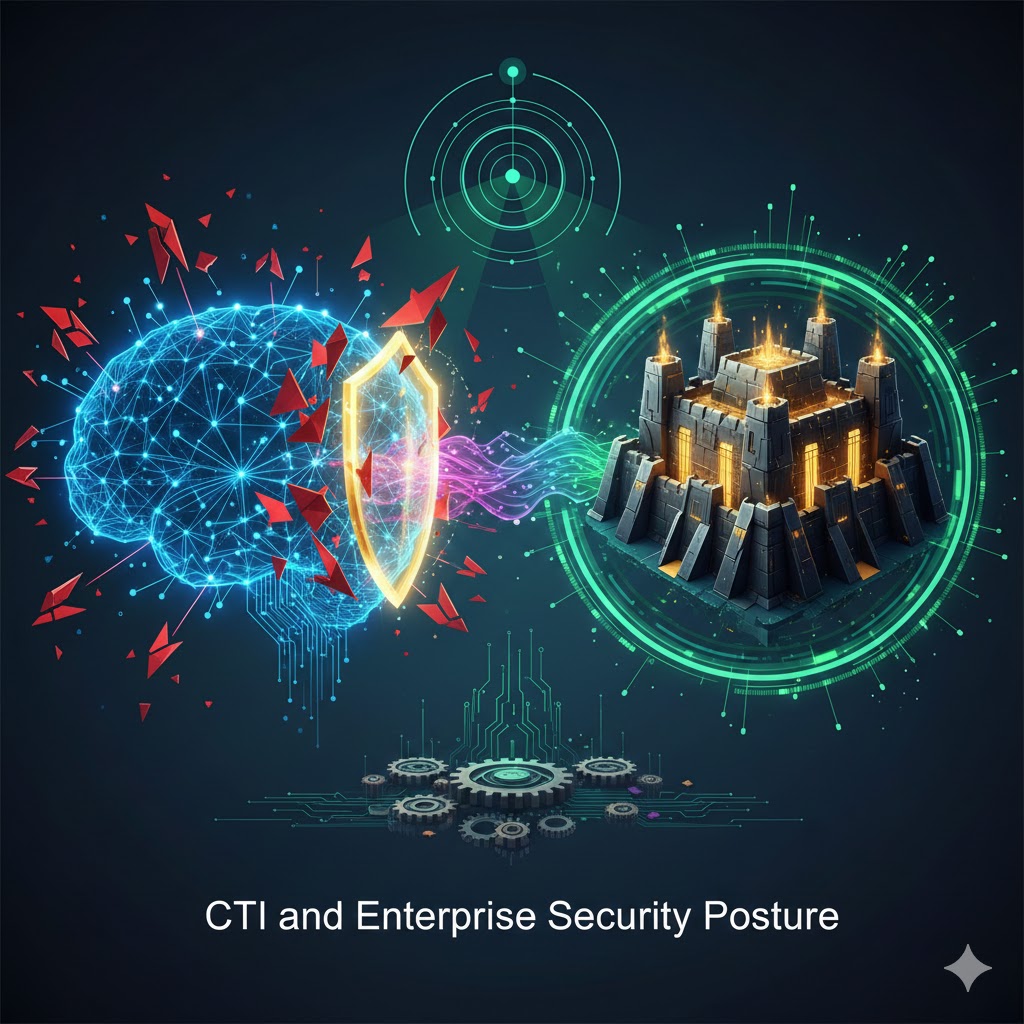
In the rapidly evolving landscape of 2026, enterprises face unprecedented cyber threats, from sophisticated ransomware campaigns to nation-state advanced persistent threats (APTs). Cyber Threat Intelligence (CTI) emerges as the cornerstone for bolstering enterprise security posture, transforming reactive defenses into proactive fortresses. Enterprise security posture refers to the overall strength and resilience of an organization's cybersecurity framework, encompassing people, processes, and technology aligned to mitigate risks effectively. CTI involves collecting, analyzing, and disseminating actionable insights on threats, adversaries, and attack tactics, enabling organizations to anticipate dangers before impact. Businesses ignoring CTI risk are facing devastating breaches. Statistics show that proactive CTI adopters reduce incident response times by up to 70% and cut breach costs significantly. For global enterprises juggling multi-cloud environments and DevSecOps pipelines, integrating CTI with tools like SIEM, XDR, and ESPM (Enterprise Security Posture Management) is non-negotiable. The business imperative is clear: In 2026, regulatory pressures like GDPR, NIST CSF, and emerging AI security mandates demand a robust CTI-driven security posture. Companies leveraging CTI report 68% fewer incidents and 54% lower security costs, freeing resources for innovation at Informatix.Systems, we provide cutting-edge AI, Cloud, and DevOps solutions for enterprise digital transformation, helping clients operationalize CTI seamlessly across hybrid infrastructures. This article explores CTI's role in elevating enterprise security posture, from foundational concepts to 2026 trends like AI-enhanced analytics and Zero Trust integration. Enterprise leaders will gain actionable strategies to measure maturity, deploy tools, and achieve ROI through real-world case studies.
What is Cyber Threat Intelligence?
Cyber Threat Intelligence (CTI) is the disciplined process of gathering, analyzing, and applying data on cyber threats to inform security decisions. It shifts organizations from reactive firefighting to predictive defense, directly enhancing enterprise security posture. CTI encompasses vetted evidence on adversaries' tactics, techniques, and procedures (TTPs), indicators of compromise (IOCs), and strategic motivations. Unlike raw logs, CTI delivers context,e.g., linking a phishing IOC to an APT group targeting finance sectors.
Types of CTI
- Strategic CTI: High-level insights for executives on geopolitical threats and industry risks.
- Operational CTI: Details adversary campaigns, campaigns, and targeting patterns for SOC teams.
- Tactical CTI: Technical IOCs and TTPs (e.g., MITRE ATT&CK mappings) for detection engineering.
- Technical CTI: Raw feeds like malware hashes for automated blocking.
Enterprises prioritizing CTI integration see improved threat prioritization, reducing alert fatigue by 50%.
Understanding Enterprise Security Posture
Enterprise security posture measures an organization's holistic cybersecurity resilience against evolving threats. It integrates visibility, detection, response, and recovery across endpoints, networks, cloud, and identities. Key components include continuous monitoring, vulnerability management, and compliance alignment. Weak postures lead to exploits; strong ones, enabled by CTI, enable Zero Trust architectures.
Core Elements
- Visibility: Real-time asset inventory and risk scoring.
- Controls: Policy enforcement and automated remediation.
- Metrics: MTTD (Mean Time to Detect) and MTTR (Mean Time to Respond).
At Informatix.Systems, we provide cutting-edge AI, Cloud, and DevOps solutions for enterprise digital transformation, optimizing security posture through CTI-enriched platforms.
The Role of CTI in Strengthening Security Posture
CTI elevates enterprise security posture by providing actionable foresight, enabling proactive hardening. It informs vulnerability prioritization, reducing exploit windows by 71%.
Key Benefits:
- Proactive Threat Hunting: Anticipate attacks via TTP analysis.
- Resource Optimization: Focus on high-impact risks.
- Incident Reduction: Early warnings block 60% more threats.
Integration with ESPM tools correlates CTI with endpoint data for unified risk views.
CTI Maturity Models for Enterprises
CTI maturity models roadmap progression from ad-hoc to AI-driven excellence. The CTI-CMM defines levels: Pre-Foundational (CTI0) to Optimized (CTI4).
Assess via NIST CSF or SANS frameworks; aim for Level 3+ by 2026.
Transition Strategies
Top CTI Tools and Platforms for 2026
2026's CTI platforms emphasize AI, multi-source fusion, and DevSecOps integration. Leaders include ThreatConnect, Cyble Vision, and Anomali.
Must-Have Features:
- Real-time feeds from 60+ OSINT sources.
- AI/ML for false positive reduction.
- ATT&CK visualizers and SOAR playbooks.
Integrating CTI with SIEM and XDR
CTI-SIEM integration enriches logs with threat context, cutting false positives by 90%. XDR extends this across endpoints, cloud, and identity.
Implementation Steps:
- Ingest CTI feeds via APIs.
- Correlate IOCs with SIEM rules.
- Automate via SOAR for enrichment.
Benefits include faster MTTR and unified dashboards.
CTI in DevSecOps and Cloud Environments
CTI in DevSecOps scans pipelines for vulnerable dependencies, blocking Log4Shell-like risks pre-deployment.
Best Practices:
- Automate feed ingestion in CI/CD.
- Use CTI for dynamic policy updates.
- Integrate with CSPM for cloud misconfigurations.
Cloud Security Posture gains from CTI via proactive vulnerability prioritization. At Informatix.Systems, we provide cutting-edge AI, Cloud, and DevOps solutions for enterprise digital transformation.
Leveraging AI and ML in CTI
AI-enhanced CTI processes vast data at speed, predicting threats with 95% accuracy. ML automates anomaly detection and TTP correlation.
Applications:
- Automation: Reduce analyst workload by 47%.
- Prediction: Forecast APT campaigns.
- Efficiency: MTTD from 200 to 20 minutes.
2026 trends: Generative AI for report synthesis.
Real-World Case Studies
Financial Firm: CTI blocked phishing, reducing incidents 80% via employee training and filters.
Healthcare Provider: Mitigated ransomware with actor profiling, restoring systems in hours.
Retail Giant: Supply chain CTI prevented vendor compromise, enhancing third-party monitoring.
Global Bank: Integrated CTI cut response from 10 days to 5 hours.
ROI: 68% incident drop, $12M savings.
Best Practices for CTI Implementation
CTI best practices follow a lifecycle: Plan, Collect, Process, Analyze, Disseminate.
- Define PIRs: Align with business risks.
- Stakeholder Buy-In: Measure ROI via MTTD/MTTR.
- Automate Workflows: Use SOAR for scalability.
Train teams on MITRE ATT&CK start small, scale to AI.
Measuring CTI ROI and Metrics
CTI ROI tracks reduced breaches and compliance savings. Key metrics: MTTD (<24h), MTTR (<1h), risk reduction (68%).
Quantification:
- Cost Savings: 54% lower ops costs.
- Efficiency: 71% faster audits.
- Business Impact: Dollar-based risk scoring.
Dashboards visualize posture improvements.
Future Trends in CTI and Security Posture (2026+)
2026 CTI trends: AI-driven automation, quantum-resistant feeds, ecosystem sharing. ESPM evolves with XDR for unified views.
- Post-Quantum CTI: Defend against quantum threats.
- AI Amplification: Auto-remediation.
- Global Collaboration: ISACs for real-time intel.
Enterprises adopting now lead in resilience. CTI fundamentally transforms enterprise security posture from vulnerable to resilient, driving proactive defense, efficiency, and ROI in 2026. By mastering maturity models, AI tools, and integrations like SIEM/XDR/DevSecOps, organizations stay ahead of threats.
FAQs
What is the difference between CTI and traditional security alerts?
CTI provides contextual, predictive insights beyond raw alerts, enabling prioritization and proactivity.
How does CTI improve enterprise security posture?
It reduces MTTD/MTTR, optimizes resources, and aligns defenses with real threats.
Which CTI platforms are best for 2026 enterprises?
ThreatConnect for automation, Cyble for AI prediction; integrate with SIEM/XDR.
Can small enterprises implement CTI effectively?
Yes, start with open-source tools like MISP and cloud feeds for foundational maturity.
What role does AI play in CTI?
AI automates analysis, predicts threats, and cuts false positives by 90%.
How to measure CTI success?
Track MTTD, MTTR, incident reduction, and ROI via risk metrics.
Is CTI essential for cloud security posture?
Absolutely; it prioritizes CSPM findings and blocks supply chain risks.
What are CTI integration challenges?
Data silos and skills gaps; overcome with automation and training.
No posts found
Write a review