- 3/8, North Pirerbag
- 60 Feet Main Road
- Mirpur, Dhaka 1216
- +880-967-8247365
- support@informatix.systems

Cyber Threat Intelligence and Intelligent Cyber Intelligence
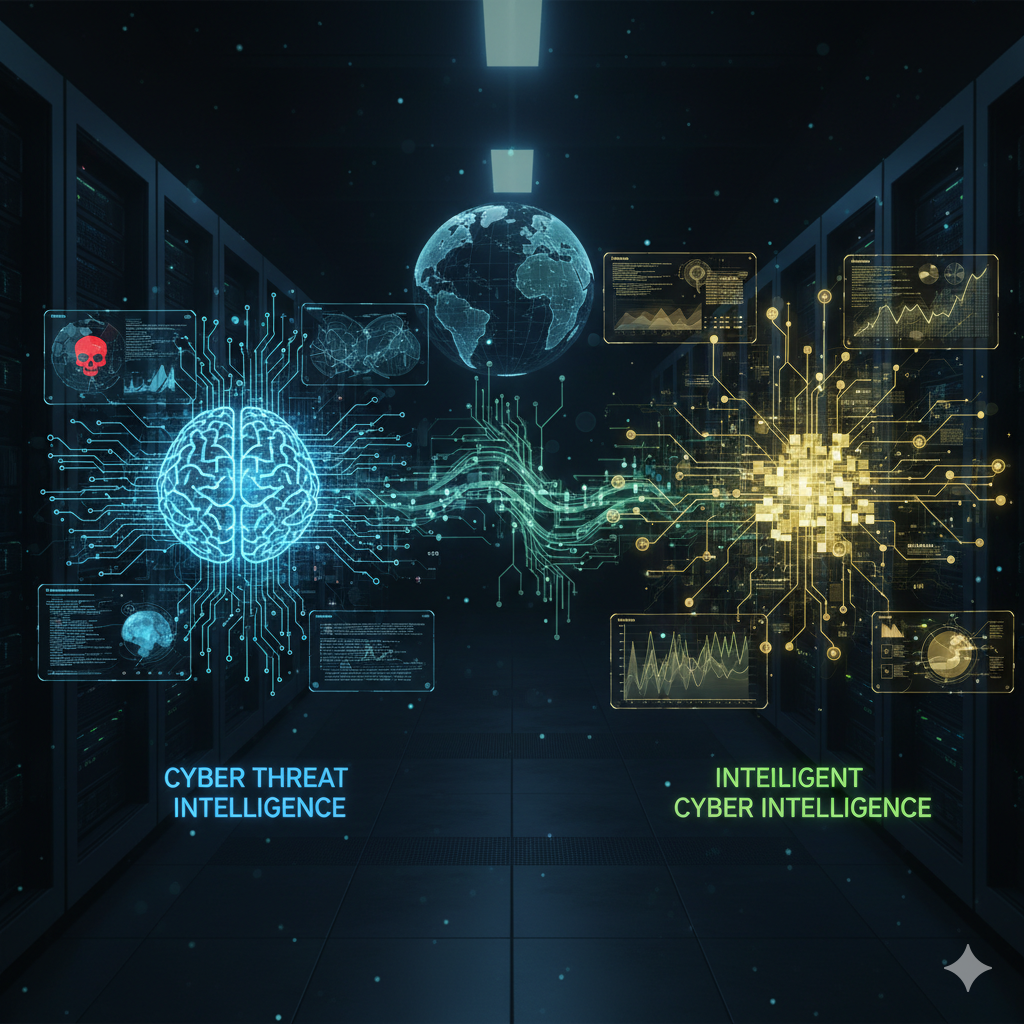
In 2026, cyber threat intelligence (CTI) matures into intelligent cyber intelligence, marking a paradigm shift from reactive data aggregation to proactive, AI-orchestrated foresight that anticipates adversary maneuvers with machine precision. Traditional CTI delivers structured insights across strategic (campaign landscapes), operational (actor targeting), tactical (MITRE ATT&CK TTPs), and technical (IOCs like hashes and domains) dimensions, but intelligent cyber intelligence infuses agentic AI to automate the full lifecycle, self-collecting from OSINT/dark web, enriching via graph analytics, predicting via ML ensembles, and acting through SOAR integrations. As attackers wield generative AI for polymorphic malware, deepfake phishing, and autonomous reconnaissance, enterprises face $12+ trillion in cyber losses, with identity fabrics and supply chains as prime vectors. Agentic threats scale attacks beyond human response times, demanding intelligence that evolves autonomously. Business criticality intensifies: CISOs deploying intelligent CTI achieve 70% MTTD reductions, 5x alert prioritization, and compliance with EU AI Act mandates, converting security from overhead to revenue protector. Intelligent systems fuse external feeds with internal telemetry for real-time risk surfaces, enabling self-healing networks and predictive containment. At Informatix.Systems, we provide cutting-edge AI, Cloud, and DevOps solutions for enterprise digital transformation, powering seamless transitions to intelligent paradigms. This comprehensive guide dissects distinctions, frameworks, platforms, and 2026 trends like TTP operationalization and cyber fusion centers, equipping leaders to harness intelligence that thinks, adapts, and defends like never before.
CTI Fundamentals
Cyber threat intelligence systematically processes threat data into actionable knowledge, categorizing threats by IOCs, TTPs, and campaigns to inform defenses. It operates reactively, relying on human analysts for correlation and dissemination. High-maturity CTI reduces false positives by 60% through enrichment.
CTI Intelligence Pyramid
- Strategic: Executive geopolitical overviews.
- Operational: Campaign motivation analysis.
- Tactical: Tool/infrastructure mapping.
- Technical: Immediate IOC blocking rules.
Forms the foundation for intelligent evolution.
Intelligent Cyber Intelligence Defined
Intelligent cyber intelligence deploys AI agents to execute CTI autonomously: reasoning over data, predicting evolutions, and orchestrating responses without constant oversight. It shifts to behavioral IOBs over static IOCs, achieving 80% predictive accuracy. Agentic systems self-improve via feedback loops.
Intelligence hallmarks
- Autonomy: End-to-end lifecycle execution.
- Adaptivity: Real-time model retraining.
- Proactivity: Preemptive action triggers.
Transforms SOCs into thinking ecosystems.
Key Differences: CTI vs Intelligent CI
CTI describes what happened; intelligent CI forecasts what will happen next. Humans dominate CTI processing; AI handles 85% in intelligent systems. Scale differs: CTI for teams, intelligence for enterprise swarms.
| Aspect | CTI | Intelligent CI |
|---|---|---|
| Processing | Manual/ML-assisted | Fully agentic |
| Output | Reports/IOCs | Predictions/actions |
| Speed | Hours/days | Milliseconds |
Hybrid models bridge gaps.
Evolution Path to 2026
2026 trajectory: CTI → AI-assisted → agentic intelligence, driven by skills shortages (4.8M gap) and attack velocity. Milestones include TTP focus, supply chain fusion, and AI threat monitoring.
Phased Roadmap:
- 2025: Enrichment automation.
- 2026: Autonomous fusion centers.
At Informatix.Systems, we provide cutting-edge AI, Cloud, and DevOps solutions for enterprise digital transformation.
Lifecycle Transformation
Six-phase CTI cycle gains intelligence: AI plans via risk models, collects multi-source, analyzes predictively, disseminates via natural language, and feeds back autonomously. Cuts cycle time 90%.
Intelligent Phases
| Phase | Traditional | Intelligent Upgrade |
|---|---|---|
| Analysis | Correlation | ML forecasting |
| Dissemination | Static reports | Dynamic dashboards |
| Feedback | Manual | Self-optimization |
Enables continuous intelligence.
2026 Trends in Intelligent CI
Agentic dominance: AI defends AI via model guards, prompt filters; collective defense via shared agents; cyber fusion with vuln/asset data. Identity intelligence surges for machine humans.
Emerging Trends:
Building Intelligent Teams
Augmented teams: 20% analysts, 80% AI orchestrators/engineers. Skills: agent governance, ML ops, ethical AI. Scale via CoEs.
Roles Matrix
| Role | Focus | Tools |
|---|---|---|
| Intelligence Lead | Agent strategy | LangChain |
| AI Engineer | Model deployment | TensorFlow |
| Validator | Oversight | Red-team sims |
Leading Intelligent Platforms
2026 elite: Cyware (proactive agents), Flare (identity intel), Anomali (fusion), Recorded Future (prediction). Metrics: autonomy depth, TTP coverage.
Platform Comparison
| Platform | Intelligence Strength | Best For |
|---|---|---|
| Cyware | Agentic CTI | Enterprises |
| Flare | Behavioral focus | Identity threats |
| Anomali | Risk fusion | SOCs |
API ecosystems extend.
Metrics for Intelligent Success
Track prediction accuracy (85%), autonomy ratio (90%), action velocity, and ROI (6:1). Dashboards monitor drift.
Core KPIs:
Secure Intelligence Sharing
STIX 2.2/TAXII with agent verification; federated learning preserves privacy. ISACs become intelligence meshes, boosting efficacy 65%.
Protocols:
Intelligence Impact
Banks preempted AI phishing via behavioral forecasts; manufacturers fused supply intel, averting 95% compromises. Healthcare guarded models from poisoning.
Lessons:
DevSecOps Intelligence Integration
Embed agents in pipelines: predictive scans, auto-policy gen, threat-sim merges. Accelerates secure velocity 50%.
Steps:
- Streaming feeds.
- Intelligence gates.
- Feedback enrichment.
At Informatix.Systems, we provide cutting-edge AI, Cloud, and DevOps solutions for enterprise digital transformation.
Skills for Intelligent Leaders
Master agentic AI, Bayesian forecasting, MITRE CTID. Certs: GCTI, SANS CTI.
Framework:
Maturity Model
Levels: Basic CTI (1), Assisted (3), Intelligent (5). Annual progression.
Path:
Countering Intelligent Adversaries
AI guards, adversarial training, zero-trust intelligence. Dynamic defenses match speeds.
Regulatory Alignment
AI Act compliance via auditable intelligence. Builds trust.
Vendor Ecosystems
POC agentic platforms; hybrid MSSPs.
2027 Horizons
Neuromorphic intelligence, global meshes.
Cyber threat intelligence and intelligent cyber intelligence converge in 2026 to create adaptive, prescient defenses against agentic eras. Frameworks, platforms, and integrations deliver transformative security. Elevate to intelligent defense with Informatix.Systems. Visit https://informatix.systems for AI, Cloud, and DevOps to intelligize your security now.
FAQs
CTI vs intelligent cyber intelligence?
CTI reactive data; intelligence proactive AI action.
2026 key trends?
Top platforms?
Success metrics?
Sharing methods?
DevSecOps role?
Leader skills?
Challenges?
No posts found
Write a review