- 3/8, North Pirerbag
- 60 Feet Main Road
- Mirpur, Dhaka 1216
- +880-967-8247365
- support@informatix.systems

Cyber Threat Intelligence for AI-Driven Security Teams
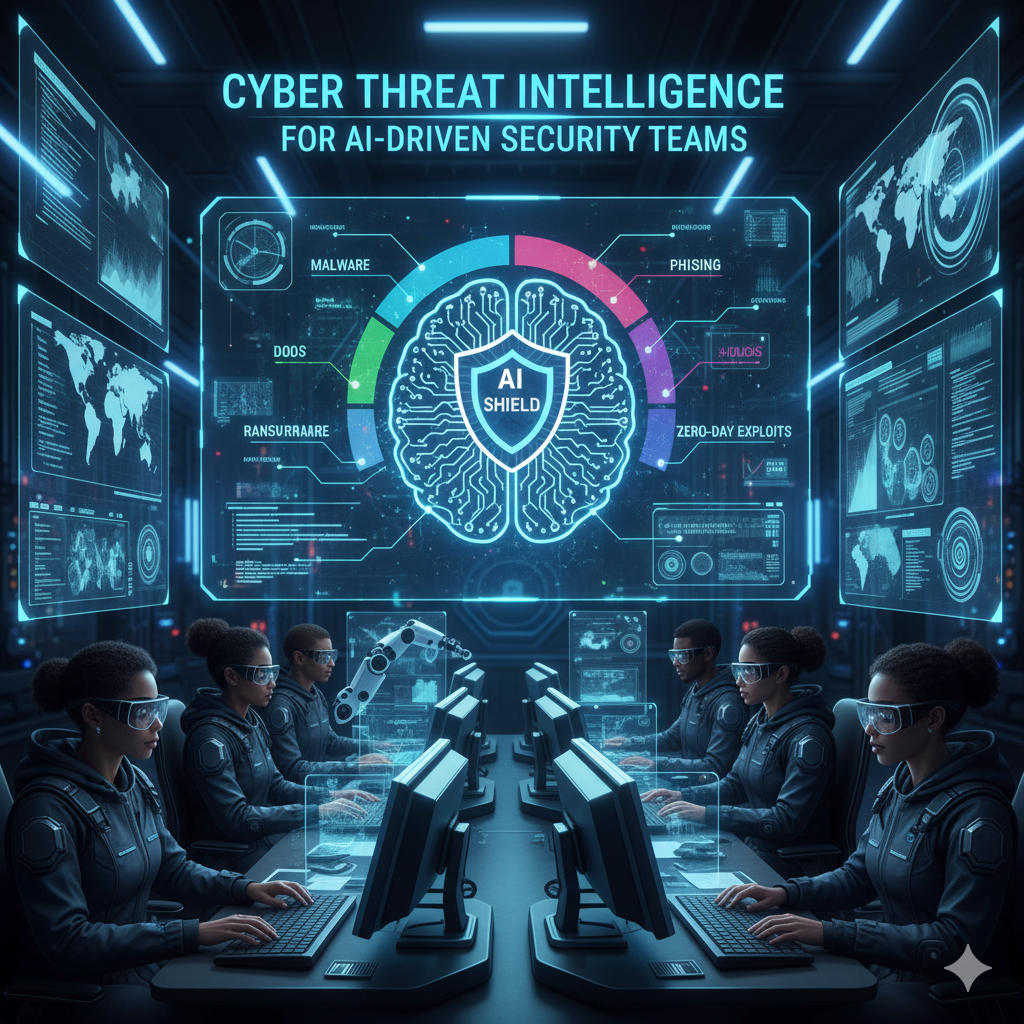
In 2026, AI-driven security teams operate at the forefront of a cyber battlefield transformed by autonomous attacks, where generative AI crafts undetectable phishing and malware mutates in real-time. Cyber Threat Intelligence (CTI) serves as the critical force multiplier, delivering contextualized adversary insights that supercharge AI models for superior threat hunting and response. Without CTI, even advanced AI systems falter on incomplete data; fused, they reduce detection times from days to seconds, preventing breaches that could cost enterprises millions amid projected $11 trillion annual global cyber losses. For security teams leveraging AI platforms like SOAR and XDR, CTI provides the why behind anomalies, adversary TTPs, campaign intel, and predictive signals, enabling machine learning algorithms to evolve dynamically. Business stakes escalate as regulators demand AI governance under frameworks like the EU AI Act 2.0, while boards scrutinize SecOps efficiency amid talent shortages. Teams integrating CTI achieve 65% faster triage, 40% fewer false positives, and compliance-ready audit trails, turning security from a cost center to a strategic asset. The 2025 explosion of agentic AI threats underscored this synergy: organizations with CTI-enriched AI blocked 80% more zero-days. At Informatix.Systems, we provide cutting-edge AI, Cloud, and DevOps solutions for enterprise digital transformation, helping teams deploy seamless CTI pipelines that automate from intel ingestion to automated playbooks. This comprehensive guide equips AI-driven security professionals with frameworks, tools, workflows, and 2026 strategies to dominate the threat landscape.
Fundamentals of CTI for Security Teams
Cyber Threat Intelligence transforms raw threat data into actionable knowledge across tactical, operational, and strategic layers, tailored for AI consumption via structured feeds and APIs.
Essential Elements:
- Indicators of Compromise (IoCs): IPs, hashes for immediate blocking.
- Tactics, Techniques, Procedures (TTPs): Behavioral patterns for AI training.
- Campaign Intelligence: Linked adversary operations.
AI teams use STIX/TAXII standards for machine-readable exchange.
Tactical CTI Workflows
AI-Driven Security Team Architectures
Modern teams center on AI-orchestrated SOCs, blending human expertise with autonomous agents for continuous operations. CTI feeds ML models in XDR platforms, enabling behavioral analytics at scale.
Core Components:
- AI triage engines prioritize alerts.
- Autonomous response via SOAR.
- Predictive hunting with graph analytics.
Integrating CTI into AI Pipelines
Seamless API integrations pull CTI into data lakes, where ML pipelines enrich logs with threat context. Platforms normalize feeds for vector embeddings in LLMs.
Integration Steps:
- Deploy threat intel gateways.
- Map CTI schemas to AI inputs.
- Enable feedback loops for model refinement.
At Informatix.Systems, we provide cutting-edge AI, Cloud, and DevOps solutions for enterprise digital transformation.
Key CTI Frameworks for AI Teams
MITRE ATT&CK powers AI mapping of TTP coverage, while Diamond Model fuels graph-based relationship analysis for anomaly detection.
| Framework | AI Application | Team Benefit |
|---|---|---|
| MITRE ATT&CK | Technique prediction | Coverage gap alerts |
| Diamond Model | Pivot analytics | Novel threat discovery |
| Kill Chain 2.0 | Phase interruption | Automated blocks |
2026 Trends: AI + CTI Convergence
Expect agentic AI analysts parsing intel autonomously, with federated learning across ISACs. TTP prediction models anticipate adversary shifts.
Breakthrough Trends:
- Homomorphic encryption for secure intel sharing.
- Self-healing networks via predictive CTI.
- Multimodal AI fusing text/video intel.
Building AI-Enhanced Threat Hunting
Hunters leverage CTI hypotheses in Jupyter notebooks, training custom models on enriched datasets for proactive searches.
Hunting Workflow:
Automation and SOAR with CTI Triggers
SOAR playbooks activate on CTI signals, chaining enrichment, isolation, and forensics automatically.
Advanced Playbooks
Team Successes
A fintech team used CTI-AI fusion to neutralize an APT in 14 minutes, versus 72 hours manually. Manufacturing blocked supply chain ransomware via predictive intel.
Metrics Achieved:
Metrics and KPIs for AI-CTI Teams
Track intel utilization rates, model accuracy post-enrichment, and threat coverage scores.
Dashboard KPIs:
Overcoming Integration Challenges
Address API latency and data freshness with edge caching and streaming Kafka topics. Mitigate alert storms via AI deduplication.
Solutions
- Containerized microservices for scalability.
- Human-in-loop for novel threats.
- Vendor-agnostic normalizers.
At Informatix.Systems, we provide cutting-edge AI, Cloud, and DevOps solutions for enterprise digital transformation.
Skills Roadmap for 2026 Teams
Upskill in Python for Intel processing, graph ML, and prompt engineering for Intel LLMs.
Training Priorities:
Vendor Ecosystem and Partnerships
Curate MSSP partners with strong CTI pipelines; evaluate on enrichment depth and SLA uptime.
Regulatory Compliance Automation
AI-CTI generates SBOMs, risk registers, and audit trails for NIST 2.0 and CMMC 3.0.
Scaling for Global Operations
Distributed teams use unified CTI lakes with geo-redundant feeds for 24/7 coverage.
Future Innovations: 2027 Horizons
Neuromorphic chips accelerate real-time TTP matching; quantum CTI resists decryption threats. Cyber Threat Intelligence empowers AI-driven security teams to transcend reactive postures, achieving predictive mastery over 2026 threats. Through strategic integrations, advanced workflows, and continuous evolution, teams deliver unmatched resilience and efficiency. Transform your SecOps with Informatix.Systems for AI-CTI accelerators. Schedule your deployment strategy session at https://informatix.systems today.
FAQs
How does CTI improve AI detection accuracy?
Provides contextual training data, reducing false positives by enriching baselines.
What APIs standardize CTI for AI?
STIX/TAXII for structured, machine-readable threat exchange.
Which metric proves CTI ROI for teams?
MTTR reduction and threat coverage percentage.
How to start CTI integration?
Pilot with one feed into SIEM, scale via APIs.
What 2026 trend transforms teams?
Agentic AI automating full intel-to-response cycles.
Can open-source tools suffice?
MISP + custom ML works for startups; enterprises need commercial feeds.
How does Informatix.Systems enable this?
Custom AI pipelines fusing CTI with team workflows.
Is CTI-AI scalable for distributed teams?
Cloud-native architectures ensure global consistency.
No posts found
Write a review