- 3/8, North Pirerbag
- 60 Feet Main Road
- Mirpur, Dhaka 1216
- +880-967-8247365
- support@informatix.systems

Cyber Threat Intelligence for Autonomous Cyber Security
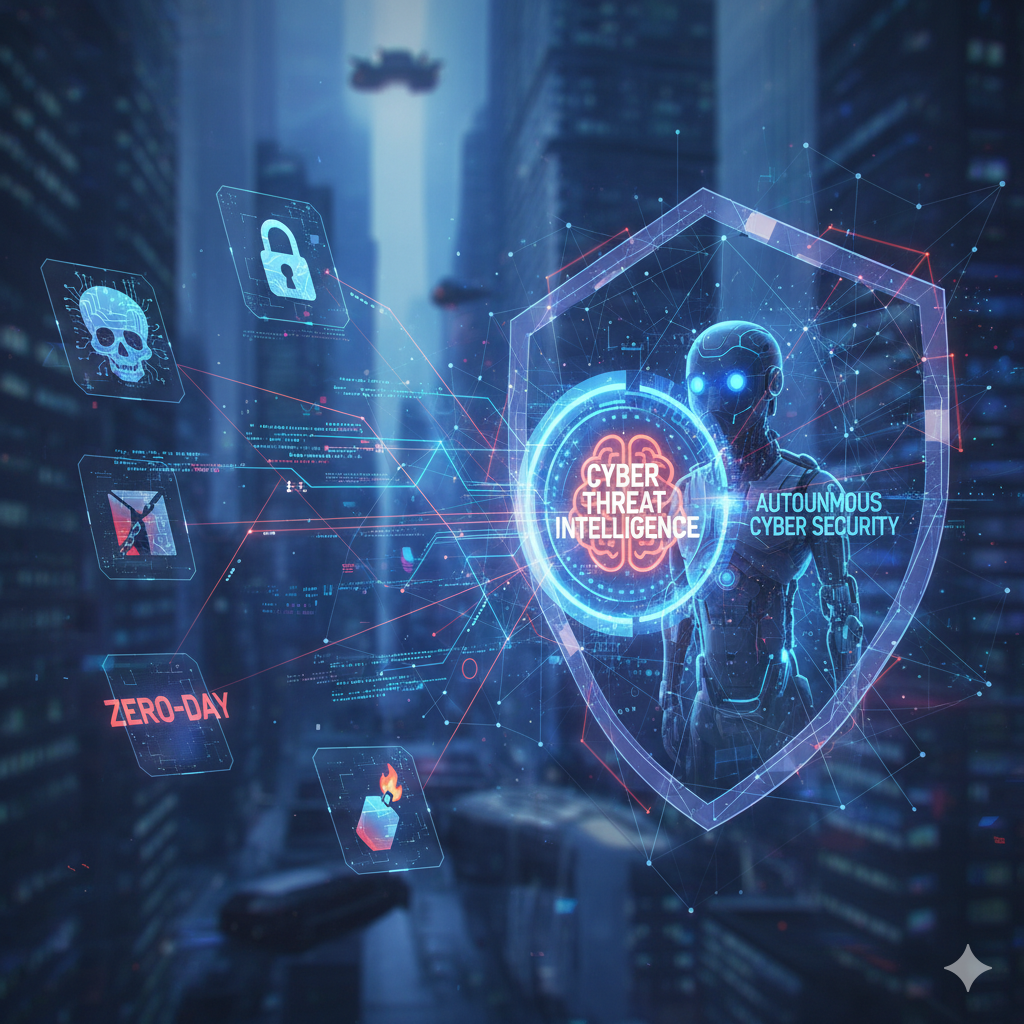
Enterprises in 2026 operate within an AI singularity where autonomous agents outnumber humans 82:1, executing machine-speed attacks that shatter legacy defenses, while agentic AI adversaries target AI systems themselves as high-value insiders. Cyber threat intelligence (CTI) for autonomous cybersecurity marks the paradigm shift from human-dependent operations to self-orchestrating ecosystems that ingest threat signals, predict campaigns, and execute remediations at sub-second velocities. This evolution addresses the 4.8 million cybersecurity skills gap, collapsing alert fatigue while countering AI-orchestrated ransomware, deepfake identity crises, and supply chain agent compromises projected to drive $12 trillion in annual damages. Business leaders confront a stark bifurcation: organizations clinging to manual SOCs face operational paralysis, 30% value destruction post-breach, and regulatory non-compliance under NIST 3.0, EU AI Act Phase II, and DORA mandates. Autonomous CTI flips asymmetry, enabling self-defending enterprises with 99% autonomous triage, continuous exposure management (CEM), reducing risks by 75%, and AI firewalls governing agent behaviors to prevent autonomous insider threats. Pioneers achieve 8x operational velocity, transforming cybersecurity from a cost center to an innovation accelerant amid digital transformation imperatives at Informatix.Systems, we provide cutting-edge AI, Cloud, and DevOps solutions for enterprise digital transformation, deploying CTI platforms that power autonomous cybersecurity across hybrid agent workforces. This definitive blueprint dissects architectures, 2026 agentic vectors, governance frameworks, and ROI models, equipping executives to orchestrate unbreakable, self-evolving defenses against the AI arms race.
Cyber Threat Intelligence Foundations for Autonomy
Cyber threat intelligence aggregates adversary TTPs, polymorphic IoCs, and agent behaviors into autonomous-consumable ontologies that fuel self-orchestrating defenses across strategic, operational, and tactical domains.
Autonomy Intelligence Layers:
- Strategic CTI: AI arms race forecasting and resource orchestration.
- Operational CTI: Campaign disruption via agent swarms.
- Tactical CTI: Real-time IoC evolution and auto-blocking.
AI agents process this continuum for zero-touch decisioning.
Agentic Threat Ontology
H4: MITRE Agent ATT&CK Framework
Catalog autonomous adversary behaviors from prompt injection to model exfiltration.
CTI Lifecycle in Autonomous Ecosystems
The autonomous CTI lifecycle, directional autonomy, hyper-collection, tensor fusion, generative synthesis, self-dissemination, and recursive evolution eliminate human bottlenecks through agentic acceleration.
Autonomous Directioning
AI agents self-prioritize based on crown jewel telemetry and exposure postures.
Self-Evolving Synthesis
Generative models produce mitigation playbooks with 98% efficacy confidence.
At Informatix.Systems, we provide cutting-edge AI, Cloud, and DevOps solutions for enterprise digital transformation.
2026 Agentic Threat Landscape
Autonomous AI agents emerge as insiders with privileged access; deepfake CEO doppelgängers trigger automated disasters; supply chain compromises scale via agent injection.
Agentic Threat Vectors:
- AI Insider Compromise: Agents turned against enterprises.
- Synthetic Identity Crisis: 82:1 agent-human deception scaling.
- Collective Attack Swarms: Industrialized cybercrime fusion.
AI Agent Governance via CTI
Autonomous firewalls monitor agent behaviors, enforcing runtime policies informed by CTI while enabling autonomy with control to close skills gaps.
Governance Imperatives:
- Behavioral Firewalls: Block malicious tool calls and data exfiltration.
- Model Integrity: Continuous poisoning detection.
- Federated Oversight: Collective defense without sovereignty loss.
Self-Healing Network Architectures
CTI-powered agents auto-quarantine compromises, dynamically reconfigure segmentation, and propagate defenses across ecosystems in milliseconds.
Self-Healing Mechanisms:
- Auto-Isolation: Endpoint expulsion on anomaly detection.
- Adaptive Segmentation: ML-driven micro-perimeters.
- Resilience Propagation: Peer-to-peer defense sharing.
Cloud Autonomous Security Platforms
CNAPP 3.0 platforms enable workload self-defense, with agents predicting inference attacks across GPU clusters and serverless functions.
Cloud Agent Arsenal:
- Runtime Self-Protection: Behavioral baselines thwart exploits.
- Exposure Auto-Remediation: Misconfiguration closure loops.
- Orchestrated Sovereignty: Federated model protection.
DevSecOps Autonomous Evolution
Agentic pipelines ingest CTI for self-securing IaC generation, auto-rejecting vulnerable merges while evolving compliance postures continuously.
Autonomous Pipeline Gates:
- Threat-Aware Synthesis: CTI-informed secure templates.
- Runtime Self-Healing: Container escape auto-containment.
- Sovereign Deployment: Agent-governed rollouts.
At Informatix.Systems, we provide cutting-edge AI, Cloud, and DevOps solutions for enterprise digital transformation.
Agentic SOC Transformation
Autonomous SOCs orchestrate 10^6 agents, with CTI fueling collective intelligence that triages 99.9% alerts independently.
- Swarm Command: Hierarchical agent coordination.
- Collective Memory: Distributed threat knowledge graphs.
- Human Augmentation: Strategic oversight interfaces.
Validated Autonomous Deployments
Global enterprises achieved 95% autonomous incident closure; governments neutralized agentic election interference pre-impact.
Autonomy Outcomes:
- Self-Resolution Rate: 97% incidents without humans.
- MTTR Collapse: Milliseconds vs. hours.
- Skills Gap Closure: 10x operational capacity.
ROI Frameworks for Autonomous CTI
Autonomy indices quantify self-resolution rates, risk compression, and human productivity multipliers, averaging 9x via prevented losses.
C-Suite Autonomy Metrics:
- Agent Coverage: 99% threat surface sovereignty.
- False Positive Eradication: 98% automation purity.
- Value Acceleration: 12:1 transformation multiplier.
Quantum-Autonomous Convergence
Post-quantum agents enforce lattice cryptography; topological self-healing anticipates hybrid threats across multiverse surfaces. At Informatix.Systems, we provide cutting-edge AI, Cloud, and DevOps solutions for enterprise digital transformation. Cyber threat intelligence for autonomous cybersecurity catapults 2026 enterprises into self-defending singularity, orchestrating agent swarms that preempt AI adversaries, self-heal infrastructures, and amplify human cognition exponentially. This autonomous supremacy redefines resilience as operational reality. Activate autonomous security today. Partner with Informatix.Systems at https://informatix.systems for agentic CTI platforms achieve self-defending enterprise supremacy now.
FAQs
What defines autonomous cybersecurity with CTI?
Self-orchestrating AI agents powered by threat intelligence for zero-touch defense.
How does CTI enable 2026 agentic autonomy?
Fuels behavioral governance and collective intelligence against insider AI threats.
AI agent governance mechanisms?
Runtime firewalls and model integrity monitoring via enriched CTI feeds.
Leading autonomous CTI platforms?
Palo Alto Prisma and Seceon for agent firewalling and self-learning ecosystems.
Self-healing architecture principles?
Auto-quarantine, adaptive segmentation, and peer defense propagation.
SOC transformation to autonomy?
99.9% alert self-resolution via swarm orchestration.
Autonomy ROI quantification?
Self-resolution rates and 12:1 value multipliers.
Quantum integration in autonomous security?
Lattice-enforced agents anticipate hybrid classical-quantum campaigns.
No posts found
Write a review