- 3/8, North Pirerbag
- 60 Feet Main Road
- Mirpur, Dhaka 1216
- +880-967-8247365
- support@informatix.systems

Cyber Threat Intelligence for Intelligent Risk Forecasting
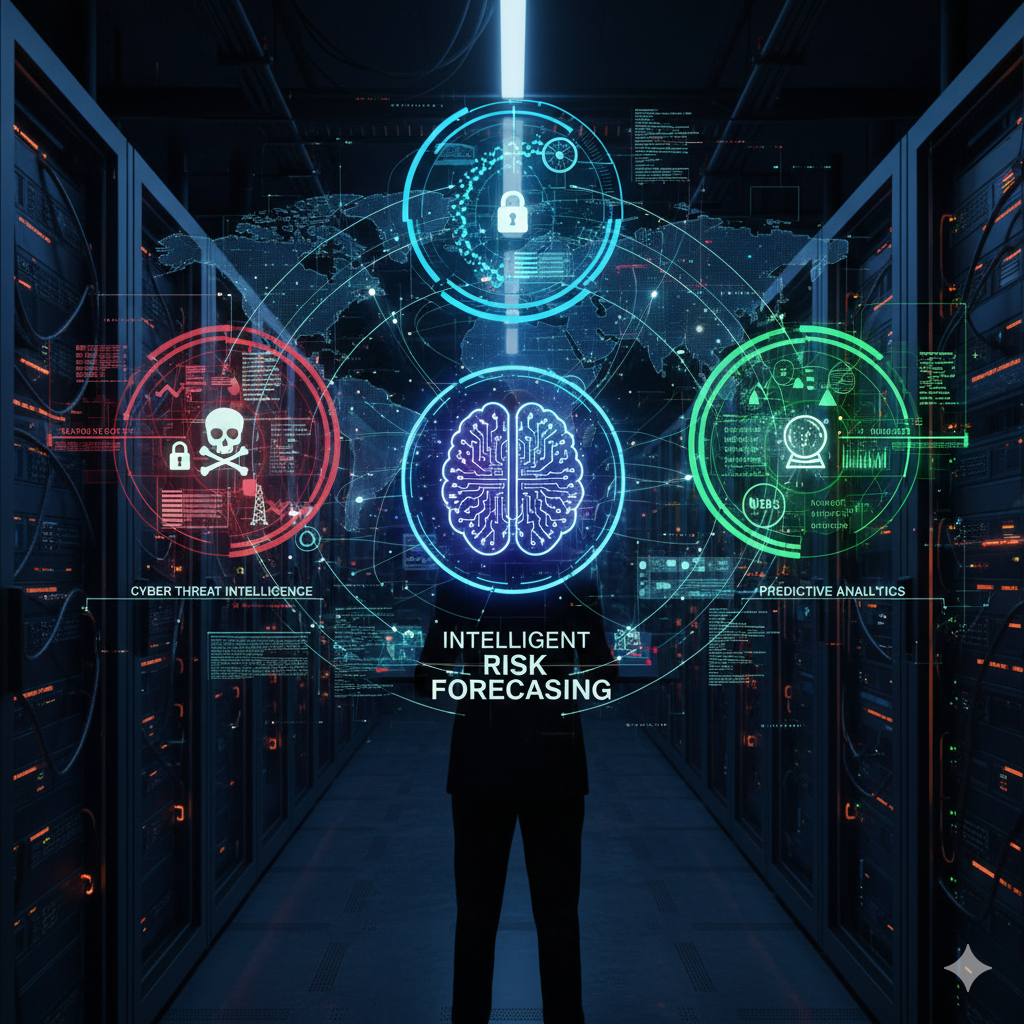
In the accelerating digital era of 2026, enterprises face an onslaught of sophisticated cyber threats powered by agentic AI, quantum risks, and expansive attack surfaces across cloud, IoT, and supply chains. Cyber threat intelligence (CTI) for intelligent risk forecasting represents the pivotal evolution from reactive security to predictive resilience, enabling organizations to model threats, quantify risks, and preempt disruptions before they materialize. This capability is no longer optional; it's a business imperative as global cybercrime costs are projected to exceed $10 trillion annually, with AI-enhanced attacks automating reconnaissance, exploitation, and extortion at unprecedented scales. For enterprise leaders, the business stakes are profound: a single breach can erode customer trust, trigger multimillion-dollar fines under evolving regulations like NIST 2.0 and EU AI Act, and halt operations amid ransomware triple targeting backups and executives. Intelligent risk forecasting through CTI shifts the paradigm, reducing mean time to detect (MTTD) from days to minutes and cutting breach probabilities by up to 50% via continuous exposure management (CEM). By fusing global threat data with internal telemetry, organizations achieve proactive foresight, prioritizing high-impact vulnerabilities and allocating resources efficiently. At Informatix.Systems, we provide cutting-edge AI, Cloud, and DevOps solutions for enterprise digital transformation, integrating CTI platforms that deliver real-time risk scores and automated forecasting models. This article delves into the methodologies, tools, and 2026 trends shaping CTI for risk forecasting, equipping executives with actionable frameworks to fortify defenses against deepfakes, identity sabotage, and AI agent swarms. From lifecycle mastery to ROI measurement, discover how intelligent CTI transforms uncertainty into strategic advantage.
Defining Cyber Threat Intelligence for Risk Forecasting
Cyber threat intelligence for intelligent risk forecasting involves collecting, analyzing, and applying threat data to predict potential impacts on business assets, going beyond detection to model probabilistic outcomes. It leverages AI to correlate indicators of compromise (IoCs), tactics, techniques, and procedures (TTPs), and external signals into forward-looking risk scores.
Core Distinctions:
- Reactive TI: Focuses on known threats post-alert.
- Predictive CTI: Forecasts attack paths using ML models and attack surface mapping.
Enterprises using this approach report 3x faster threat neutralization.
Strategic vs. Predictive Layers
Strategic CTI informs board-level decisions; predictive layers simulate scenarios for operational agility.
CTI Lifecycle in Risk Forecasting
The enhanced CTI lifecycle, direction, collection, processing, analysis, dissemination, and feedback now incorporates AI for continuous forecasting loops. Direction sets risk priorities; analysis generates probabilistic models.
Direction Phase
Align intelligence with crown jewel assets and business impact scores.
Predictive Analysis
Employ Bayesian networks and ML to forecast attack success rates. At Informatix.Systems, we provide cutting-edge AI, Cloud, and DevOps solutions for enterprise digital transformation.
2026 Trends in Intelligent Risk Forecasting
2026 forecasts highlight AI arms races, shadow agent risks, and CEM dominance, with adversaries deploying autonomous cybercrime agents. GenAI integrates into phishing and malware, demanding predictive countermeasures.
Key Trends:
- Agentic AI Threats: Autonomous agents conduct scaled reconnaissance.
- Identity Risk Explosion: Deepfakes and biometric spoofing surge.
- Quantum Risk Modeling: Post-quantum crypto forecasting.
Gartner emphasizes CEM for 3x breach reduction.
AI-Powered Risk Prediction Models
AI elevates CTI by processing petabytes of data for 95% accurate threat forecasts, automating triage and scenario simulation. Models like graph neural networks map attack paths dynamically.
Advanced AI Techniques
- Predictive Analytics: Time-series forecasting of TTP evolution.
- Anomaly Detection: Behavioral baselines for zero-day risks.
- Simulation Engines: Monte Carlo for impact quantification.
Integrating CTI with Enterprise Risk Management
CTI feeds into GRC frameworks, translating threats into financial risk metrics like Value at Risk (VaR). Automate via API integrations with SIEM and ERM tools.
Integration Benefits:
Cloud-Native Risk Forecasting Strategies
Cloud CTI forecasts misconfigurations and lateral movement risks using CSPM and CNAPP tools, predicting exploit chains in multi-cloud setups. Real-time telemetry enables exposure prioritization.
Best Practices
- Continuous Scanning: AI-driven vulnerability ranking.
- Attack Path Mapping: Visualize privilege escalations.
- Zero-Trust Forecasting: Model identity risks.
DevSecOps for Predictive Threat Intelligence
Embed CTI in CI/CD pipelines for shift-left forecasting, scanning code against live threat feeds pre-deployment. Tools like Snyk integrate TTP libraries.
Pipeline Steps:
- Threat feed ingestion.
- Static/dynamic analysis with risk scores.
- Automated policy enforcement.
At Informatix.Systems, we provide cutting-edge AI, Cloud, and DevOps solutions for enterprise digital transformation.
SOC Enhancement via Risk Forecasting
Integrate CTI feeds to prioritize alerts by predicted impact, reducing fatigue by 70% with SOAR automation. Hunt proactively using forecasted IoCs.
CTI Forecasting Success
A global bank used CTI to forecast phishing campaigns, blocking 90% pre-click; a retailer predicted supply chain risks, averting $5M loss. IBM's AI models cut MTTR by 80%.
Quantified Wins:
Measuring the ROI of Risk Forecasting CTI
Track KPIs: risk score reductions, prevented incidents, MTTR. Use CRQ (Cyber Risk Quantification) for financial baselines.
Metrics Dashboard:
- Breach probability delta (e.g., -40%).
- Cost savings from prioritization.
- Analyst productivity gains (2x).
Future Horizons: Quantum and Beyond
Post-2030, quantum-AI hybrids demand lattice-based crypto forecasting; edge CTI anticipates IoT swarms. Autonomous SOCs emerge. At Informatix.Systems, we provide cutting-edge AI, Cloud, and DevOps solutions for enterprise digital transformation. Cyber threat intelligence for intelligent risk forecasting empowers 2026 enterprises to navigate AI-driven threats, cloud complexities, and geopolitical risks with precision, delivering proactive security and tangible business value. Mastering the lifecycle, AI models, and integrations ensures resilience and a competitive edge. Elevate your risk forecasting today. Partner with Informatix.Systems for bespoke CTI solutions at https://informatix.systems turn threats into foresight now.
FAQs
What is cyber threat intelligence for risk forecasting?
CTI that predicts threat impacts using AI models and data fusion for proactive enterprise defense.
How does AI improve risk forecasting in CTI?
AI simulates attack paths, forecasts TTPs with 95% accuracy, and automates exposure prioritization.
What are 2026 key risks for CTI forecasting?
Agentic AI agents, identity deepfakes, and quantum threats demand advanced prediction.
Which tools excel in CTI risk forecasting?
Recorded Future and Google Chronicle for real-time predictive analytics.
How to integrate CTI into DevSecOps?
Embed threat feeds in pipelines for shift-left risk scoring.
What metrics measure CTI forecasting ROI?
Risk score reductions, MTTR drops, and prevented loss quantification.
Why prioritize cloud in risk forecasting?
Cloud misconfigs represent 80% of exposures; CTI maps multi-cloud paths.
How does CTI support executive risk decisions?
Delivers probabilistic scenarios and financial VaR for board alignment.
No posts found
Write a review