- 3/8, North Pirerbag
- 60 Feet Main Road
- Mirpur, Dhaka 1216
- +880-967-8247365
- support@informatix.systems

Cyber Threat Intelligence Trends to Watch
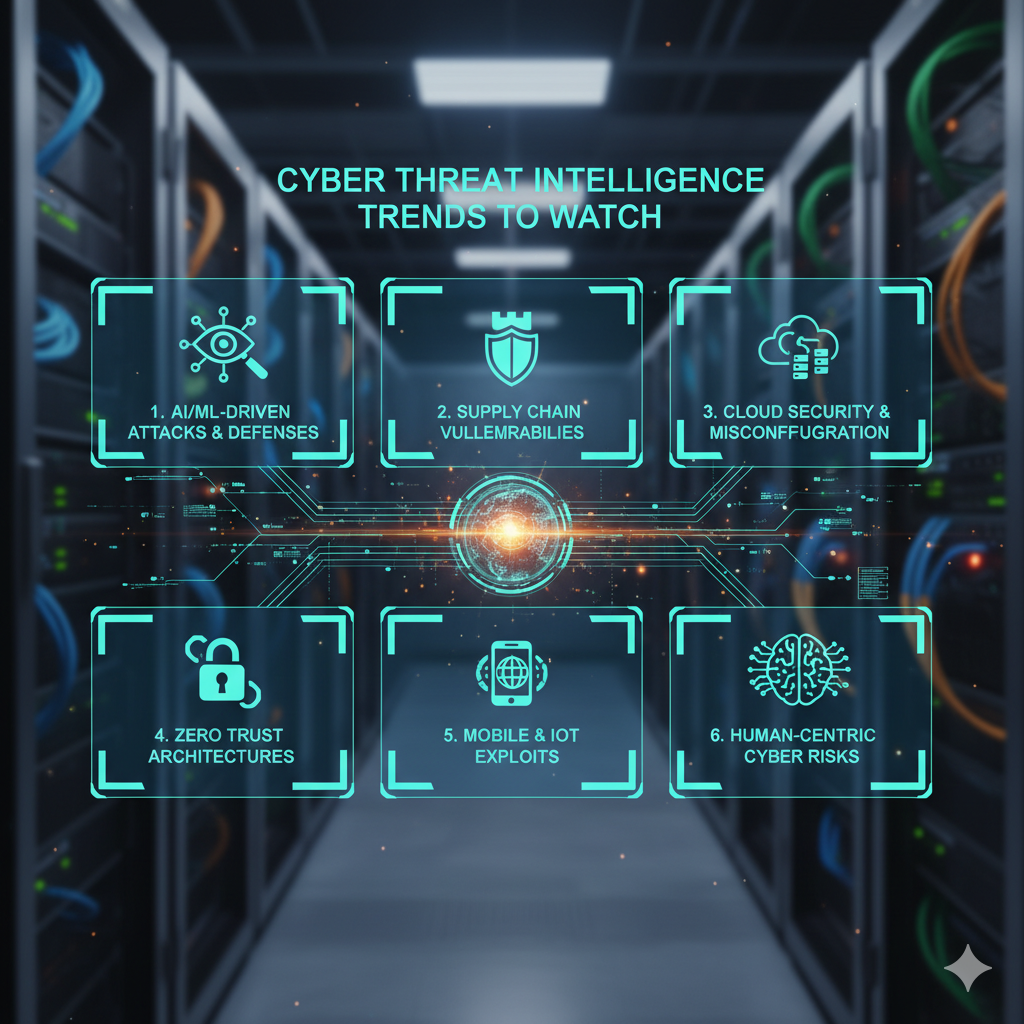
Cyber threat intelligence trends in 2026 will determine which enterprises successfully anticipate attacks and which remain trapped in reactive firefighting. Ransomware-as-a-service, AI-powered phishing, and nation-state campaigns are all evolving at a pace that traditional defenses cannot match. As digital transformation accelerates and hybrid cloud architectures become the norm, organizations must understand how cyber threat intelligence (CTI) is changing to keep security aligned with business risk. CTI is no longer just a feed of indicators of compromise; it is a strategic function that fuses external adversary data with internal telemetry to drive decisions across security operations, identity, cloud, fraud, and governance. The CTI market is forecast to grow rapidly, analysts project double‑digit CAGR through 2030, as enterprises seek proactive, intelligence‑driven security capabilities. This growth reflects a shift from simple blacklists toward AI‑enhanced platforms that prioritize threats by business impact, automate enrichment, and predict likely attack paths. At Informatix.Systems, we provide cutting-edge AI, Cloud, and DevOps solutions for enterprise digital transformation, enabling organizations to embed cyber threat intelligence into every layer of their technology stack and operating model. CTI trends are directly tied to board‑level concerns: financial loss, regulatory exposure, supply chain fragility, and reputational damage. Understanding where CTI is heading in 2026 helps CISOs, risk leaders, and digital transformation teams prioritize investments, define roadmaps, and build defenses that can withstand the next generation of AI‑enabled adversaries. The following sections explore the most important cyber threat intelligence trends to watch, what they mean for enterprises, and how to operationalize them using modern platforms, automation, and cloud-native architectures.
AI-Augmented Cyber Threat Intelligence
AI is reshaping cyber threat intelligence by automating analysis, triage, and enrichment at machine speed. Threat intelligence platforms increasingly use machine learning, natural language processing, and generative AI to correlate massive volumes of indicators, behavioral signals, and open‑source data.
Key AI Capabilities in CTI
- Automated enrichment and correlation of indicators of compromise (IoCs) across multiple data sources greatly reduces analyst time spent on manual lookups.
- Behavioral clustering and threat actor profiling, where AI identifies patterns in TTPs, infrastructure, and malware families to attribute campaigns and detect related threats.
- NLP-driven intelligence extraction from dark web forums, paste sites, underground markets, and threat reports, transforming unstructured text into structured, queryable CTI.
Benefits for Enterprise Security Teams
- Reduced alert fatigue by using AI to prioritize CTI signals that align with an organization’s assets, technology stack, and current campaigns.
- Faster decision-making as AI‑enabled platforms deliver context-rich intelligence directly into SIEM, SOAR, EDR, and ticketing workflows.
- Scalability across global footprints, allowing a small CTI team to support thousands of endpoints, identities, and applications worldwide.
At Informatix.Systems, we provide cutting-edge AI, Cloud, and DevOps solutions for enterprise digital transformation, helping clients deploy AI‑driven CTI pipelines that integrate with existing SOC tooling and governance frameworks.
Predictive and Proactive CTI
A major trend is the shift from reactive threat intelligence to predictive, anticipatory models that forecast likely threats before they fully materialize. Instead of simply cataloging past incidents, CTI programs increasingly use historical data, behavioral patterns, and external telemetry to anticipate campaigns and prioritize controls.
Predictive Threat Modeling in Practice
- Time‑series and anomaly models analyze historical incidents, scanning patterns in malware, domains, and phishing themes to forecast future activity.
- Campaign‑level analytics connect disparate events into evolving adversary operations, enabling defenders to see how current probes relate to known TTPs.
- Risk‑based alerting uses intelligence to adjust detection thresholds dynamically when a relevant campaign targets an industry or geography.
Outcomes for Enterprises
- Shorter dwell time as predictive CTI focuses detection on the most probable attack paths before adversaries establish long‑term persistence.
- More efficient controls because organizations can align patching, segmentation, and hardening to threats most likely to impact critical assets.
- Better board communication, with predictive CTI mapping scenarios to financial and operational risk, supporting investment decisions.
At Informatix.Systems, we provide cutting-edge AI, Cloud, and DevOps solutions for enterprise digital transformation, enabling predictive CTI models that plug into real‑time monitoring and automated response workflows.
Data Fusion: Internal and External Intelligence
Another cyber threat intelligence trend to watch is the fusion of external CTI with rich internal telemetry from endpoints, identities, cloud workloads, and applications. Enterprises increasingly recognize that external feeds alone cannot reveal true risk without context from their own environments.
What Data Fusion Looks Like
- Merging CTI with SIEM and XDR telemetry to see which external indicators actually touch your networks, users, and cloud workloads.
- Combining CTI with vulnerability and asset inventories to prioritize exposures that adversaries are actively exploiting in the wild.
- Integrating CTI into identity and access management (IAM) to dynamically adjust access based on active campaigns targeting specific roles or locations.
Benefits of a Unified Intelligence Picture
- Context-rich investigations, where analysts can pivot from an external IoC to internal logs, user behavior, and asset data in a single interface.
- Improved prioritization of mitigation efforts by focusing on adversary‑linked exposures rather than theoretical vulnerabilities.
- Higher CTI ROI by measuring how intelligence directly reduces successful intrusions, fraud, and service disruptions.
At Informatix.Systems, we provide cutting-edge AI, Cloud, and DevOps solutions for enterprise digital transformation, building data fusion pipelines that align CTI with SIEM, XDR, IAM, and cloud security posture management.
CTI Market Growth and Platform Consolidation
The cyber threat intelligence market is expanding rapidly as organizations invest in platforms, feeds, and services to support intelligence‑driven security models. Reports project CTI revenues to grow at over 14–22% CAGR through 2029–2034, with Asia Pacific emerging as a particularly fast‑growing region.
Key Market Trends
- Platform consolidation, where enterprises replace multiple point intelligence tools with unified CTI platforms tightly integrated into security operations.
- Cloud-delivered CTI, with SaaS‑based platforms and APIs making advanced capabilities accessible without heavy on‑premises infrastructure.
- Vertical specialization, with vendors offering tailored intelligence for finance, healthcare, government, and critical infrastructure.
What This Means for Buyers
- Strategic vendor selection is now essential, as platforms differ in data coverage, AI capabilities, integration options, and compliance support.
- Focus on integration and automation should drive RFPs, ensuring CTI can plug into SOC tools, ticketing systems, and risk platforms.
- Attention to regional considerations, including data residency, regulatory requirements, and local threat ecosystems, is growing in importance.
At Informatix.Systems, we provide cutting-edge AI, Cloud, and DevOps solutions for enterprise digital transformation, helping clients design CTI architectures that balance vendor capabilities, integration depth, and long‑term scalability.
AI-Driven Adversaries and CTI Response
CTI trends for 2026 are shaped not only by defensive innovation but also by the rapid adoption of AI by cybercriminals and nation‑state actors. Attackers leverage generative AI for phishing content, deepfake voice and video, malware obfuscation, and automated vulnerability discovery.
AI-Enabled Threat Landscape
- Malicious generative content that produces highly personalized phishing emails, synthetic identities, and convincing business correspondence at scale.
- AI-assisted reconnaissance, where bots continuously scan cloud endpoints, exposed APIs, and misconfigurations to identify weak points.
- Cybercrime-as-a-service platforms offering AI‑driven tools and playbooks that lower the barrier to entry for sophisticated attacks.
How CTI Must Respond
- Tracking AI-related TTPs as distinct patterns in campaigns, including generative content signatures and automation artifacts.
- Monitoring underground markets for AI-enabled toolkits, prompts, and models traded among threat actors.
- Building defensive AI that can detect and neutralize AI‑generated phishing, deepfakes, and synthetic network patterns in near real time.
At Informatix.Systems, we provide cutting-edge AI, Cloud, and DevOps solutions for enterprise digital transformation, helping enterprises adopt defensive AI that evolves in step with AI‑powered adversaries.
CTI Integration with Cloud and Hybrid Environments
As organizations adopt hybrid and multi‑cloud strategies, CTI must adapt to cloud‑native architectures, ephemeral workloads, and API‑driven services. Cloud providers and security vendors increasingly publish threat intelligence specific to their ecosystems, including abuse patterns, credential‑stuffing campaigns, and misconfiguration exploitation.
Cloud-Centric CTI Requirements
- Coverage of cloud control planes, such as management APIs, identity roles, and policy changes that attackers target to gain persistent access.
- Integration with cloud security tools, including CSPM, CWPP, and cloud‑native logging, to enrich CTI with workload and configuration context.
- Awareness of supply chain dependencies, including third‑party SaaS applications and managed services that can be abused as entry points.
Benefits of Cloud-Aware CTI
- Faster detection of cloud account takeover, abuse of programmatic keys, and anomalous geographic access patterns.
- Better prioritization of cloud misconfigurations based on known adversary campaigns targeting specific services or regions.
- Improved resilience of digital transformation initiatives, ensuring new cloud services launch with intelligence‑informed controls.
At Informatix.Systems, we provide cutting-edge AI, Cloud, and DevOps solutions for enterprise digital transformation by embedding cloud‑aware CTI into CI/CD pipelines, Kubernetes security, and multi‑cloud governance.
CTI for Identity, Fraud, and Business Systems
A critical cyber threat intelligence trend is the expansion of CTI beyond infrastructure into identity systems, fraud prevention, and core business processes. As attacks increasingly exploit compromised credentials and business email, CTI must support identity‑centric and fraud use cases.
Identity and Access Intelligence
- Monitoring credential dumps and phishing kits to detect stolen accounts before they are weaponized against enterprise applications.
- Linking CTI with identity providers and PAM, allowing high‑risk logins or roles to trigger additional verification or policy changes.
- Detecting identity abuse patterns, such as impossible travel or anomalous device usage tied to known adversary infrastructure.
Fraud and Business Process Protection
- Applying CTI to payment flows to detect known mule accounts, fraudulent merchants, or bot‑driven abuse campaigns.
- Using CTI to enhance anti‑phishing and BEC detection, correlating suspicious messages with known infrastructure and lures.
- Aligning CTI with risk scoring engines, improving decisions for credit issuance, account opening, or high‑value transactions.
At Informatix.Systems, we provide cutting-edge AI, Cloud, and DevOps solutions for enterprise digital transformation, enabling organizations to extend CTI beyond the SOC and into identity, fraud, and business‑risk platforms.
CTI Automation, Orchestration, and SOC Transformation
Automation is now central to CTI operations, with many enterprises using SOAR, playbooks, and workflow engines to operationalize intelligence at scale. The volume of CTI and security events far exceeds what human analysts can handle, making machine‑speed orchestration essential.
CTI-Driven Automation Examples
- Auto‑enrichment of alerts, where incoming incidents are instantly annotated with reputation data, tags, and TTP mappings from CTI.
- Dynamic blocking rules, automatically updating firewalls, EDR blocklists, and email gateways based on high‑confidence intelligence.
- Automated case creation and routing, triggering playbooks for account containment, forensics, or user notification when CTI flags critical activity.
SOC Outcomes from CTI Automation
- Reduced mean time to detect (MTTD) and respond (MTTR) as intelligence flows directly into action without manual bottlenecks.
- Higher analyst productivity, freeing experts to focus on threat hunting, purple teaming, and strategic initiatives.
- Consistent response quality, as playbooks standardize how intelligence is applied across teams and time zones.
At Informatix.Systems, we provide cutting-edge AI, Cloud, and DevOps solutions for enterprise digital transformation, designing CTI‑driven automation architectures that integrate platforms, playbooks, and observability tools.
CTI, Regulation, and Governance
Regulatory expectations and governance frameworks increasingly reference or imply the need for cyber threat intelligence. As laws demand timely incident reporting, risk assessments, and board‑level cyber oversight, CTI becomes essential for evidence, metrics, and justifiable decisions.
Regulatory Drivers for CTI
- Sectoral regulations and guidelines that expect organizations to understand their threat landscape and demonstrate proactive controls.
- Incident reporting timelines, where CTI helps determine whether events are part of known campaigns and how material the impact could be.
- Board and risk committee expectations, requiring quantified, intelligence‑based views of cyber risk and emerging threats.
Governance and Metrics
- Threat coverage metrics, showing how many relevant adversary campaigns are monitored and addressed by controls.
- Risk reduction indicators, such as fewer successful intrusions or lower fraud losses linked to intelligence‑driven measures.
- Maturity assessments, evaluating how CTI supports strategy, investments, and cross‑functional collaboration.
At Informatix.Systems, we provide cutting-edge AI, Cloud, and DevOps solutions for enterprise digital transformation, helping organizations align CTI with governance frameworks and produce board‑ready cyber risk intelligence.
Future of CTI: From 2026 to 2030
Looking beyond immediate cyber threat intelligence trends in 2026, several long‑term developments will shape how CTI is produced, shared, and consumed. These include advances in quantum computing, federated AI, and global threat‑sharing ecosystems.
Emerging Directions
- Quantum-safe CTI, where intelligence includes insights on quantum‑resilient cryptography and adversary interest in post‑quantum schemes.
- Federated intelligence models enable organizations to share model learnings and patterns without exposing raw data.
- Autonomous defense ecosystems, where AI systems collaborate across organizations to detect campaigns and coordinate countermeasures.
Strategic Implications
- Investment in flexible platforms becomes critical, ensuring CTI systems can incorporate new data types, analytics methods, and sharing models.
- Emphasis on ethical and explainable AI, as regulators and boards demand transparency in how intelligence and automated decisions are derived.
- Greater collaboration across industries and governments is driven by shared exposure to systemic risks like critical infrastructure disruptions.
At Informatix.Systems, we provide cutting-edge AI, Cloud, and DevOps solutions for enterprise digital transformation, preparing clients for the next wave of CTI innovation through modular architectures and AI governance frameworks.
How Enterprises Should Respond to CTI Trends
Enterprises that treat CTI trends as a strategic roadmap can build more resilient security programs, while those that ignore them risk falling behind rapidly evolving threats. Responding effectively requires a blend of technology, process, and talent initiatives.
Immediate Actions (Next 12–18 Months)
- Assess CTI maturity across data sources, platforms, integrations, and business adoption.
- Prioritize AI-augmented platforms that support automation, data fusion, and predictive analytics.
- Integrate CTI deeply into SOC, IAM, and cloud security, going beyond standalone feeds.
- Align CTI reporting with board and regulatory expectations, emphasizing risk, trends, and business impact.
Medium-Term Initiatives (2–4 Years)
- Develop federated and collaborative CTI capabilities, participating in information-sharing communities relevant to your sector.
- Invest in AI governance and explainability for CTI models to maintain trust and compliance.
- Transform CTI into a cross-functional capability, supporting security, fraud, legal, compliance, and digital product teams.
At Informatix.Systems, we provide cutting-edge AI, Cloud, and DevOps solutions for enterprise digital transformation, guiding organizations through CTI strategy, platform selection, and operating model design. Cyber threat intelligence trends to watch in 2026 include AI‑augmented analysis, predictive modeling, data fusion, cloud‑aware intelligence, automation, and tighter links to governance and business risk. These trends reflect a broader transformation of CTI from a niche technical function into a strategic, enterprise‑wide capability that informs decisions across security operations, identity, fraud, and digital transformation. Enterprises that invest in modern CTI platforms, automation, and AI‑driven analytics will gain decisive advantages in detecting, understanding, and mitigating advanced threats, especially as adversaries themselves adopt AI and target complex hybrid environments. The time to act is now: CTI roadmaps, platform consolidation, and integration with SOC, IAM, and cloud security should be central elements of 2026 security planning, at Informatix.Systems, we provide cutting-edge AI, Cloud, and DevOps solutions for enterprise digital transformation, enabling organizations to operationalize cyber threat intelligence from strategy through execution. To explore how these CTI trends can be tailored to your environment, book a consultation via https://informatix.systems and start building intelligence‑driven defenses for the next decade.
FAQs
Why is cyber threat intelligence so important in 2026?
CTI is crucial in 2026 because AI‑powered attacks, ransomware evolution, and expanding cloud attack surfaces make reactive defenses insufficient. Intelligence provides the context and prediction needed to prioritize controls, reduce dwell time, and align cybersecurity with business risk.
How does AI change cyber threat intelligence?
AI transforms CTI by automating enrichment, correlating massive data sets, and identifying patterns that humans would struggle to see. It also supports predictive models that anticipate campaigns and prioritize alerts based on likelihood and impact, improving SOC efficiency.
What are the biggest CTI trends enterprises should watch?
Key CTI trends include AI‑augmented analysis, predictive threat intelligence, data fusion between external and internal telemetry, and CTI integration with cloud, identity, and fraud systems. Automation, platform consolidation, and regulatory alignment are also major themes shaping CTI roadmaps.
How can smaller organizations benefit from CTI trends?
Smaller organizations can leverage cloud‑delivered CTI platforms and managed services to access advanced intelligence without large internal teams. Many providers offer SaaS, API, and MSSP models that make AI‑driven CTI affordable and manageable for mid‑market enterprises.
How should CTI integrate with cloud security?
CTI should feed directly into cloud security tools, including CSPM, CWPP, and identity systems, to prioritize misconfigurations and detect anomalous access patterns. Cloud‑aware CTI must understand provider‑specific services, control planes, and common abuse patterns in multi‑cloud environments.
What role does CTI play in regulatory compliance?
CTI supports compliance by documenting threat landscapes, informing risk assessments, and providing evidence for incident reports and board‑level oversight. Intelligence‑driven metrics help demonstrate due diligence, proportional controls, and continuous monitoring to regulators and auditors.
How can enterprises measure the ROI of CTI investments?
Organizations can track metrics such as reduced successful intrusions, lower fraud losses, decreased MTTD/MTTR, and improved patch prioritization as CTI outcomes. They can also measure alignment with business objectives by showing how CTI influences strategic decisions and risk reduction.
How can Informatix.Systems help with CTI modernization?
At Informatix.Systems, we provide cutting-edge AI, Cloud, and DevOps solutions for enterprise digital transformation, including CTI strategy, platform implementation, and automation design. Our teams help integrate CTI into SOC, cloud, identity, and risk workflows, ensuring intelligence directly supports resilience and growth.
No posts found
Write a review