- 3/8, North Pirerbag
- 60 Feet Main Road
- Mirpur, Dhaka 1216
- +880-967-8247365
- support@informatix.systems

How CTI Identifies Data Breach Risks
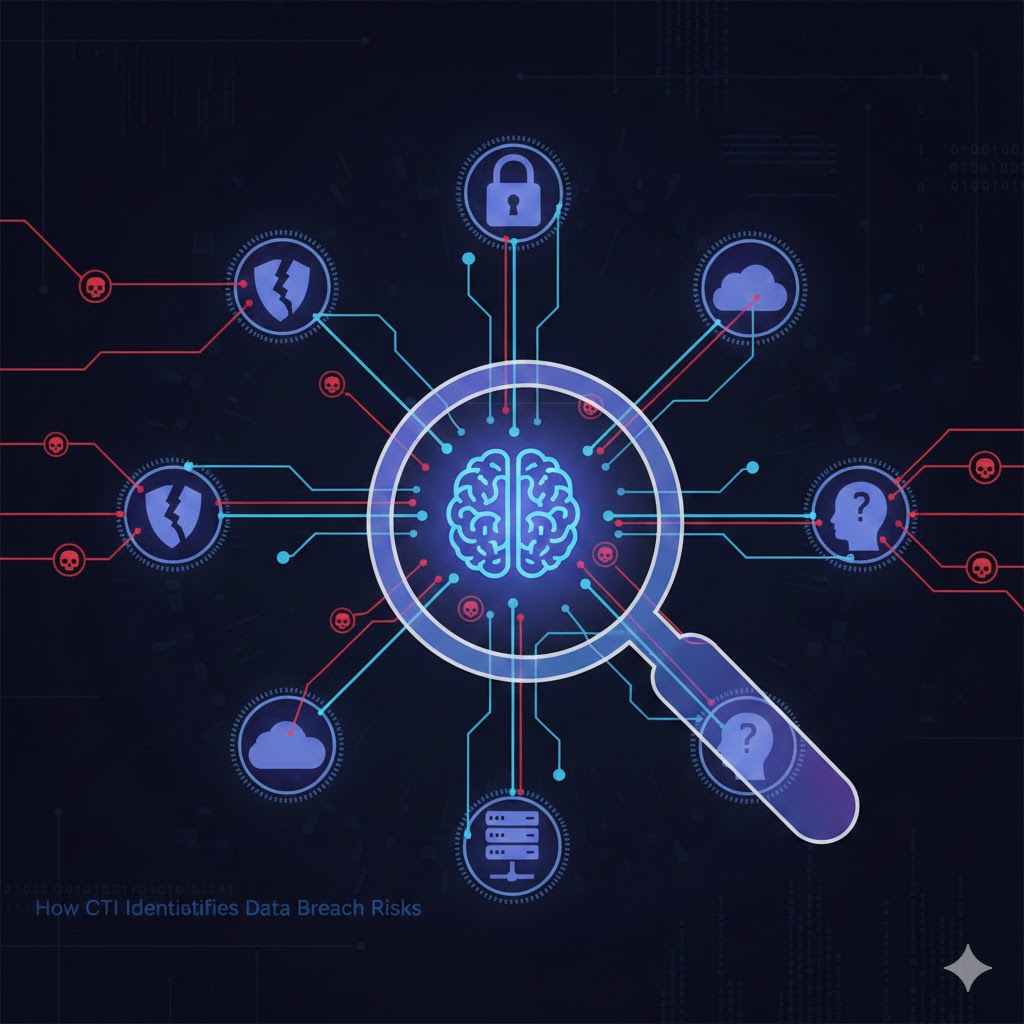
In today's hyper-connected digital landscape, data breaches pose existential threats to enterprises, with average costs exceeding $4.5 million per incident in 2025. Cyber Threat Intelligence (CTI) emerges as the proactive shield, transforming raw threat data into actionable insights that pinpoint vulnerabilities before exploitation. By analyzing indicators of compromise (IOCs), tactics, techniques, and procedures (TTPs), and external intelligence feeds, CTI identifies data breach risks with precision, enabling organizations to shift from reactive firefighting to strategic defense. The business stakes are immense: reputational damage, regulatory fines under GDPR or CCPA, and operational disruptions can cripple even Fortune 500 companies. Consider the 2024 ransomware surges targeting healthcare and finance, where early CTI warnings could have prevented multimillion-dollar payouts. At Informatix.Systems, we provide cutting-edge AI, Cloud, and DevOps solutions for enterprise digital transformation, integrating CTI to fortify your defenses against evolving threats. This comprehensive guide delves into how CTI identifies data breach risks, covering frameworks, processes, tools, and real-world applications tailored for 2026. Enterprises leveraging CTI report up to 70% faster threat detection and reduced breach likelihood, underscoring its role in resilient cybersecurity postures. Whether you're a CISO prioritizing risk or an IT leader scaling operations, mastering CTI ensures your organization stays ahead of adversaries.
What is Cyber Threat Intelligence?
Cyber Threat Intelligence (CTI) encompasses evidence-based knowledge about cyber threats, including context, mechanisms, indicators, and actionable advice to defend against attacks. It goes beyond alerts, providing structured insights into adversary behaviors and potential impacts on specific environments.CTI empowers enterprises by enriching security operations with real-time data on attackers' TTPs, revealing hidden motives and advanced persistent threats (APTs). This intelligence uncovers vulnerabilities exploited in data breaches, such as unpatched systems or leaked credentials. At Informatix.Systems, we provide cutting-edge AI, Cloud, and DevOps solutions for enterprise digital transformation, embedding CTI into holistic security strategies.
Core Components of CTI
- Indicators of Compromise (IOCs): Malware hashes, suspicious IPs, or domains signaling breaches.
- Tactics, Techniques, Procedures (TTPs): Adversary playbooks mapped to MITRE ATT&CK framework.
- Strategic Intelligence: Long-term trends like nation-state campaigns targeting industries.
Types of CTI for Breach Risk Detection
CTI manifests in four primary types, each tailored to identify data breach risks at different stages. Strategic CTI offers high-level overviews of threat landscapes, while tactical focuses on exploitable IOCs.Operational CTI delivers real-time alerts on active campaigns, crucial for imminent breach prevention. Technical CTI dissects malware and tools, blocking social engineering vectors like phishing. Combining these types creates comprehensive visibility, reducing false positives in SIEM systems by 50%.
Strategic vs Tactical CTI
The CTI Lifecycle in Breach Prevention
The CTI lifecycle, planning, collection, processing, analysis, dissemination, and feedback systematically identify data breach risks. It starts with defining intelligence requirements based on crown jewel assets like customer databases. Collection pulls from diverse sources: dark web forums, breach datasets, and internal logs. Processing enriches data with context, while analysis predicts exploitation likelihood. Feedback loops refine models, ensuring adaptability to 2026 threats like AI-driven attacks.
Key Stages Breakdown
- Planning: Prioritize assets via Crown Jewel Analysis.
- Collection: Scan paste sites and hacker forums.
- Analysis: Correlate IOCs with TTPs using AI.
- Dissemination: Alerts to SOC via SIEM integration.
Sources of CTI Data for Risk Identification
CTI identifies data breach risks by aggregating from open-source intelligence (OSINT), commercial feeds, and internal telemetry. Dark web monitoring detects leaked credentials before reuse in phishing or ransomware. External feeds like AlienVault OTX provide free IOCs, while paid platforms offer predictive analytics. Internal sources, such as antivirus logs, create contextual CTI tailored to your environment. In 2026, AI-enhanced sources like cloud logs and IoT telemetry will dominate, revealing hidden exposures.
- Dark Web Marketplaces: Leaked data sales.
- Threat Feeds: Real-time IOC updates.
- Internal Logs: Behavioral anomalies.
How IOCs Signal Data Breach Risks
Indicators of Compromise (IOCs) are forensic artifacts like IPs or hashes indicating breaches. CTI uses IOCs to match network traffic against known threats, flagging risks like credential stuffing. Dynamic feeds update IOCs hourly, prioritizing those tied to active campaigns. Sandboxing analyzes suspicious files, preventing zero-days. Enterprises integrating IOCs into firewalls block 90% of known threats preemptively.
Common IOC Types
- Network IOCs: Malicious domains/IPs.
- File Hashes: Ransomware signatures.
- Behavioral: Unusual data exfiltration.
TTPs Analysis for Proactive Breach Detection
TTPs map adversary behaviors per MITRE ATT&CK, enabling CTI to identify data breach risks through pattern recognition. For instance, reconnaissance TTPs signal pre-breach scanning.CTI platforms score TTP relevance to your industry, prioritizing defenses like MFA against credential access techniques. Machine learning detects TTP drifts in evolving attacks. This approach thwarted phishing in financial sectors by emulating real-world campaigns. At Informatix.Systems, we provide cutting-edge AI, Cloud, and DevOps solutions for enterprise digital transformation, leveraging TTPs for customized threat hunting.
CTI Frameworks for Structured Risk Assessment
Leading frameworks like the Diamond Model and F3EAD structure CTI data breach risk identification. The CTI Lifecycle ensures continuous refinement, while MITRE ATT&CK provides TTP taxonomies. Crown Jewel Analysis identifies critical assets, feeding threat modeling with STRIDE or PASTA. These integrate with SIEM for automated risk scoring. In 2026, AI-augmented frameworks predict breaches via predictive analytics.
Popular CTI Frameworks Comparison
Integrating CTI with SIEM and XDR
SIEM-CTI integration enriches logs with threat context, reducing alert fatigue by 60%. CTI identifies data breach risks by correlating internal events with external IOCs/TTPs.XDR extends this to endpoints, cloud, and networks, enabling unified detection. Platforms like Splunk or Rapid7 InsightIDR automate enrichment. Real-time dashboards visualize risks, accelerating MTTR to minutes.
Top CTI Tools for 2026 Breach Detection
2026's top CTI platforms include CrowdStrike Falcon XDR for behavioral AI and Microsoft Defender for unified signals. These tools identify data breach risks via automated IOC/TTP matching. Darktrace uses unsupervised learning for anomalies, while AccuKnox excels in zero-trust Kubernetes threats. Free options like MISP facilitate sharing. Select based on scalability: enterprises favor integrated suites.
Recommended Tools List
- CrowdStrike Falcon: EDR with CTI feeds.
- SentinelOne Singularity: AI-driven response.
- Rapid7 InsightIDR: SIEM+UEBA.
- Palo Alto Cortex: Attack surface management.
At Informatix.Systems, we provide cutting-edge AI, Cloud, and DevOps solutions for enterprise digital transformation, recommending tailored CTI toolsets.
Real-World Examples of CTI Preventing Breaches
CTI prevented phishing at a financial firm by blocking IOCs from underground forums, reducing attempts by 80%. In healthcare, ransomware profiling via TTPs enabled early patching. A supply chain attack was thwarted when CTI detected third-party targeting on leak sites. Emotet botnet takedown showcased global CTI collaboration. These cases highlight CTI's role in data breach risk identification, saving millions.
Case Study Highlights
- Finance Phishing Block: Employee training + email filtering.
- Healthcare Ransomware: IOC blocking + response plans.
Challenges in CTI Implementation
Common hurdles include data overload and skill gaps, overwhelming SOCs with unprioritized alerts. Integration silos hinder contextual analysis for data breach risks. Alert fatigue from poor IOC quality affects 70% of teams. Geopolitical blind spots ignore nation-state threats. Overcome via automation and managed services.
Future of CTI in 2026 and Beyond
By 2026, AI-driven predictive CTI will forecast breaches using big data trends. Quantum-resistant encryption and zero-trust integration amplify defenses. Expect DRP-CTI fusion for external exposure monitoring. Regulatory mandates will enforce CTI reporting. Enterprises adopting now gain a competitive edge in threat landscapes.CTI revolutionizes data breach risk identification through IOCs, TTPs, frameworks, and integrations, slashing breach probabilities and costs. From lifecycle processes to 2026 tools, it delivers proactive security. Secure your enterprise today. Contact Informatix.Systems for a free CTI assessment. At Informatix.Systems, we provide cutting-edge AI, Cloud, and DevOps solutions for enterprise digital transformation. Start preventing breaches now.
FAQs
What exactly is CTI in cybersecurity?
CTI is evidence-based knowledge on threats, aiding detection and prevention of data breaches via IOCs and TTPs.
How does CTI differ from traditional security alerts?
CTI provides context and prediction, unlike reactive alerts, enabling proactive data breach risk mitigation.
Can small enterprises afford CTI tools?
Yes, free feeds like OTX and open-source MISP make CTI accessible and scalable via cloud integrations.
What are the most common IOCs for breaches?
IPs, hashes, and leaked credentials top lists, monitored via dark web scans.
How long does SIEM-CTI integration take?
Typically, 2-4 weeks, yielding immediate false positive reductions.
Is CTI effective against zero-day attacks?
Yes, behavioral TTP analysis detects unknowns beyond signatures.
How does CTI support regulatory compliance?
It documents threats for audits, aligning with GDPR via risk-based strategies.
What ROI can enterprises expect from CTI?
Up to 70% faster detection, millions saved in breach avoidance.
No posts found
Write a review