- 3/8, North Pirerbag
- 60 Feet Main Road
- Mirpur, Dhaka 1216
- +880-967-8247365
- support@informatix.systems

How CTI Services Reduce False Positives
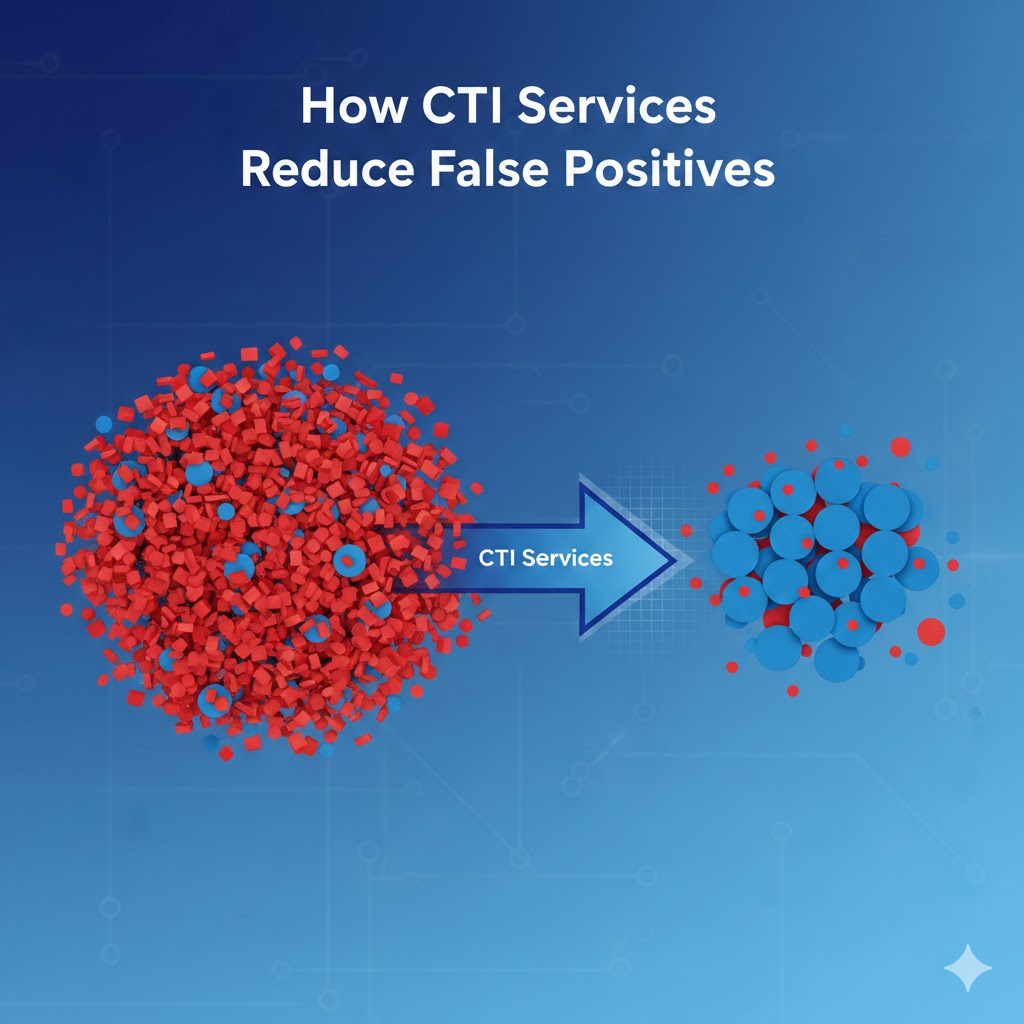
In today's hyper-connected enterprise landscape, cybersecurity teams face an overwhelming flood of alerts, up to 80% of which turn out to be false positives. These erroneous notifications waste valuable analyst time, drain budgets, and create dangerous alert fatigue that masks genuine threats. Cyber Threat Intelligence (CTI) services emerge as a game-changer, providing contextualized, actionable insights that filter noise and prioritize real risks. CTI services collect, analyze, and disseminate threat data from diverse sources like dark web forums, malware repositories, and global feeds, transforming raw information into intelligence that enriches security tools. Enterprises leveraging CTI report 70-98% reductions in false positives, enabling SOC teams to focus on high-impact incidents rather than chasing shadows. This isn't just technical efficiency; it's a strategic imperative for 2026, where AI-driven attacks surge, and compliance demands precision. The business stakes are immense: false positive investigations cost organizations millions annually, with one study pegging the alert tax at nearly $500,000 for mid-sized firms alone. CTI counters this by adding threat actor context, TTPs (tactics, techniques, and procedures), and IOCs (indicators of compromise), ensuring alerts align with verified threats. At Informatix.Systems, we provide cutting-edge AI, Cloud, and DevOps solutions for enterprise digital transformation, helping clients integrate CTI to achieve these gains. This article dives deep into how CTI services reduce false positives, from mechanisms and integrations to proven ROI and implementation roadmaps. Enterprises ignoring CTI risk face operational paralysis; those adopting it gain proactive defense and resilience.
What Are CTI Services?
CTI services deliver curated intelligence on cyber threats, encompassing threat actors, campaigns, and vulnerabilities tailored to organizational needs. Unlike generic alerts, CTI provides actionable context, who's attacking, why, and how, directly reducing false positives by validating signals against known patterns.
Core Components of CTI
- Data Collection: Aggregates from open-source, commercial feeds, and internal logs.
- Analysis: Applies AI/ML to identify patterns and score threats.
- Dissemination: Delivers via APIs to SIEM/SOAR for real-time enrichment.
At Informatix.Systems, we provide cutting-edge AI, Cloud, and DevOps solutions for enterprise digital transformation, customizing CTI feeds for sector-specific threats.
The False Positives Crisis
False positives plague 45-80% of security alerts, overwhelming SOCs and inflating costs. In 2025 surveys, 73% of organizations cite them as the top detection challenge, up dramatically from prior years.
Economic Impact
- Alert Fatigue: Analysts investigate 2-4 false alerts per real threat, burning hours.
- Hidden Costs: Up to $468,750 annual tax per team from wasted investigations.
- Risk Amplification: Real threats slip through amid noise.
CTI services mitigate this by enriching alerts with intelligence, slashing irrelevant notifications.
How CTI Filters False Positives
CTI reduces false positives through contextual enrichment, cross-referencing alerts against verified threat data. Platforms score events using TTPs, victimology, and historical attack data, dismissing benign anomalies.
Key Filtering Mechanisms
- IOC Whitelisting: Exclusion lists block known benign indicators pre-alert.
- Behavioral Baselines: Compares activity to norms, flagging deviations only.
- Threat Scoring: AI assigns risk levels (e.g., low/medium/high) based on actor intent.
Studies show 98% false positive drops when CTI pre-filters feeds.
CTI Integration with SIEM Systems
SIEM tools generate raw alerts; CTI enriches them for accuracy. Integration maps CTI data to SIEM fields, normalizing IOCs and automating enrichment.
Integration Best Practices
- Feed Normalization: Standardize formats for seamless ingestion.
- Real-Time Enrichment: Query CTI on every alert for context.
- Feedback Loops: Refine rules from IR data.
Result: 58% faster incident response, fewer false alerts. At Informatix.Systems, we provide cutting-edge AI, Cloud, and DevOps solutions for enterprise digital transformation, streamlining SIEM-CTI pipelines.
SOAR Platforms and CTI Synergy
SOAR automates responses; CTI makes them intelligent. Playbooks trigger only on high-confidence CTI-validated alerts, reducing manual triage.
Automated Workflows
- Enrichment Playbooks: Auto-pull actor profiles, TTPs.
- Response Orchestration: Block IPs from known campaigns instantly.
- Dynamic Tuning: Adjust thresholds based on intel.
Enterprises see 70%+ false positive cuts via SOAR-CTI.
Machine Learning in CTI False Positive Reduction
ML-powered CTI learns from data, adapting to evolving threats. Algorithms analyze patterns, reducing false positives by 60-70% over static rules.
ML Techniques
- Anomaly Detection: Baselines normal vs. malicious behavior.
- Predictive Scoring: Forecasts attack likelihood from intel.
- Continuous Training: Incorporates analyst feedback.
Hunters.io reports 98% reductions using ML on feeds.
Real-World Case Studies
CTI delivers measurable wins. One firm cut false positives 80% via API-integrated feeds and ML.
Notable Examples
These prove CTI's ROI in production.
ROI of CTI Services
CTI yields positive ROI through cost savings and resilience. Finance sectors link it to lower breach costs and faster MTTR.
Quantified Benefits
- Cost Savings: 38-75% drop in ops expenses.
- Efficiency Gains: 75% faster investigations.
- Risk Reduction: 58% MTTR cut.
Formula: ROI = (Savings - CTI Cost) / CTI Cost. Typical 3-5x return. At Informatix.Systems, we provide cutting-edge AI, Cloud, and DevOps solutions for enterprise digital transformation, maximizing CTI ROI.
Top CTI Platforms for 2026
Leading platforms excel in false positive reduction via native integrations.
Platform Comparison
| Platform | Key Strength | False Positive Cut | Integration Ease |
|---|---|---|---|
| Stellar Cyber | Open XDR Enrichment | 60-70% | High |
| CrowdStrike | Premium Feeds | 70%+ | Medium |
| Hunters | ML Filtering | 98% | High |
| Palo Alto | Real-Time IPS | 50-70% | Medium |
Select based on the SIEM/SOAR stack.
Implementation Roadmap
Deploy CTI in phases for quick wins.
Step-by-Step Guide
- Assess Needs: Map threats to business assets.
- Select Feeds: Mix open/commercial sources.
- Integrate Tools: API to SIEM/SOAR.
- Tune & Train: Baseline ML models.
- Monitor ROI: Track metrics quarterly.
Challenges and Solutions
Common hurdles include data overload and integration complexity.
Overcoming Barriers
- Overload: Use scoring to prioritize.
- Skills Gap: Partner with experts like Informatix.Systems.
- Legacy Systems: Start with API feeds.
Pro Tip: Pilot on one SOC segment.
Future of CTI in 2026
AI-deepfakes and ransomware will dominate; CTI with ML will counter via predictive intel. Expect zero-trust CTI integrations. At Informatix.Systems, we provide cutting-edge AI, Cloud, and DevOps solutions for enterprise digital transformation, future-proofing your stack. CTI services revolutionize cybersecurity by slashing false positives 70-98%, empowering SOCs, and delivering stellar ROI. From SIEM enrichment to ML filtering, the mechanisms are proven across enterprises. Transform your security posture today. Contact Informatix.Systems at https://informatix.systems for a free CTI assessment and deploy cutting-edge solutions tailored for 2026 success.
FAQs
What exactly are CTI services?
CTI services gather and analyze threat data for actionable insights, reducing false positives via context.
How much do false positives cost enterprises?
Up to $468K yearly in wasted investigations for mid-sized firms.
Can CTI integrate with existing SIEM?
Yes, via APIs for real-time enrichment, cutting alerts 70%.
What's the fastest way to reduce false positives with CTI?
Implement ML scoring and whitelists for 98% gains.
Do small enterprises need CTI?
Absolutely, scales to reduce alert fatigue universally.
How does CTI handle AI-powered attacks?
Predictive analytics flag deepfakes and adaptive threats early.
What's the ROI timeline for CTI?
3-5x return within 90 days via efficiency gains.
Is open-source CTI sufficient?
Best combined with a commercial for comprehensive coverage.
No posts found
Write a review