- 3/8, North Pirerbag
- 60 Feet Main Road
- Mirpur, Dhaka 1216
- +880-967-8247365
- support@informatix.systems

Cyber Threat Intelligence Services
We deliver actionable threat intelligence to identify risks before they become incidents.
Our services analyze adversaries, attack vectors, and indicators in real time.
Built to strengthen proactive defense, informed decision-making, and security resilience.

Cyber Threat Intelligence for Credential Stuffing Attacks
Credential stuffing attacks represent one of the most pervasive cyber threats in 2025, exploiting stolen username-password pairs from data breaches to gain unauthorized access to user accounts across unrelated platforms. These attacks leverage automation tools like bots and botnets, testing millions of credential combinations at scale while mimicking...

Cyber Threat Intelligence and Digital Security Intelligence
In 2026, enterprises navigate a battlefield where AI-powered adversaries deploy agentic attacks at machine speed, targeting cloud infrastructures, supply chains, and intelligent systems. Cyber threat intelligence (CTI) provides the foundational insights into adversary tactics, techniques, and procedures (TTPs), while digital security...

Cyber Threat Intelligence and Enterprise AI Defense
Enterprise AI adoption surges in 2026, powering everything from predictive analytics to autonomous operations, but unleashes a new era of sophisticated cyber threats where adversaries wield AI for hyper-targeted attacks. Cyber threat intelligence (CTI) stands as the vanguard, delivering real-time insights into AI-specific threats like model...

Cyber Threat Intelligence for Fake Domains
Cyber threat intelligence has become a cornerstone of modern cybersecurity, especially as fake domains fuel over 77% of phishing attacks through deliberate registrations by criminals. These deceptive domains, ranging from typosquatted variants like g00gle.com to homoglyph mimics using Unicode characters, exploit human error and visual similarity to...
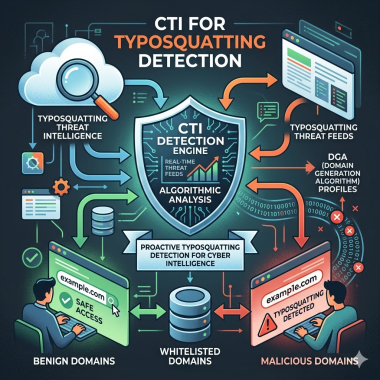
CTI for Typosquatting Detection
In the digital landscape of 2026, typosquatting remains a stealthy yet devastating cyber threat that exploits simple human error to undermine enterprise security. Cybercriminals register domains that mimic legitimate ones through subtle misspellings, homographs, or bit flips, luring users into phishing traps, malware downloads, or credential theft. A...

Cyber Threat Intelligence for DDoS Threats
In the digital age of 2026, Distributed Denial of Service (DDoS) attacks represent one of the most persistent and evolving cyber threats facing enterprises worldwide. These attacks overwhelm networks, applications, and services with malicious traffic, causing downtime, revenue loss, and reputational damage that can exceed millions per hour for large...

Cyber Threat Intelligence and Cyber Intelligence Automation
Cyber threat intelligence (CTI) automation represents the convergence of advanced analytics, AI, and orchestration to process vast threat data at machine speed, enabling enterprises to outpace adversaries. In 2026, with cyberattacks leveraging agentic AI and ransomware-as-a-service surging, manual CTI processes fail under volume alert fatigue, which...

Cyber Threat Intelligence for Intelligent Security Operations
Cyber threat intelligence (CTI) revolutionizes intelligent security operations by transforming SOCs from reactive alert factories into predictive, autonomous command centers capable of outmaneuvering AI-powered adversaries. In 2026, SOCs confront unprecedented challenges: alert volumes exceeding 10,000 daily, dwell times compressing to minutes, and...
No posts found
Write a review