- 3/8, North Pirerbag
- 60 Feet Main Road
- Mirpur, Dhaka 1216
- +880-967-8247365
- support@informatix.systems

Why Actionable CTI Beats Raw Data
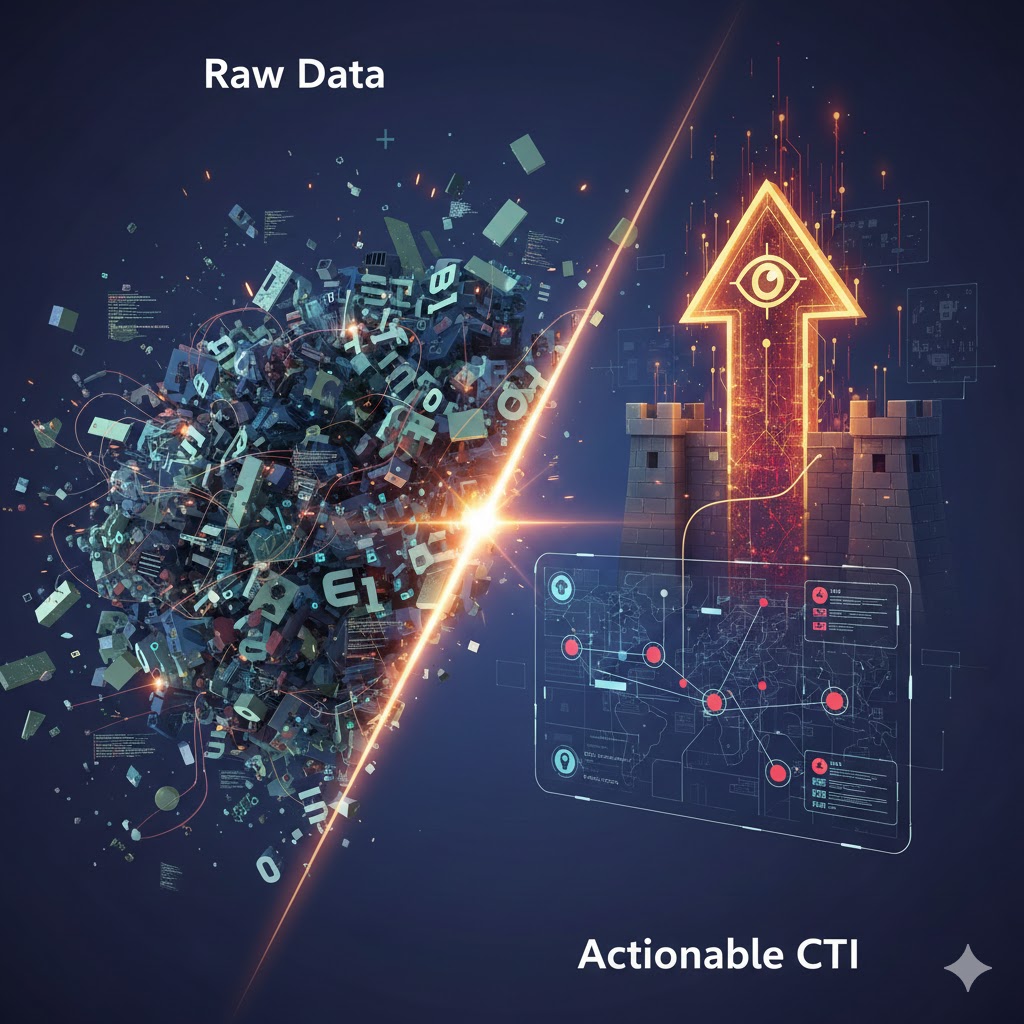
Cybersecurity leaders face an overwhelming flood of data daily, but raw threat data alone leaves teams paralyzed by noise. Actionable Cyber Threat Intelligence (CTI) transforms this chaos into precise, executable insights that drive real-time decisions and fortify defenses. In 2026, as AI-powered attacks escalate, enterprises prioritizing actionable CTI over raw data gain a decisive edge in threat prevention and response. This shift matters profoundly for businesses. Raw data, vast streams of indicators like IP addresses or malware hashes, lack context, leading to alert fatigue where 82% of security teams miss critical threats amid data overload. Actionable CTI, by contrast, delivers evidence-based knowledge on adversaries, tactics, techniques, and procedures (TTPs), enabling proactive mitigation. For enterprises undergoing digital transformation, this means reduced breach costs, faster incident response (up to 58% quicker), and optimized resource allocation. At Informatix.Systems, we provide cutting-edge AI, Cloud, and DevOps solutions for enterprise digital transformation, helping organizations operationalize actionable CTI seamlessly. This article explores why actionable CTI beats raw data, backed by real-world examples, lifecycle insights, and 2026 trends. Enterprises adopting it report stronger ROI on security investments, turning intelligence into a strategic asset rather than a data burden.
Defining Key Concepts
Cyber Threat Intelligence (CTI) involves collecting, analyzing, and disseminating structured data on cyber threats, adversaries, and attack methods. It evolves raw inputs into contextual insights for defense. Raw threat data consists of unprocessed feeds like Indicators of Compromise (IoCs), hashes, domains, or IPs without analysis, often overwhelming Security Operations Centers (SOCs). Actionable CTI, however, prioritizes relevance, providing step-by-step mitigation advice tailored to your environment. Distinguishing these elevates security from reactive firefighting to a predictive strategy. Platforms like those from Stellar Cyber aggregate feeds into real-time, contextual alerts.
Types of CTI
- Strategic CTI: High-level trends for executives.
- Tactical CTI: TTPs for SOC teams.
- Operational CTI: Specific IoCs with actions.
- Technical CTI: Raw feeds enriched for tools.
Problems with Raw Threat Data
Raw data floods SOCs with billions of alerts daily, causing alert fatigue where analysts ignore 90% as false positives. Without context, teams chase irrelevant IoCs, delaying real threats.
Challenges include:
- Data Overload: Unstructured logs in varied formats explode storage costs.
- Lack of Prioritization: No risk scoring leaves high-impact threats buried.
- Integration Issues: Feeds don't correlate across SIEMs or EDRs.
- Scalability Limits: Manual processing can't match 2026's AI-driven attack volumes.
A Ponemon study notes that raw data contributes to 50% longer breach detection times. Enterprises waste millions on unused logs.
False Positives Impact
Raw data generates thousands of daily alerts, with 70% irrelevant, eroding team morale and response efficacy.
What Makes CTI Actionable
Actionable CTI distills data into real-time, contextual recommendations like blocking specific TTPs or updating playbooks. It includes adversary profiles, campaign details, and automated workflows.
Key qualities:
- Contextual Relevance: Tailored to your industry, assets, and threats.
- Real-Time Delivery: Integrated into SIEM/SOAR for instant alerts.
- Measurable Outcomes: Tracks mitigation success via ROI metrics.
At Informatix.Systems, we provide cutting-edge AI, Cloud, and DevOps solutions for enterprise digital transformation, embedding actionable CTI into your stack.
Enrichment Process
Raw IoCs gain value through correlation with TTPs, yielding steps like Quarantine endpoint X using Y signature.
CTI Lifecycle Explained
The CTI lifecycle is a six-stage cycle that turns raw data into intelligence: Direction, Collection, Processing, Analysis, Dissemination, and Feedback.
- Direction: Define needs based on assets/threats.
- Collection: Gather from feeds, OSINT, dark web.
- Processing: Normalize and filter noise.
- Analysis: Contextualize with AI/ML.
- Dissemination: Deliver via dashboards/playbooks.
- Feedback: Refine based on outcomes.
This repeatable process ensures continuous improvement, unlike static raw feeds.
AI's Role in Lifecycle
AI accelerates analysis, predicting threats from patterns vital for 2026.
Core Benefits of Actionable CTI
Actionable CTI boosts threat detection by 50%, cuts response times, and enhances decision-making. SOCs prioritize high-risk alerts automatically.
Benefits include:
- Proactive Defense: Hunt threats before impact.
- Resource Optimization: Lean teams handle more via automation.
- ROI Measurement: Track controls against real threats.
- Reduced Breaches: Contextual prioritization averts 40% more attacks.
Enterprises using it report 58% faster incident response.
Quantified Improvements
Real-World Use Cases
Actionable CTI shines in SecOps, vulnerability management, and threat hunting. Financial firms block supply chain attacks via enriched vendor insights.
- Incident Response: Enrich alerts with TTPs for playbooks.
- Proactive Blocking: Auto-update firewalls with relevant IoCs.
- Vulnerability Prioritization: Focus on exploited flaws per sector.
- Threat Hunting: Guide searches with adversary patterns.
A manufacturer used CTI to mitigate ransomware targeting ICS.
Enterprise Examples
Healthcare: Bitsight contextualizes third-party risks.
Integrating CTI with DevOps
DevSecOps embeds actionable CTI into pipelines for shift-left security. Automate threat scans in CI/CD.
Steps:
- Feed CTI into IaC tools.
- Auto-block vulnerable images.
- Monitor runtime with enriched logs.
Reduces deployment risks by 40%.
Cloud-Specific Integration
AWS/Google Cloud natives pull CTI for runtime protection.
AI and Future of CTI in 2026
AI/ML powers predictive CTI, forecasting attacks via pattern recognition. Agentic AI automates defense in 2026.
Trends:
- Zero-Trust AI: Runtime firewalls.
- Quantum-Resistant CTI: Prep for post-quantum threats.
- Automated Scaling: Handle exabyte-scale data.
82% of CISOs prioritize AI-CTI for overload.
Challenges and Solutions
Even actionable CTI faces hurdles like data silos. Solutions: Unified platforms with ML normalization.
Measuring CTI Success
Track via KPIs: MTTD/MTTR reduction, false positive drop, breach prevention rate. Dashboards quantify ROI. Actionable CTI beats raw data by delivering context, speed, and precision essential for 2026's threat landscape. Enterprises gain proactive defenses, optimized SOCs, and measurable security ROI, outpacing reactive raw data approaches. Ready to transform your cybersecurity? Contact Informatix.Systems today for cutting-edge AI, Cloud, and DevOps solutions tailored to enterprise digital transformation. Schedule a free, actionable CTI assessment now.
FAQs
What is the difference between raw threat data and actionable CTI?
Raw data is unprocessed IoCs; actionable CTI adds context, TTPs, and mitigation steps for immediate use.
How does actionable CTI reduce alert fatigue?
It prioritizes relevant threats via ML scoring, cutting false positives by 70%.
Which industries benefit most from actionable CTI?
Finance, healthcare, and manufacturing high-value targets with complex supply chains.
Can small enterprises afford CTI platforms?
Yes, SaaS models like Bitsight start accessible, scaling with ROI gains.
How long to see ROI from actionable CTI?
Typically, 3-6 months via faster response and breach avoidance.
Is AI essential for modern CTI?
Yes, for predictive analysis and automation in 2026 threats.
How to integrate CTI with existing SIEM?
Use platforms with native APIs for real-time enrichment.
What are the 2026 CTI trends?
Agentic AI, zero-trust, quantum security.
No posts found
Write a review