- 3/8, North Pirerbag
- 60 Feet Main Road
- Mirpur, Dhaka 1216
- +880-967-8247365
- support@informatix.systems

Informatix Systems CI/CD Security Best Practices
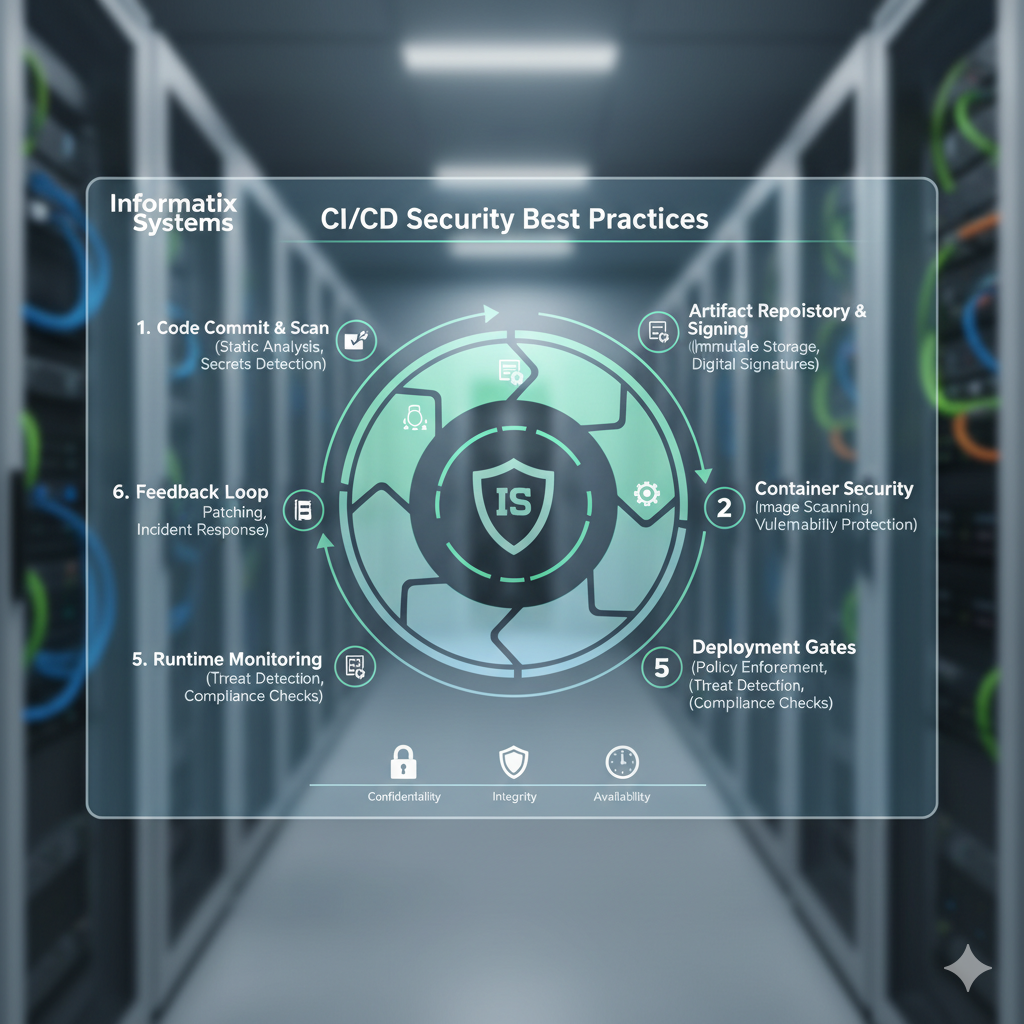
Continuous Integration and Continuous Deployment (CI/CD) pipelines represent the backbone of modern enterprise software delivery, automating development, testing, and deployment at scale. Securing these pipelines is non-negotiable; a single vulnerability can expose source code, sensitive credentials, and production environments to attackers. Effective CI/CD security not only protects digital assets but builds trust and compliance, enabling faster, safer innovation. At Informatix.Systems, we provide cutting-edge AI, Cloud, and DevOps solutions for enterprise digital transformation, ensuring your CI/CD workflows are both agile and secure.
Identity, Access, and Authentication
Enforce Role-Based Access Control (RBAC)
- Implement RBAC to restrict access to CI/CD pipelines, source repositories, and secrets, granting only the minimum required privileges.
- Require Multi-Factor Authentication (MFA) for all code repository and pipeline access points.
Fine-Grained Permission Management
- Use least privilege principles to segment access by roles, teams, and project scopes.
- Regularly audit permission sets and eliminate stale credentials.
- Employ short-lived tokens and rotating keys, integrating with enterprise identity providers.
Secrets Management and Credential Protection
Centralized Secrets Management
- Store API keys, passwords, certificates, and environment variables in dedicated secrets managers like HashiCorp Vault, AWS Secrets Manager, or Doppler, not in source code or CI config files.
- Automate credential rotation policies to minimize exposure.
Detect and Prevent Hardcoded Secrets
- Implement pre-commit and CI/CD pipeline hooks to scan for hardcoded secrets using tools like GitGuardian or truffleHog.
- Educate developers on secret hygiene with regular security training.
Code Security—SAST, SCA, and DAST Integration
Static Application Security Testing (SAST)
- Embed SAST tools such as SonarQube and Checkmarx in pull request workflows to automatically scan code for vulnerabilities before merging.
- Enforce mandatory code reviews and signed commits on protected branches.
Software Composition Analysis (SCA)
- Analyze open-source dependencies for vulnerabilities with SCA scans (e.g., Snyk, Mend).
- Pin dependency versions and avoid pulling latest tags without review.
Dynamic Application Security Testing (DAST)
- Integrate DAST solutions to test running applications in staging environments for runtime vulnerabilities, catching issues SAST might miss.
Container and Image Security
Image Scanning in CI/CD Workflows
- Automate container image scanning for vulnerabilities using tools like Aqua, Anchore, and Docker Security Scanners before deployment.
- Enforce trusted, signed images and block the use of unverified or outdated base images.
Immutable Artifact Repositories
- Store build artifacts in immutable repositories; verify signatures and ensure tamper resistance.
- Employ Secure Supply Chain standards like SLSA and Sigstore for artifact signing.
Pipeline Flow Control and Isolation
Mandatory Approvals and Protection Rules
- Configure state transitions with approval gates on critical pipeline steps.
- Use branch protection and only allow workflow execution from authorized sources.
Ephemeral Runners and Execution Isolation
- Isolate untrusted code or PRs in sandboxed, ephemeral runners to prevent poisoned pipeline execution (PPE).
Continuous Monitoring, Logging, and Auditability
Centralized Immutable Logging
- Log all pipeline activities in centralized, secure, immutable stores to support incident investigation and compliance.
- Use SIEM/SOAR integration for real-time anomaly detection and automated response workflows.
Real-Time Anomaly Detection
- Deploy AI-driven anomaly detection to monitor for off-hours commits, suspicious pipeline changes, or resource spikes.
Automated Security Testing
Comprehensive Pipeline Security Scans
- Schedule regular pipeline audits; embed penetration testing, red/blue/purple team exercises into your CI/CD cycle.
- Automate vulnerability testing by combining static, dynamic, and interactive techniques.
Compliance and Documentation
- Document all pipeline security results for audits; ensure alignment with standards (SOC2, ISO 27001, industry norms).
Incident Response and Containment
CI/CD Incident Response Playbooks
- Create detailed playbooks for security events—include steps for isolation, rollback, and forensic analysis.
- Configure automated build quarantines to block further deployments if suspicious code or behavior is detected.
Continuous Improvement
- Review and update playbooks after incidents; integrate lessons learned for greater resilience.
AI and ML-Driven DevSecOps
AI-Based Security Integration
- Leverage machine learning models for real-time risk assessment and threat detection, analyzing code changes, build logs, and deployment metrics for anomalies.
- Use AI to refine detection, prioritize genuine threats, and reduce false positives throughout the DevOps pipeline.
Predictive Cyber Defense
- Apply predictive analytics to anticipate and automatically remediate vulnerabilities before code reaches production, leveraging platforms from Informatix.Systems.
Cloud-Native Security and Compliance
Infrastructure as Code (IaC) Security
- Embed secure configuration validation, secrets scanning, and automated compliance checks for Terraform, CloudFormation, and Kubernetes manifests.
- Use IaC security tools to ensure deployment environments are hardened from development to production.
Governance and Continuous Compliance
- Automate compliance policy enforcement inside pipelines, supporting continuous audit-readiness and regulatory reporting at Informatix.Systems specialty.
Safeguarding CI/CD pipelines is a cornerstone of enterprise DevOps. By deploying robust identity controls, automated secret management, integrated security testing, and AI-powered monitoring, organizations can prevent costly breaches while enabling rapid, secure releases. Informatix.Systems delivers AI, Cloud, and DevOps solutions tailored for enterprise digital transformation, helping your business achieve agile security and compliance in every code deployment. Invest in pipeline protection today for resilient, future-ready innovation. Ready to fortify your CI/CD pipelines? Contact Informatix.Systems for an expert security assessment, AI-powered DevSecOps solutions, and end-to-end cloud compliance to transform your enterprise development lifecycle.
FAQs
What are the top CI/CD security risks in 2025?
Supply chain attacks, credential theft, hardcoded secrets, PPE (Poisoned Pipeline Execution), misconfigured access controls, and unverified artifacts.
How do I secure secrets and credentials in pipelines?
Store them in a secrets manager, automate rotation, scan for hardcoded secrets, and never include secrets in code repositories or CI/CD configuration files.
What tools support pipeline security scanning?
SAST tools (SonarQube, Checkmarx), SCA (Snyk, Mend), DAST (OWASP ZAP), secrets scanning (GitGuardian), image scanners (Aqua, Docker Security).
How can AI enhance CI/CD pipeline protection?
Machine learning-based systems detect anomalies in code commits, build logs, or deployment activities, flagging risks in real time and reducing false positive rates.
What’s the role of incident response in CI/CD security?
Playbooks guide incident containment, rollback, and forensics. Automate quarantines and response workflows for speed and scalability.
How is compliance managed in DevOps pipelines?
Automate compliance checks, document security results, integrate audit trails, and align with frameworks (SOC2, ISO 27001) for industry and regulatory requirements.
Why use ephemeral runners and isolated environments?
They prevent cross-contamination between trusted and untrusted code and block pipeline poisoning attacks, protecting build environments.
How does DevOps automation boost SEO security?
Continuous code optimization, integrated SEO audits, and robust security practices foster high-performing, faster-loading sites and protect against threats, improving both search rankings and user trust.